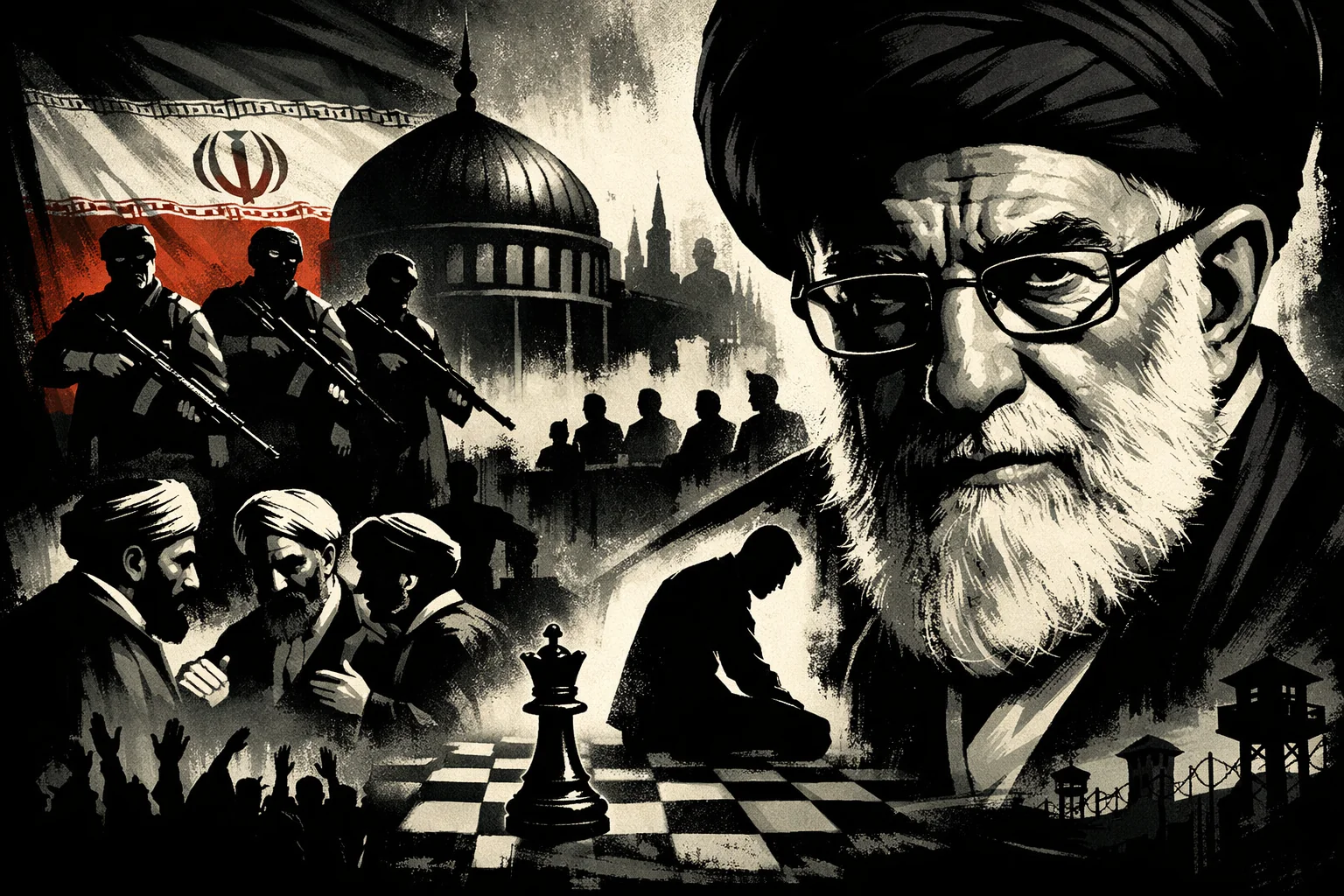
Ali Hosseini Khamenei has been the Supreme Leader of the Islamic Republic of Iran since 1989, and is the highest political and religious authority in the country. This position is not a symbolic role, but has broad powers that make him the centerpiece of the Iranian regime and the final say on major strategic issues, from foreign policy to military and security affairs.
Khamenei was born in 1939 in the northeastern Iranian city of Mashhad. He received his religious education in seminaries and was influenced by the ideology of Ayatollah Ruhollah Khomeini, the founder of the Islamic Republic.After the victory of the Islamic Revolution in 1979, he rose through the political ranks. He served as president from 1981 to 1989, a period that coincided with the Iran-Iraq war. Following Khomeini's death in June 1989, the Assembly of Experts chose him as supreme leader, although he was not a senior traditionalist at the time, marking a pivotal moment in the development of the regime.
The Iranian constitution stipulates that the Supreme Leader is the commander-in-chief of the armed forces, responsible for appointing the commanders of the army and the Revolutionary Guards, the head of the judiciary, the director of the radio and television establishment, the main Friday imams, as well as half the members of the Guardian Council. He also has the power to approve the election of the president of the republic or remove him in certain cases. This means that the position of the guide is not limited to spiritual supervision, but extends deep into the executive and security state. Although there is an elected president, government and parliament, major policies, especially on issues such as the nuclear program and regional relations, are drawn within the general guidance of the guide.
Over the past three decades, the relationship between the Supreme Leader and the IRGC, which has evolved from an ideological military force to an influential political and economic player, has strengthened. Analysts believe that this relationship has been one of the pillars of the regime's stability, especially during periods of internal tension and external pressures. The IRGC does not limit its role to security, but has a wide economic influence, making the position of the Leader at the top of this system a factor of balance between different political currents within the country.
Khamenei has the final say on issues related to the United States, Israel, relations with the Gulf states, and the nuclear file. Although the Iranian government is officially negotiating, the red lines are drawn in the office of the leader. During the negotiations for the 2015 nuclear deal, Khamenei supported the negotiations but kept a political distance, emphasizing in his speeches the need to be wary of and not fully trust the West. After the United States withdrew from the deal in 2018, he adopted a more hardline rhetoric toward Washington.
At home, his tenure has faced many challenges, from political protests such as the events of 2009, to economic crises linked to sanctions, to social protests in recent years. In these moments, Khamenei has emphasized maintaining the "constants of the revolution" and the role of security institutions in protecting the system. At the same time, the regime has allowed a margin of political pluralism within the Islamic Republic, where two main streams compete: conservatives and reformists. However, this competition remains within limits set by the Guardian Council and institutions linked to the Leader.
In addition to his political authority, Khamenei holds a religious status as the "guardian of the jurist," a concept on which the Iranian regime is based. The theory of Wilayat al-Faqih (Guardianship of the Jurist) grants political authority in the absence of the infallible Imam according to Twelver Shiite jurisprudence. This dimension gives the position religious legitimacy and makes it transcend traditional politics.
Khamenei is not just a political leader, but the centerpiece of a complex system that combines religion, politics, and security. His constitutional position gives him broad powers that make him the final authority in strategic decisions, while his authority is based on a network of official, security, and economic institutions. Understanding Khamenei's personality means understanding the nature of the Iranian regime itself: a system that combines formal electoralism with strong institutional control, a centralized religious authority, and a modern state structure.Therefore, any reading of the Iranian scene - whether at home or in its regional relations - inevitably passes through the Supreme Leader and his role in setting the general direction of the state.
Comments