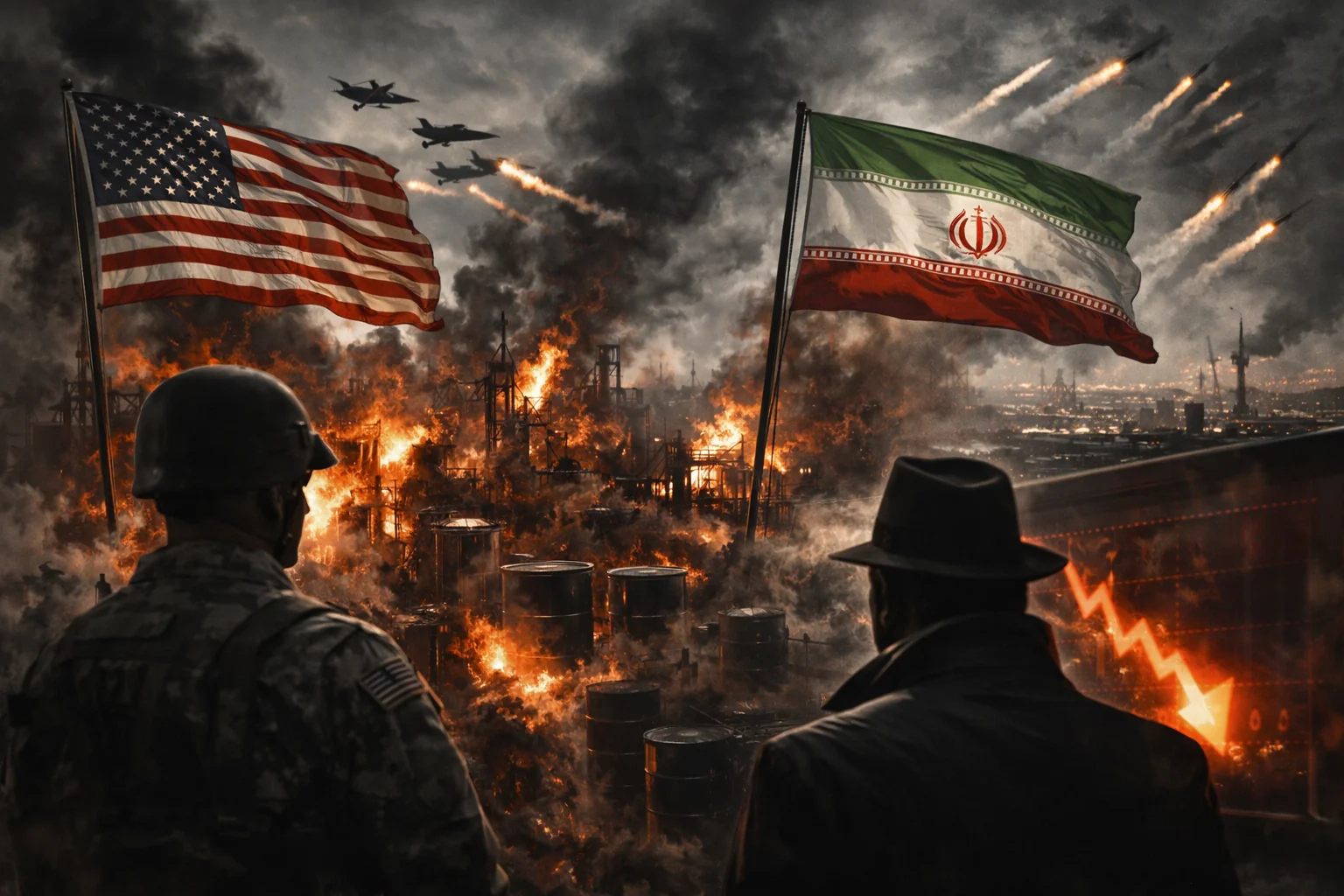
On February 28, 2026, the phrase "Hormuz: When Geography Becomes Price" went from an analytical description to an operational reality captured by markets moment by moment. The strait is not just a sea lane, but a "choke point" through which huge quantities of oil and gas pass, so the suspicion of disruption - even if it has not yet turned into a full physical closure - is enough for the "risk premium" to rise immediately.This explains why analysts and traders considered that the most important development today was not the price action alone, but the fact that concerns moved from screens to operational decisions by shipping, trading, and energy companies.
A number of major oil companies, trading houses and tanker owners have temporarily suspended shipments of crude, fuel and liquefied natural gas through the Strait. This type of decision is usually made not just because of a political statement, but when the risk assessment becomes higher than the companies' ability to cover it operationally and insurably. There are also reports of ships piling up near ports such as Fujairah in the UAE, a waiting and gathering point on the outskirts of the Strait, suggesting that part of the fleet would rather wait than cross.
Another notable development is that European naval sources reported that an official of the EU maritime mission reported that the Revolutionary Guard had broadcast via VHF that "no ship is allowed to pass through the Strait of Hormuz." Importantly, this is not necessarily an official written statement, but a direct operational message to ships in the corridor, which alone is enough to raise the risk level because mariners treat field messages as an immediate warning.
In the same context, the United States moved on the maritime safety line, as the US Navy reportedly issued a security warning for navigation through the Gulf, Gulf of Oman, North Arabian Sea, and Hormuz. In parallel, Greece announced through the Ministry of Shipping a recommendation for Greek-flagged ships to avoid high-risk routes including the Gulf, Hormuz, Gulf of Oman, and North Arabian Sea, warning of dangers such as missiles, marches, electronic jamming, and disruption of navigation systems. These warnings are read in the market as a signal that danger is not a media forecast but an official assessment of a theater of operations that could expand.
In maritime crises, disruption may not immediately manifest itself as a shortage of barrels, but rather as a jump in the cost of passage, namely insurance, war-risk premiums and freight charges. Financial reports have spoken of insurers canceling or repricing war-risk policies and raising their costs for ships in the Gulf and Hormuz, with talk of potentially large increases in the cost of coverage per voyage. This means that geography becomes a direct bill even before it becomes a shortage of supply.
A notable number of LNG tankers have reportedly slowed, diverted or stopped near the strait, a sign of actual disruption in the energy chain, especially since a large portion of the region's LNG exports pass through Hormuz. When gas tanker routes change so quickly, fears become visible and not just hypothetical.
The reason why Hormuz is becoming a literal "geo-price" is that roughly one-fifth of the global oil trade passes through the strait, as well as a significant share of the LNG trade.Energy benchmark reports emphasize the importance of Hormuz as the largest critical oil transit point globally, and that a significant portion of oil and gas flows pass through it annually. Therefore, any disruption - even partial - drives up the price through three interconnected channels: a political risk premium, a freight and insurance risk premium, and the potential for delayed delivery and increased demand for inventory as a hedge.
However, the distinction between a prolonged physical shutdown and a precautionary or partial disruption remains important, because the market prices the two scenarios differently. An extended physical shutdown means a large supply shock and sharp price jumps, while a precautionary or partial disruption may raise prices via insurance, shipping, and delays without a complete disruption of barrels. What today's developments reflect is that we are facing a precautionary disruption that is starting to turn into operational decisions: suspension of shipments, ships stacking or changing routes, official naval warnings, and clear signs that insurance costs are rising.
In short, what happened on February 28 illustrates how geography becomes an actual price in global markets. The strait was not officially closed, but the mere fact that the likelihood of disruption increased and concerns moved into operational and insurance measures was enough to make Hormuz an immediate indicator of the potential for war and its impact on energy. At such moments, the market prices not just the number of barrels, but the likelihood of risk, and how quickly it moves from theoretical threat to tangible disruption.
Comments