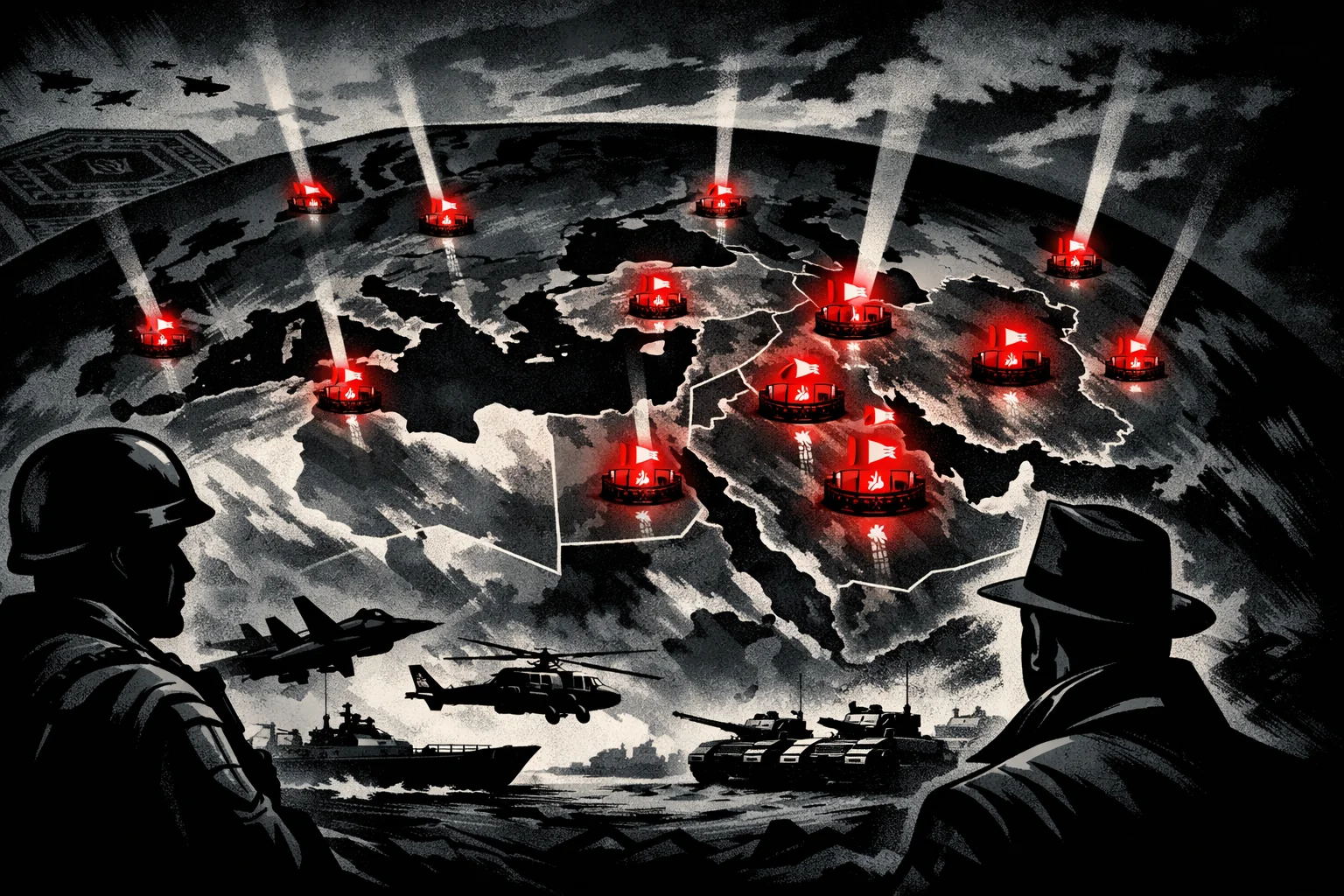
The distribution of US bases in the Arab world is not just a "map of military points" but a stratified system that combines command centers, air bases, logistics nodes, naval support ports, and forward stationing points linked to specific missions such as deterrence, combating armed organizations, protecting energy lines, and crisis management. In most cases, we are not talking about "large bases" in the traditional sense, but rather a combination of permanent installations, access agreements, pre-positioning of equipment, and rotating forces depending on the level of tension. This explains why the numbers and sizes change rapidly, while the "structure" remains constant: The Gulf as the logistical and air core, the maritime crane in Bahrain, and forward extensions in Jordan, Iraq, and Syria.
First, the Gulf represents the backbone of the U.S. presence, because it is where three elements intersect: Its proximity to Iran, the presence of advanced infrastructure and large air bases, and its ability to receive troops around the clock. In Qatar is al-Udeid, repeatedly described as the largest air base used by the United States in the region, hosting forward headquarters for Central Command and Central Air Forces Command, with a large aircraft presence and command and control capabilities. In Kuwait, there are logistics nodes and bases that support ground and air deployments, such as Camp Arifjan, which serves as a forward support and command center for the U.S. military in the theater, along with bases such as Ali al-Salem and Camp Buhrin as staging, supply, and preparation points for forces heading to Iraq and Syria. The UAE includes Al Dhafra Air Base, which is mostly associated with reconnaissance, surveillance, and air support missions, as well as the role of ports such as Jebel Ali in supporting ships and naval supply. Bahrain offers the most stable maritime dimension: the U.S. Navy's regional headquarters and the Fifth Fleet are based at the Naval Support Facility there, making it a focal point for operations in the Gulf, Arabian Sea, and Red Sea.
Second, Saudi Arabia is once again a critical part of the air stationing and missile defense equation. A U.S. presence at Prince Sultan Air Base is usually associated with air defense systems, early warning capabilities, and support aircraft, and gains importance when the need to intercept missiles or protect critical infrastructure arises. As tensions escalated in February 2026, reports emerged of a significant increase in the number of aircraft at that base, an indication that bases are not fixed in size but swell when needed.
Third, Jordan represents a link between the Levant and the Gulf, and an advanced base for air and defense operations, especially through the Muwaffaq al-Salti (Azraq) base. During periods of escalation, Jordan emerges as a logistical and intelligence platform and as an "edge" point relatively far from the Gulf coasts but close to the theaters of tension in Iraq and Syria. Recent reports spoke of a significant buildup of aircraft at the base, reflecting Jordan's function as a flexible base that can be quickly expanded.
Fourth, Iraq remains a forward staging area with two missions: Supporting the Iraqi forces/coalition mission against ISIS and managing the balance with local armed forces, while minimizing the footprint as much as possible compared to the post-2003 era. In this context, bases such as Ain al-Asad in Anbar and Erbil stand out as key points of presence. The presence in Iraq is different from the Gulf: It is more of a "mission" than a "node," and remains subject to internal Iraqi political balances and the possibility of being targeted at moments of escalation.
Fifth, Syria (despite the sensitivity of its characterization in the "Arab world" due to the multiplicity of actors on its territory) represents a relatively small but highly significant point of concentration, related to combating ISIS and cutting off some paths of regional positioning, with limited bases/locations such as al-Tanf and others. Media and research estimates indicate the presence of US forces in Syria, Jordan and Iraq in varying numbers, with the nature of the mission remaining the decisive factor.
Sixth, there are Arab countries that do not host "US bases" in the explicit sense but are part of the access network: Oman is a classic example of "access facilities" and locations that can be used logistically when needed; Egypt provides transit and transit facilities by virtue of the Suez Canal and security coordination; while in North Africa (Morocco, Tunisia), cooperation is more through exercises and military agreements rather than permanent bases. In the Horn of Africa, Djibouti (a member of the Arab League) hosts a prominent U.S. presence outside the narrow "Middle East" but directly linked to the security of the Red Sea and Bab al-Mandab.
If we try to understand the "logic of distribution," we find that it is based on three circles. The first circle is deterrence and protection of energy routes: Bahrain, Qatar, Kuwait, the UAE and Saudi Arabia are at the forefront of the scene because they are close to the Gulf and the Strait of Hormuz and have infrastructures that allow for rapid deployment. The second circle is combating armed organizations and limited ground operations: This is why Jordan, Iraq and Syria appear as outposts. The third circle is crisis management and alliances: The presence of large bases in the Gulf allows for the absorption of additional forces in an emergency, and gives Washington the ability to send political and military signals to its allies and adversaries.
But this deployment is not without political cost. The presence of foreign bases remains a sensitive point in Arab public consciousness: Questions of sovereignty, the risk of turning host countries into battlefields, and the internal debate over the relationship with Washington. This is why we see many countries describe the arrangements as "defense cooperation" or "facilities" rather than "bases," and sometimes prefer a rotating presence rather than a permanent one, especially when the risk of targeting is high. In moments of escalation, the rules themselves turn into indicators: Closing airspace, raising alert status, moving defense assets, and changing air and sea traffic patterns.
In summary, the distribution of US bases in the Arab world can be read as a network of "nodes" rather than a straight line: Bahrain for the maritime nerve, Qatar for the air and command nerve, Kuwait for the land logistics nerve, the UAE as a supporting air/naval platform, Saudi Arabia as a sensitive defense depth, Jordan as a flexible front edge, and Iraq/Syria as critical points linked to the counter-ISIS mission and the balances of the Levant. This network varies in density according to the level of tension, but it remains constant in its logic: Ensuring quick access, minimizing crisis surprises, and managing deterrence in a region that Washington considers a vital hub for navigation, energy, and regional security.
Comments