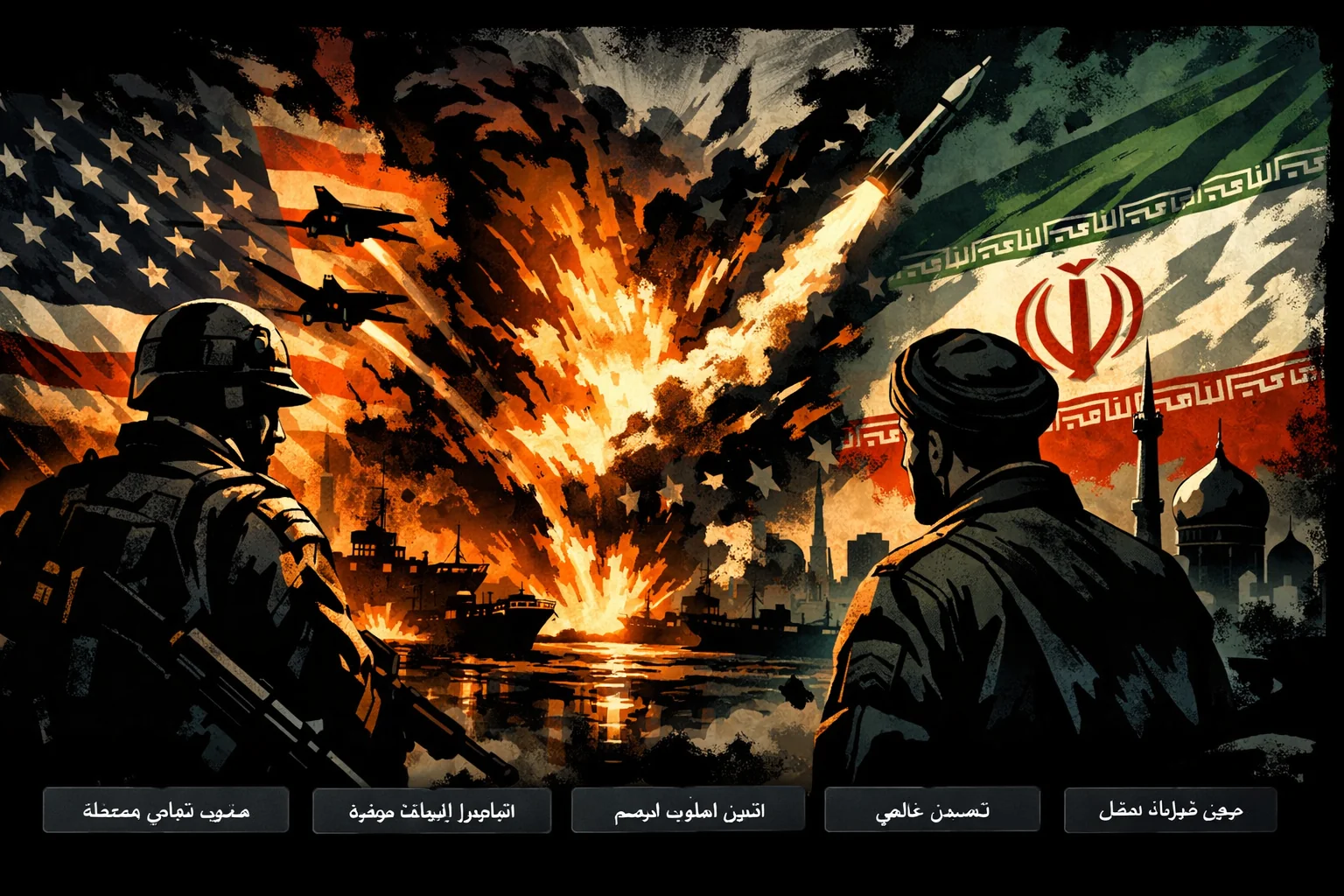
During the final hours of coverage on February 28, 2026, the story moved from "describing strikes and retaliation" to practical signs of the widening cost of war: Limited nuclear reassurance from the International Atomic Energy Agency (IAEA), escalating disruption to energy and navigation through the Strait of Hormuz, and domestic Israeli measures affecting gas supplies, while air tensions and flight suspensions continue.
The first notable development in this window of time came from the International Atomic Energy Agency (IAEA), which said it had not detected "no radioactive trace" as a result of the US and Israeli strikes on Iran or retaliatory strikes in other countries in the region, but did not confirm whether Iranian nuclear sites had indeed been targeted. The importance of the statement is not that it is "completely reassuring," but that it draws a line between "immediate danger" and "potential danger." No reported radiation yet, but the IAEA is monitoring and calling for restraint to avoid any nuclear risk to public safety.
The second, economically heavier development was the disruption of the Strait of Hormuz. Iran declared the strait "closed," but the scene on the ground remained more complicated: Major oil companies, tanker owners and energy traders have suspended or temporarily halted shipments of oil, fuel and liquefied gas through the strait, while satellite imagery showed ships piling up near ports such as Fujairah, and liquefied gas tankers were spotted slowing down, reversing course or stopping near the strait. At the same time, the British Navy considered the Iranian "directives" received by some ships to be legally non-binding but advised caution, while the US Navy issued a security warning for navigation in the Gulf, Gulf of Oman, North Arabian Sea and Strait of Hormuz. This combination of "political declaration of closure" and "commercial hedging behavior" is itself a critical development: Even before any documentation of a total shutdown, the fear of escalation is enough to effectively freeze shipping traffic.
What does this mean "on the ground" in the last couple of hours? It means that the crisis is no longer measured by the number of missiles, but by the decisions that markets and businesses make to avoid risk: When a manager at a major trading firm says "our ships will be grounded for days," it reflects an appreciation that risk is not a fleeting moment but a wave that may be repeated. The fact that the strait transports nearly 20 percent of the world's oil and large amounts of Qatar's liquefied natural gas makes any slowdown - even if temporary - an immediate pressure on the global economy.
The third development came from within Israel, but with a domestic energy angle: Israel's Energy Ministry reported that it had ordered a temporary shutdown of parts of the natural gas production system "based on security assessments," referring to the shutdown of the Leviathan field and an Energean production vessel serving several fields. The ministry said that energy needs will be met through alternative sources, and that the electricity sector is prepared to operate fuel stations with alternatives if necessary. This development is important because it shows that Israel is treating the escalation as a threat to "critical infrastructure" and not just on the military front.
In the background, the fourth factor pressuring the public sense of crisis continued: Closed skies. According to the latest reports, several international airlines have continued to suspend or cancel flights through the Middle East, and airspaces such as Iran, Iraq, Kuwait, Kuwait, Israel, and Bahrain appeared almost empty according to flight tracking data, with the European aviation regulator advising avoidance of the region. These kinds of developments usually accelerate when warnings of missiles or marches are repeated or when the potential for miscalculation becomes high.
If we combine these four developments into "two hours," we note that they do not so much present a "single dramatic shot" as an accelerating pattern of war effects:
Nuclear: "no radioactive trace so far" but tight monitoring and risk warning.
Maritime/Oil: Shipments suspended and navigational confusion around the Strait of Hormuz with multiple naval warnings.
Energy within Israel: Shutting down gas fields as a precautionary security measure, expanding the meaning of the "home front".
Air: Continued flight disruptions and avoidance of airspace, reflecting an ongoing threat assessment.
Analytical conclusion: The last two hours not only add "new details," but prove that the crisis is rapidly turning into an Operational War that touches: Nuclear safety, energy routes, and the nerves of global aviation. This is precisely what makes the scenarios of the coming hours more dangerous: Any new wave of retaliation adds not only military losses, but also commercial and operational shutdowns that raise the cost of returning to "normalcy" even if the bombing subsides.
Reference list:
Reuters.(2026a,February 28).UN nuclear watchdog sees no radiological impact after strikes on Iran.Reuters.
Reuters.(2026b,February 28).Oil and gas majors, traders suspend shipments via Hormuz after U.S.-Israel strikes on Iran.Reuters.
Reuters.(2026c,February 28).Israel shuts down gas fields after U.S.-Israel strikes on Iran.Reuters.
Reuters.(2026d,February 28).Airlines cancel flights after U.S.-Israel strikes on Iran.Reuters.
Comments