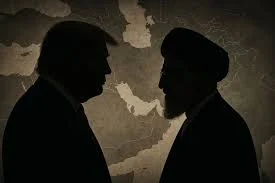
The moment of "explosion" on Saturday, February 28, 2026 cannot be understood as an isolated incident, but rather as a "founding event" that opened a new phase of escalation: coordinated US-Israeli strikes against targets inside Iran, followed by an Iranian response with missiles/drones, airspace closures, and rapid regional disruption that included the Gulf, air traffic, and markets.What we know so far is based on official statements and coverage by major agencies, with many points remaining "under verification" due to the wide range of operations and multiple narratives in the early hours.
The strikes began as a first wave, described in the US narrative as "major combat operations," and the Pentagon called the campaign "Operation EPIC FURY." According to Reuters, a US official said that the campaign is expected for several days, meaning that the "moment of explosion" is not a single strike but the start of a multi-stage campaign. In explaining the goal, Trump said that the strikes aim to destroy Iranian missile systems and neutralize/destroy naval capabilities he describes as a direct threat, with an explicit warning about possible casualties among US forces.
The "target locations inside Iran," as reported by credible sources so far, appear on two levels: leadership/decision centers and military-strategic infrastructure targets.Reuters quoted an informed source as saying that the first wave "mainly targeted Iranian officials." It also quoted an Israeli official as saying that the strikes targeted Supreme Leader Ali Khamenei and President Masoud Pazeshkian, but that "the results of the targeting were not clear," with the added information that Khamenei was moved to a safe location and was not in Tehran at some point during the strike.In the same context, Reuters reported an Iranian account, not fully confirmed, that "a number of senior commanders" in the Revolutionary Guards and political officials were killed, with the agency emphasizing that it was unable to independently verify some of the details of the reported casualties.
In terms of locations, Reuters' coverage so far has focused on explosions near Kharg Island, a vital oil export node (through which Iran exports a large percentage of its oil), making it a focal point for reading the "economic message" of the strikes and their potential impact on the markets.There were also reports of a strike on a school (in Minab in southern Iran) that, according to Iranian state media, killed dozens; Reuters quoted a figure of 40 deaths from state media, again noting that no immediate independent verification was available. (This is a sensitive point: it is part of the "details of the moment" but remains linked to what local state media broadcast and usually needs additional confirmation in the following hours).
In contrast, the Iranian response was swift and "regional," not just "local." Reuters reported that Tehran fired missiles at Israel, then expanded the response to include targeting Gulf states that host U.S. bases.According to Reuters, sites in Bahrain, Qatar, Kuwait, the UAE and Jordan were attacked/attempted attacks, with several countries announcing that they intercepted missiles, while Bahrain confirmed that a "service center" of the US Navy/Fifth Fleet was hit. Reuters also reported one death in Abu Dhabi in the context of the strikes/interceptions, without extensive details about the circumstances in the abbreviated text.
The official/semi-official Iranian rhetoric that can be documented by major agencies revolves around two ideas: the response will continue and US bases are within "targeting range." Reuters quoted the Revolutionary Guards in clear language: the operation/response will continue "until the enemy is decisively defeated," and US bases and interests in the region are "within range."
This is where "documented speeches" come in as an element that clarifies the logic of the moment.Trump's video speech (eight minutes), the full text of which was published by AP, contains three central messages: (1) announcing the start of "major combat operations," (2) justifying it with the logic of an "imminent threat" related to the nuclear and missile programs, and (3) explicit political language towards "change" by calling on the Iranians to "take over the government" after the strikes end, while warning them to stay in shelters because the situation is "dangerous."At the same time, Netanyahu's video speech focused on the joint operation to "remove an existential threat" and the idea that the strikes "create the conditions" for the Iranian people to "control their own destiny" and "remove the yoke of tyranny," a direct political formulation that goes beyond the goal of "deterrence" to mean "political change," at least in the rhetoric.
The immediate result on the ground was not just military, but "systemic": air closures and rapid regional disruption. Reuters and AP documented that vast airspace over Iran, Iraq, Kuwait, the UAE, Lebanon, Bahrain and Jordan appeared almost empty, with European regulators advising airlines to avoid danger zones, and announcements of flight cancellations/suspensions from many companies (including Gulf and European companies).This is not a minor detail: "closing the skies" is one of the most telling indicators that the region has entered a high-risk phase, because airlines usually make collective decisions of this magnitude only when they perceive a direct threat to navigation.
If we combine these elements, the picture of the "moment of explosion" is as follows: a planned operational decision (multi-day campaign) + a leadership and symbolic targeting (attempt to hit the top of the pyramid with unclear results) + strike/jamming of strategic elements (reports of sites near Kharg) + a large regional response that opens lines of engagement in the Gulf + immediate disruption of the regional air traffic infrastructure.
However, there are limits to what can be asserted "at this point in the day." Many of the details circulating on various platforms (the size of casualties inside Iran, the extent to which specific targets were destroyed, or the exact location list for each strike) are still caught between conflicting official accounts and rapid updates. Reuters itself has noted in more than one place the inability to independently verify some of the casualty reports inside Iran in the early hours.Therefore, the most accurate reading now is: we know the "general structure" of the moment and we know the documented "heavy hitters" (name of the operation, nature of the leadership targeting, expansion of the response, airspace closures, texts of speeches), while the "full detailed list" of target locations and their results will become clear as official statements, satellite imagery, and independent reports follow over the next day and days.
Comments