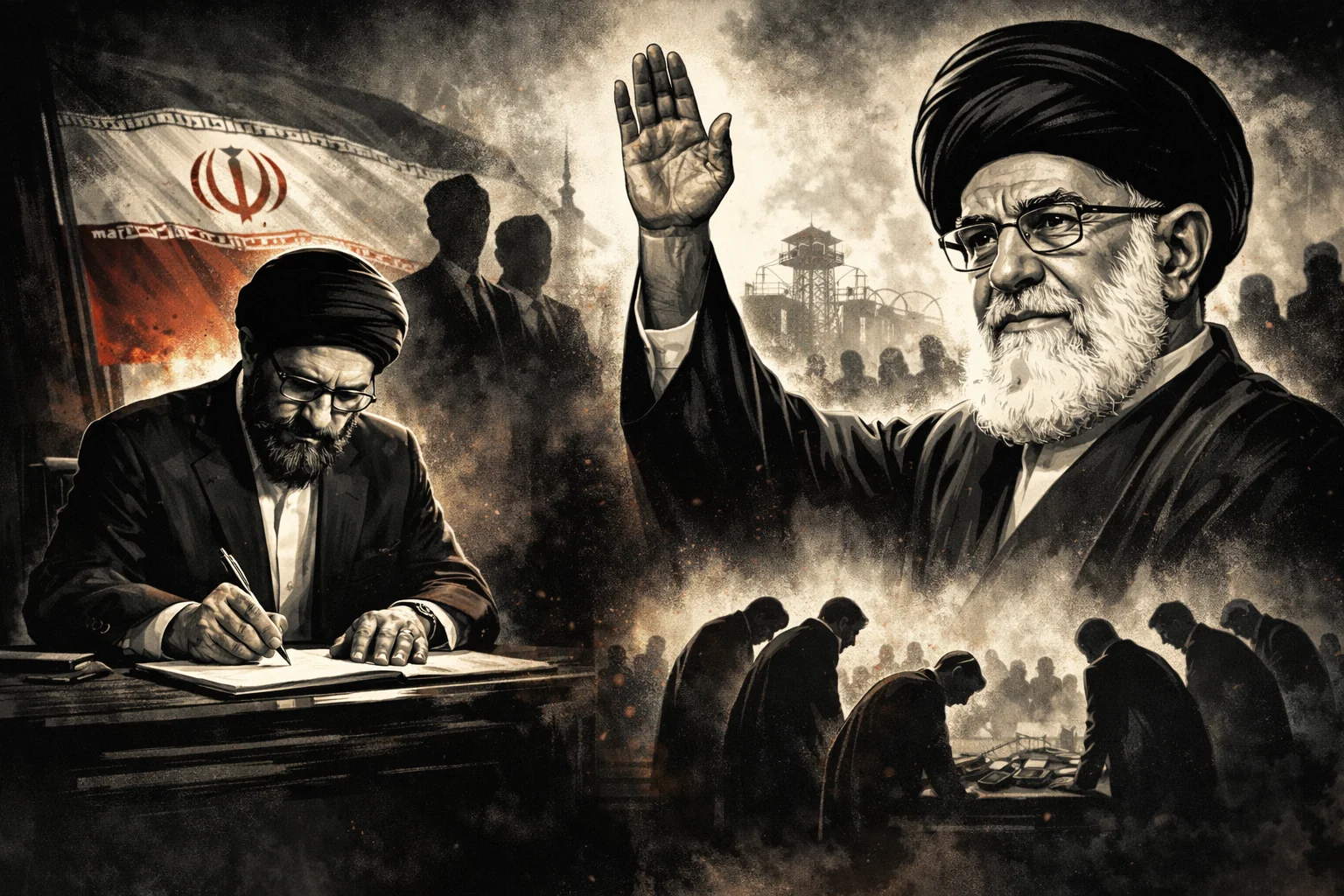
In studying the biography of Ali Hosseini Khamenei (1939-2026), it is not enough to view him as a cleric who reached the pinnacle of power. It is necessary to understand the path that linked his early seminary training, his experience as a revolutionary actor before 1979, his rise within state institutions after the revolution, and his election as supreme leader in 1989. Khamenei served as president from 1981 to 1989 and then as supreme leader for nearly four decades, making him the most continuous figure at the helm of the regime since the establishment of the Islamic Republic.
Khamenei was born in the city of Mashhad, in a traditional religious environment; his father was a cleric, which provided him with an early seminary education. He studied in the Mashhad seminary and then moved to Qom, where he contacted the movements of scholars opposed to the Shah's regime, headed by Ruhollah Khomeini, who later became the political and religious authority of the revolution. This stage formed a pivotal aspect of his rise: not only in terms of religious achievement, but also in terms of integration into underground political networks and opposition, including being arrested more than once before 1979, according to reference narratives circulating in encyclopedia and biographies.
After the victory of the revolution in 1979, Khamenei quickly entered the heart of the new institutional structure. He worked in multiple positions within the nascent regime, then became the Friday prayer leader in Tehran, a position with dual significance: religious as a platform for guidance, and political as a channel to confirm the official narrative and mobilize bases.He also participated in legislative and executive institutions, before reaching the presidency. During this period, he was subjected to an assassination attempt in the early 1980s that left a permanent physical mark, an event that was later used by the official discourse as a symbol of being the "target of the revolution" and "the witness of its sacrifice," which reinforced his image within the structure of revolutionary legitimacy.
The presidency (1981-1989) took place in a highly sensitive context: the years of the Iran-Iraq war and its accompanying mass mobilization and internal crises. This context further entrenched the state around the security apparatus and the military, and aided the rise of the Revolutionary Guards as a decisive actor. According to biographical summaries and reference reports, the presidency at that stage was not just an administrative position, but a school for learning to manage the balances between power centers and expand the network of alliances within the state, an experience that would become a crucial political capital when his name was put forward to succeed Khomeini in 1989.
The biggest shift occurred after Khomeini's death in June 1989. The 1979 constitution placed the "leadership" at the center of the system according to the principle of "Wilayat-e Faqih", with provisions specifying the conditions and powers of the leader and how he is selected. The Leader is elected by the Assembly of Experts, a council of clerics nominally elected by universal suffrage but whose nominations are filtered through the Guardian Council, making the selection process within an elite circle governed by political and religious balances. In 1989, the Assembly of Experts elected Khamenei as Supreme Leader. Multiple sources indicate that when Khamenei was selected, he was not considered the supreme religious authority (marja) in the traditional sense of Shiite jurisprudence, and that his selection was linked to internal political consensus and the 1989 constitutional amendment that amended the leadership requirements to allow a "qualified" jurist to assume leadership even if he was not a supreme authority in the previous sense.
To understand his "religious status," three layers must be distinguished: (1) his status as a Shiite cleric who has reached the rank of Ayatollah/qualified jurist; (2) his status as "Wali Faqih" according to the constitutional system, a characterization that gives him religious-political authority beyond his status as a traditional teacher or authority; and (3) the controversy over his status as an authority of tradition among all seminary schools, an issue addressed in encyclopedic sources as a matter of disagreement among senior religious scholars, but the constitution does not make seminary consensus a practical requirement as it makes the Expert Council decision the political-constitutional tiebreaker.
His "political status" is related to the nature of the position of the Leader as the top of the pyramid in the system. The Iranian Constitution (amended in 1989) grants the Leader extensive powers, specifically in Article 110, which serves as a list of powers: determining the general policies of the regime after consultation with the Expediency Council, supervising the proper implementation of general policies, supreme command of the armed forces, declaring war, peace and general mobilization, appointing and dismissing senior military leaders, appointing the head of the judiciary, appointing the head of the Radio and Television Organization, appointing the jurists of the Guardian Council, approving the election or removal of the president under specific conditions, and other detailed powers." Articles 107, 109 and 111 explain how this is done.
This theory, as developed by Khomeini in his pre-revolutionary lectures, holds that a qualified jurist assumes "guardianship" over the affairs of society in the absence of the infallible imam, including the administration of the state and the maintenance of public order.The Iranian constitution incorporated this vision into its texts, so that the guide became a "guardian" with authority with a religious legitimacy dimension, not just a civilian head of state. Therefore, his decisions acquire a "directive" character that dominates policies, and their impact extends to the legislative, executive, judicial, and security fields.
In practice, the Leader's powers are not limited to written texts. The position allows for influence through a network of appointments and oversight of important institutions: The Guardian Council, the judiciary, the official media, military and security leaders, and the Expediency Council. The existence of an "institutional architecture" in Iran makes the Leader a balancing point between the wings, and at the same time a swinging point in major clashes. Journalistic and analytical sources described Khamenei's period as witnessing the growing role of the Revolutionary Guards in the economy, politics and security, and this overlapped with the structure of the guide's powers as the commander-in-chief of the armed forces and the holder of the power of appointment in the leadership joints.
As for "how to describe the paths of his rise," it can be summarized in clear chronological steps: Religious formation in the seminaries of Mashhad and Qom, political opposition activity and arrests before the revolution, rapid integration into the institutions of the revolution after 1979, rhetorical-political prominence through the Friday pulpit in Tehran, access to the presidency in a time of war and crisis, and then the transition to the Murshidiya through the decision of the Assembly of Experts in a historic moment of transition after Khomeini's death and the amendment of the constitution. This path explains why many consider that Khamenei combined the "legitimacy of the revolution" with "legitimacy of the position" even if his status as a traditional reference remained controversial in some of the seminaries.
The exact answer is that the position of the Leader/Wali al-Faqih as a constitutional position in Iran was created after the 1979 revolution, and was formulated in the constitution of the Islamic Republic by incorporating the theory of Wilayat al-Faqih as a pillar of governance. The first guide was Ruhollah Khomeini himself, followed by Khamenei.In other words, the historical creation of the position came with the construction of the new regime after the overthrow of the monarchy, not within the traditions of the modern Iranian state before 1979. With the 1989 amendment, the terms of the position and its tools were adapted to expand the regime's ability to choose a leader who meets the requirements of "jurisprudence and political competence" according to the constitutional text, without strictly adhering to the reference requirement in the sense that was put forward before the amendment.
During his years of leadership, Khamenei's name was associated with major foreign and domestic positions: the continued conflict with the West, the sanctions file and the nuclear program, building regional influence through allies and networks, as well as managing protests and economic and social crises.However, within the limits of this paper, it is important to note that these facts do not change the essence of the definition of the position: the Leader is the center of effective sovereignty in the system, and his constitutional powers make him the apex of power above the elected authorities. Therefore, Khamenei's biography reflects the confluence of two factors: the biography of a cleric and politician formed in a time of revolution and war, and a constitutional structure that gives "leadership" both religious and political meaning.
To summarize, Khamenei rose through a cumulative process: early religious education, opposition political activism, weight within the institutions of the revolution, a confrontational presidency, and his election as supreme leader after a constitutional amendment that allowed him to stabilize his leadership.His religious status is based on his being a jurist who holds a "mandate" according to the concept of Wilayat al-Faqih, and his political status is embodied in broad constitutional powers that include public policies, military command, and key appointments. The position itself was created with the 1979 constitution after the revolution, as a constitutional embodiment of the theory of Wilayat al-Faqih, and its terms were reshaped after 1989 to ensure its continuity as the backbone of the regime.
Comments