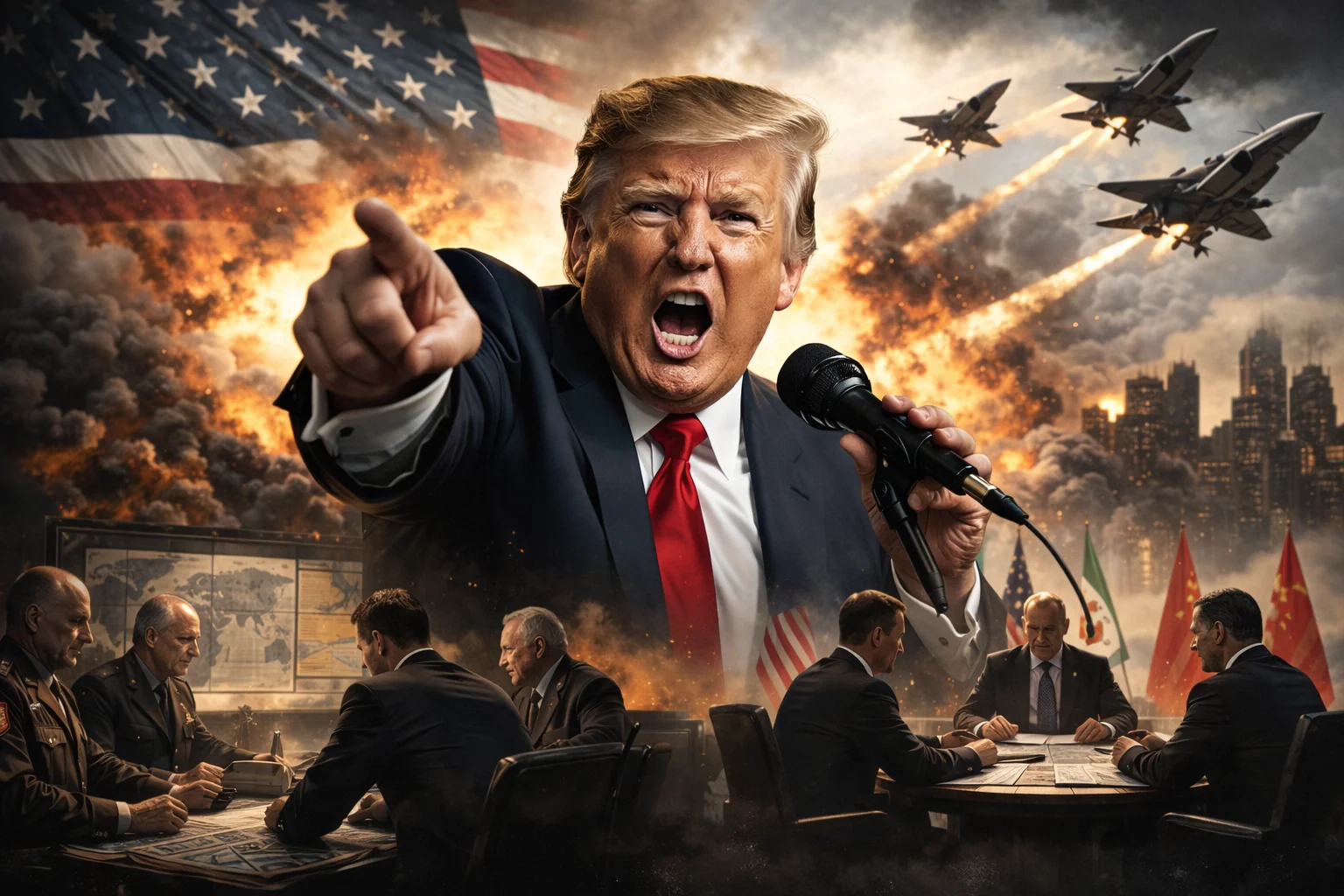
From the start of the attack on February 28, 2026 until the moment of March 1, 2026, Donald Trump's statements can be read as one continuous path, but it changes in tone and function from moment to moment: He begins with an official announcement that frames the operation as a "necessary war," then moves on to deterrence and threatening messages via his platform, interspersed with talk of "exits" to end the crisis quickly if Tehran's behavior changes, before returning on March 1 to extreme threatening language that attempts to curb any new wave of escalation.
In a video announcement on Feb. 28, Trump put the "name of the operation" politically before laying out its military details. The most important part of this announcement was his characterization of what is taking place as the actual beginning of a war inside Iran, when he said that the US military has "begun major combat operations" in Iran. At the same time, he linked the immediate objective to the vocabulary of internal security legitimacy, speaking of "defending Americans" by "removing imminent threats" from the Iranian regime. This kind of wording is usually present when the administration wants to transform the attack from an "option" to a "necessity," so that the public debate becomes about the details rather than the principle.
The second phrase that constituted the "narrative ceiling" in Trump's speech was related to the nuclear issue. In the text itself, he emphasized that Iran "can never have a nuclear weapon." He then went further by claiming that the US had "destroyed their nuclear program" at Fordow, Natanz and Isfahan, setting these sites as ready-made headlines to justify a continuation. Any subsequent strikes on missile systems, air defenses, or command structures could be subsumed under one broad objective: Preventing the rebuilding of a nuclear capability or protecting the declared "destruction" operation.
But the sharpest passages in the February 28 announcement were not related to the identification of targets, but rather to the rhetoric directed at Iran's interior. Trump not only threatened the state, but also delivered a direct message to an armed force within Iran, calling on them to "lay down their arms" in exchange for "full immunity," and then coupled that with an explicit threat if compliance did not occur. This type of quotation departs from the pattern of "deterring a state with a state" and goes towards trying to dismantle the cohesion of the opposing institution through an individual promise of amnesty and protection, which is why this particular passage was widely covered as a "shift" in Trump's language, from war on capabilities to pressure on loyalties.
After the speech, the messaging shifted to rapid update platforms, especially Truth Social, where statements attributed to Trump appeared that emphasized the length and breadth of the campaign. Reuters quoted him as saying that the "heavy bombing" would continue "all week, or as long as necessary." Reuters also quoted him with a post declaring the Iranian leader "dead" in the strikes. This ink is a clear message of "reachability" to the top of the political pyramid, and that the strikes are not symbolic or limited.
On the same day, Trump offered a very different formulation in his interview with Axios: Instead of keeping the ceiling unconditionally open, he talked about "exits" that could end the situation quickly. He explicitly said he could "end it in two or three days" or prolong it, then spoke in a direct tone about how he could end it and then tell the Iranians: "See you in a few years if you start rebuilding." In the same interview, he said that recovering from the attack "will take them several years." He also justified the decision to strike partly in a negotiating context, saying they "got close and then backed off" and that he understood they "didn't want a deal." These quotes went viral because they brought together seemingly contradictory things: Heavy-handed threats in public, and an open door to close the file quickly with a clear political condition.
Entering March 1, Trump's tone returned to maximum deterrence. Reuters quoted him as warning that the US would respond with "unprecedented force" if Iran escalates its attacks. He was also quoted with a direct "they'd better not" type of warning, speaking of an expected Iranian response. At this point, the main goal of the statement is to deter a new wave, not just justify the first strike, so the vocabulary focuses on "size of force" and "non-repetition."
As such, Trump's statements during this period can be summarized as a single text with a changing voice: Announcing the beginning of "major combat operations" and justifying them as a defense of Americans and "imminent" threats, then linking them to preventing the acquisition of a nuclear weapon and talking about destroying specific facilities, then escalating the rhetoric against the structure of the government and leadership, expanding the time frame of the campaign by "a week or necessity, then opening a window of "exits" capable of a quick termination in two or three days, and finally a warning on March 1 of an "unprecedented" response if there is a new Iranian escalation.
Comments