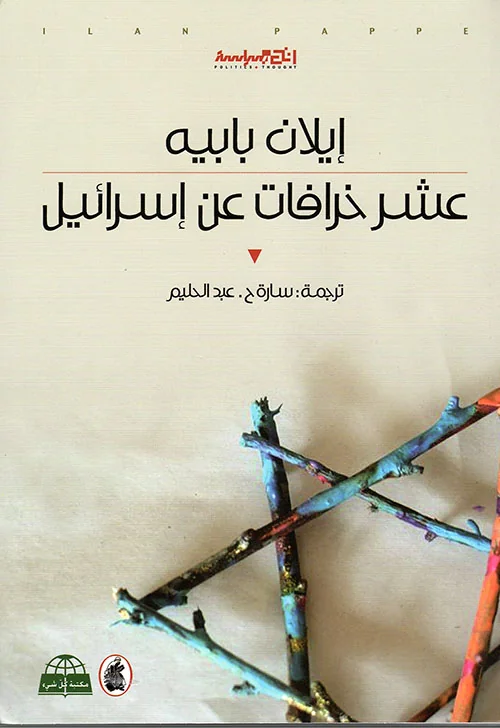
In his book 10 Myths about Israel, historian Ilan Pappé offers a deconstructive work that aims to destabilize the "axioms" that have been established by long-standing political and media narratives. Pappé treats the myth not as a crude lie, but as a shortcut interpretive framework that precedes facts and guides their understanding, turning history into axioms and giving the politics of the present a ready-made moral legitimacy. Therefore, the book is organized chronologically into ten myths, starting with the image of the place and people before 1948, and extending to the 1967 war, Oslo, Gaza, and the horizon of solutions, to emphasize that the conflict is not just separate events, but an integrated narrative system.
The first myth, "Palestine was an empty land," is the oldest and most frequently repeated. Pappé deconstructs this phrase as a process of symbolic erasure that precedes physical erasure: When a place is portrayed as empty, its inhabitants become a footnote in the story, and their presence can be guiltlessly ignored. He reminds the reader that Palestine before the end of the nineteenth century had cities, villages, a local economy, and social relations, and that turning it into a "void" was not an innocent characterization but a narrative necessity to justify a settlement project. Hence the second myth, "Jews are a people without a land," which reduces a diverse Jewish history to a single nationalist narrative and turns genuine European persecution into a political argument for an exclusive right to a particular place. Pappé does not deny suffering, but he refuses to turn it into a key to sovereignty that eliminates the existence of another community.
The third myth, "Zionism is Judaism," reveals a highly effective linguistic-political mechanism. Pappé makes a clear distinction between Judaism as a multi-track religion and identity and Zionism as a modern nationalist ideology. The function of the conflation, he explains, is twofold: To immunize the political project from criticism by giving it a religious/identity cover, and to criminalize any criticism of Zionism as anti-Jewish. In this sense, Pappé is not discussing an abstract intellectual issue, but rather exposing the "economy of accusation" in the public sphere, where words turn into moral traps.
The fourth myth, "Zionism is not colonization," is at the heart of the book's thesis. Pappé tends to characterize the project as settler colonialism rather than a national liberation movement. The importance of this characterization is that it identifies the nature of the structure that was formed: The reorganization of land, population, and law to serve a single group. This definition is not only linguistic, but also political and moral, because it changes the angle of view of the subsequent displacement, control, and borders. He rejects the "voluntary exit" narrative and places it in the context of war, violence, fear, and policies of social disintegration. For him, blaming the victim for their exit is a form of cleaning up political memory, turning a collective tragedy into an individual decision.
In the myth of the June 1967 war, "a war without choice," Pappé does not deny the existence of security concerns at that moment, but he objects to turning them into a fate that prevents thinking about the outcome of the war as a long-term policy of expansion. When "no choice" is said, subsequent control becomes an unquestioned defense. In this sense, Pappé attacks not only the military event, but the moral framework that made its outcome axiomatic. He then turns to the myth of "the only democracy in the Middle East," redefining democracy from electoral procedures to equal rights. He asks: For whom is democracy practiced? What about those who live under domination without sovereignty or equal rights? He argues that the slogan functions as a quick comparison tool aimed at Western audiences, weakening criticism and turning questions of rights into annoying details.
In the second half of the book, the myths shift from founding history to conflict management. In "The Myths of Oslo," Pappé offers a critical reading of the peace process as a framework that managed the conflict instead of resolving it, through asymmetrical negotiations that allowed the facts on the ground to persist while presenting the rhetoric of "peace" in the picture. Herein lies the paradox: The myth is not that Oslo succeeded or failed, but that the process itself has acquired a sanctity that makes criticism of it seem like a rejection of peace. In the ninth myth, "The Lies We Tell About Gaza," Pappé criticizes the way the starting point of the narrative is chosen: The discourse starts from the military action and ignores the siege, or from the "response" and forgets the conditions of daily life. Gaza is reduced to a security headline, and the context of collective punishment and cycles of violence is erased.
The tenth myth, "The two-state solution is the only way," comes as a conclusion with a futuristic tone. Pappé not only attacks the idea in theory, but also criticizes its transformation into a slogan that is repeated even when its physical and political conditions have eroded. He argues that insisting on a solution that is no longer viable on the ground is a continuation of superstition, and proposes instead a human rights horizon focused on equality and justice, regardless of the final form of the state. Readers may disagree with his diagnosis or solution, but his logic is clear: Realism does not mean repeating what is no longer possible.
The value of the book lies not only in its enumeration of myths, but in its method. Pappé writes in a consciously dialectical tone, deconstructing the "slogan" before deconstructing the "event," because for him the conflict is as much about the templates that explain the facts as it is about the facts themselves. This is what makes for interesting reading: The reader discovers that much of what he took for granted is in fact the product of intense narratives. At the same time, the book does not claim absolute neutrality; it is a conscious intervention in the battle for meaning and legitimacy. It can therefore be seen as a powerful entry point for understanding a broad critical narrative, not as a final word that closes the debate, but as an invitation to rethink the language with which we create both history and the present.
Comments