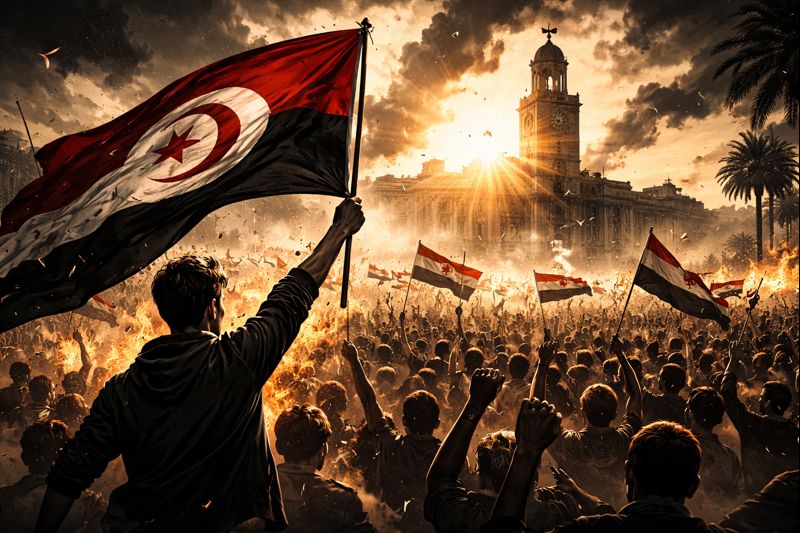
On this day, January 14, 2011, Tunisian President Zine El Abidine Ben Ali fled the country after weeks of escalating popular protests, a moment that seemed to many to have broken the barrier of fear and opened a new door in Arab political history. That day was not just the end of more than two decades of rule, but a symbolic moment that redefined the idea of "the possible" in the region and made the fall of an established regime suddenly seem repeatable.
Many in the region read the scene as a simple yet terrifying message: "If a president falls here, the idea is transferable." This is how the "domino effect" began to work, not just as an emotional contagion, but as a shift in calculations.The success of the Tunisian protests gave people in other countries proof that change was possible, and helped spark subsequent waves of protest, including Egypt, which saw the beginnings of a large-scale movement on January 25, 2011, in the well-known timeline of the Arab Spring.
But why did it look like a regional domino? Because Arab countries at the time shared a similar "crisis structure": high youth unemployment, a sense of political gridlock, corruption, economic disparity, and an educated but frustrated youth bloc. These elements were present in more than one country, so Tunisia came as a "proof" rather than a "sole cause." In addition, the fall in Tunisia came quickly.There was no classic military coup, no civil war, just accumulated pressure that exploded at a crucial political moment. This model sent a strong message to other peoples living in similar conditions: unemployment, corruption, lack of justice, and a lack of political horizon. The message was not theoretical, but practical: if it fell here, it could fall there.
For the first time, millions of Arabs followed a complete scene of the fall of a president on screens and phones, step by step. News was no longer told after the fact, but was broadcast moment by moment, creating a sense of participation and political contagion. It was as if people were exchanging a "user's manual" for protest: how to start, how to expand, and how to end.
In Tunisia, state institutions, especially the military, were less integrated into political power, allowing for a relatively quick transition without a total collapse. In other countries, power was more closely aligned with the military and security establishment, making any threat to the regime read as an existential threat and pushing for repression or open clashes, while in other countries, power was more closely aligned with the military and security establishment.
The second reason relates to society itself: the degree of organization, the presence of unions or intermediary forces, and the ability of elites to negotiate or produce political alternatives. Where organizational channels existed, the shock was contained or managed. Where they were absent, protests turned into a political vacuum that was quickly filled by chaos or external interventions. The economic factor also played a decisive role; rentier states were able to buy time and calm the street through spending, while states with limited resources were more vulnerable to explosion.
The third factor was the regional and international environment. Some arenas quickly became the scene of a power struggle between external powers, changing the domino effect from a political transition to a protracted conflict. The spark may be the same, but the materials that ignite it are not.
Years later, January 14 seems a pivotal moment not only because it brought down a president, but because it exposed the illusion of rapid generalization. The Arab Spring was not a single story, but multiple trajectories that started from a common moment. Perhaps the most important lesson is that the fall of a regime does not necessarily equal the building of an alternative, and that political dominoes do not fall according to mechanical laws, but according to the complexities of each country and society
Comments