Introduction
During the last decade, oil has transformed from a strategic commodity to a geopolitical pressure tool used by major countries to reshape the balance of power, and this transformation was clearly evident after the Russian invasion of Ukraine in February 2022, when the United States, the European Union and the G7 moved to impose broad packages of sanctions that included setting a price ceiling on Russian seaborne oil at $60 per barrel, while linking Western shipping, insurance and financing services to compliance with this ceiling. In return, Russia redirected a large part of its oil exports from Europe towards Asia, making India and China the main life line for Russian energy revenues.
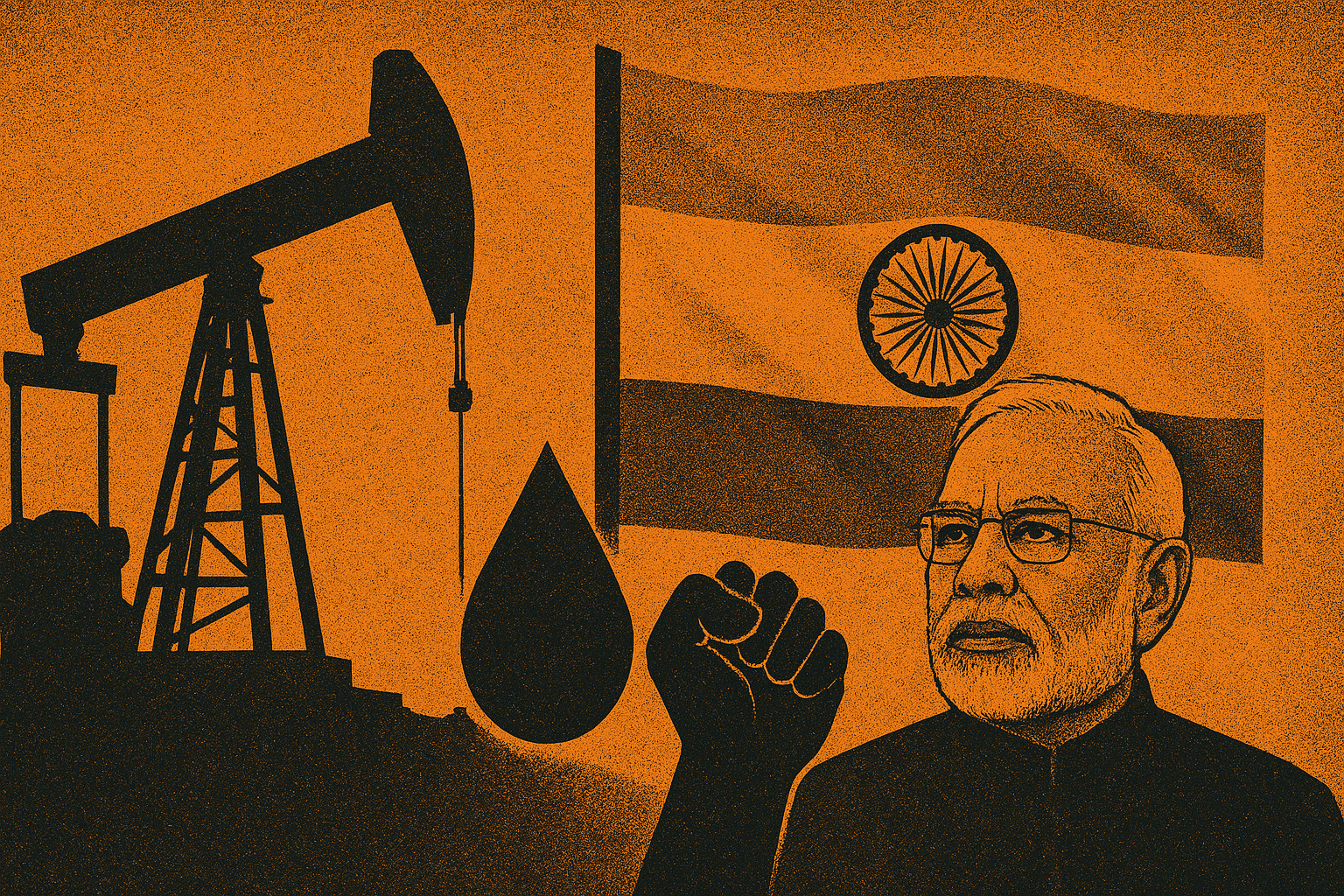
Since 2022, the share of Russian oil in India's imports has jumped from marginal pre-war levels to about a third of the import basket, and even approached 40% in some periods between 2023 and 2024, taking advantage of deep price discounts on Ural crude compared to Middle Eastern crudes (Verma, 2023; DGCI&S, 2025; Reuters, 2025).This behavior has drawn open Ukrainian and Western criticism, some going so far as to accuse New Delhi of financing Russia's war, but India's foreign minister has repeatedly countered that Europe itself has continued to buy more Russian energy for long periods, stressing that India will buy from the "cheapest available supplier" as long as it is not directly subject to sanctions.This paper sets out to analyze a central question: Why has India chosen energy pragmatism rather than political alignment? How have oil barrels themselves become a "negotiating language" used by major powers to pressure and cajole New Delhi? Who gains and loses from this tension between energy security in the Global South and the Western sanctions strategy?
India's need for energy and its rise as an economic power-why can't New Delhi align itself with Washington?
India's growing need for energy is a key lens for understanding its behavior on the Russian oil issue. India is today the world's fastest growing driver of energy demand growth; IEA and OPEC estimates indicate that India alone will account for about a quarter of global oil demand growth in 2024-2025, with consumption rising from about 5. 5 million barrels per day in 2024 to 5. 5 million barrels per day in 2025.(IEA, 2024; OPEC, 2025; Reuters, 2025). This demand reflects not just a consumer luxury, but a huge industrializing and urbanizing economy that needs diesel for transportation and infrastructure, liquefied natural gas for cooking, and fuel for heavy industry.November 2025 data, for example, shows that India's fuel demand reached 21.27 million tons, a six-month high, with diesel consumption jumping more than 12% month-on-month, reflecting a direct correlation between energy consumption growth and the expansion of transportation and business.Since India imports more than 85% of its crude oil needs, any sharp rise in global prices is immediately reflected in inflation, domestic transportation costs, the government's subsidy bill, and the value of the rupee, making energy price stability an integral part of the concept of "economic national security" in the Indian strategic mind (Reuters, 2025; Reuters, 2025).
In this context, discounted Russian oil after 2022 seemed an economic opportunity that New Delhi's decision-makers could not ignore. With the loss of the European market under sanctions, Moscow offered significant discounts on Urals crude, which according to press estimates reached levels near $35 per barrel in some periods, well below Brent prices, which enabled India to absorb a large part of the price shock after the war, and protect domestic consumers from larger jumps in fuel prices (Forbes, 2025; DGCI&S, 2025; European Commission, 2022).Official Indian data showed that Russia's share of oil imports jumped from around 2% in 2020 to nearly 22% in fiscal year 2022-2023, then to about 36% in 2023-2024, and stabilized around 35% in 2024-2025, with imports concentrated in 2024-2025 (Forbes,2025; DGCI&S,2025; European Commission,2022).2025, with imports increasingly concentrated from five major suppliers-Russia, Iraq, Saudi Arabia, Saudi Arabia, the United Arab Emirates, the United States, and Kuwait-which now cover about 86% of India's imports (DGCI&S, 2025; Reuters, 2025; OPEC, 2025).This jump was less an ideological decision than a response to financial and business considerations; Indian refiners have reoriented their purchases toward cheaper crude that can be blended and re-exported, while the government has benefited from better margins to control inflation.
But an understanding of the Indian position is incomplete without recalling New Delhi's ambition to play the role of an "independent power" in a multipolar international system.Since the end of the Cold War, India has adopted a philosophy of "strategic independence" as a country that does not want to be an automatic extension of any axis, but one that is able to position itself at multiple intersections: a deep partnership with the United States in technology, defense, and economics, membership in the Indo-Pacific Quad groupings, continued defense and technical ties with Russia, and involvement in frameworks such as BRICS and the Shanghai Cooperation Organization.This "multiplicity of engagements" makes the decision to fully align with the sanctions camp against Moscow costly, as it threatens two pillars at once: energy security and diversified sources of armaments.Although Russia's share of Indian arms imports has declined in recent years, it is still the largest supplier, with estimates indicating that its share fell from about two-thirds of Indian arms imports in 2013-2017 to nearly 45% in 20182017 to about 45% in 2018-2022, with India still relying on key Russian systems such as Sukhoi fighter jets, S-400 missiles, and the BrahMos joint venture (CSIS, 2025; Chatham House, 2024; Reuters, 2025).This defense architecture makes severing ties with Moscow a direct risk to the readiness of the Indian military, which explains why defense industrial cooperation talks will continue until 2025 (Reuters, 2025).
India's reading of Western pressure is different: it is not a dispute over a commodity, but over its position in the international system. Ukraine and some Western countries' criticism of India's imports of Russian oil, along with repeated threats of secondary sanctions or punitive tariffs on countries that buy oil from Russia or Venezuela, are seen in New Delhi as an attempt to reduce its margin of maneuver.The Indian political response was clear: Europe itself has long continued to buy more from Russia, and India will continue to buy oil from the cheapest supplier not subject to direct sanctions (Reuters, 2023; DGCI&S, 2025). Thus, India is not a "rebel," but a pragmatic state that sees its first job as protecting the welfare of millions of citizens, even if this requires tension with some allies.
The second axis: Oil as a global political weapon - how do major countries use it to change India's positions?
On the one hand, the West adopted the "weapon of sanctions and price restrictions": setting a price ceiling of $60 per barrel and restricting Western shipping, finance, and insurance services to adhere to it (European Commission, 2022; Forbes, 2025; DGCI&S, 2025).Restrictions were later extended to "invisible fleet" tanker networks and intermediary companies, with threats of secondary sanctions against countries and companies dealing with Russian oil outside the authorized frameworks (CSIS, 2025; Reuters, 2025).The goal was not to stop the flow of oil to India, but to reduce discount margins and make Middle Eastern or US alternatives more attractive. As US pressure mounts in 2024-2025, including talk of additional tariffs on countries buying oil from Russia or Venezuela, Washington is trying to push New Delhi to reduce its exposure to Russian crude (Reuters, 2025; Reuters, 2025).
In addition to significant price reductions, Moscow has developed a parallel logistics system that relies on non-Western tankers and alternative financing networks to bypass Western service restrictions, so that more than two-thirds of Russian oil destined for India in 2024 passed through such tankers.Russia has also facilitated payment terms in rubles, rupees, or dirhams through intermediary banks, in an attempt to bypass financial sanctions, despite the reservations of major Indian banks (DGCI&S, 2025; Reuters, 2025).
The Gulf's "weapon" is to control global oil supply and prices through OPEC+ decisions to cut or increase production. Since 2022, OPEC+ has implemented a series of major cuts, which were later extended to 2025.For India, a large part of whose imports come from the Middle East, this means that a decision from Riyadh or Abu Dhabi could raise the import bill by billions of dollars in a single year. India's oil minister has warned that worsening tensions in the Middle East could hurt energy availability despite alternatives in an oversupplied market (Reuters, 2025; Reuters, 2025).
The indirect role of China cannot be overlooked; it is the largest buyer of Russian oil, making its competition with India for shipments an influential factor in prices and discounts. The US-China conflict also pushes the US to consider India as a pivotal partner, giving New Delhi space to assert its right to an independent energy policy (IEA, 2024; OPEC, 2025).In parallel to the "weaponization of oil," the major powers use non-oil pressure tools: trade threats, reluctance to transfer advanced defense technology, and linking investments to the degree of India's closeness to Western positions (CSIS, 2025; Reuters, 2025). However, India benefits from multiple partners, importing from Russia, the Middle East and the United States, and exporting refined products to Europe, which reduces its vulnerability to any source of pressure.
The third axis: Who benefits and who loses? The cost of the Indian challenge and its impact on the global balance of power
The question of who wins and loses from India's defiance of Western pressure is more complex than simply measuring financial flows. From a gains perspective, India has clear benefits: cheaper oil reduces inflation, protects the budget, and boosts economic growth momentum. High refining margins allow it to export some 65 million tons per year of refined products, strengthening India's position as a player in the oil value chain.At the same time, it establishes India as an independent power in the Global South, combining short-term pragmatism in fossil fuels with a long-term vision of green transformation, with a target of 500 GW of non-fossil capacity by 2030 (Ministry of Power, 2025; IEA, 2024; Reuters, 2025).
Some Indian refiners, such as Reliance, have reduced their purchases of Russian crude for fear of secondary sanctions, while others have continued to import heavily. Oil dependence may also slow the energy transition and make it more difficult to achieve carbon neutrality by 2070 (IEA, 2024; Reuters, 2025).Russia is a major beneficiary of continued Indian purchases, albeit with significant discounts reducing its revenues, while the West faces clear limits to the effectiveness of sanctions in a world of diverse trade routes (European Commission, 2022; Forbes, 2025; Reuters, 2025).
In conclusion, it can be said that the use of oil as a political weapon in the post-Ukrainian war era is no longer just a matter of prices or flows, but has become a tool to redraw the map of alliances and the position of states in the international system. India's choice to continue buying Russian oil, while diversifying its suppliers and deepening its partnerships with the West, the Gulf and China, has made it a model for a new approach in the Global South based on strategic independence and energy pragmatism.In the long term, the question remains: How much longer will oil remain an effective tool for political pressure in light of the rapid expansion of renewable energy? Will the "resource war" shift from oil to critical metals, batteries, and green hydrogen?
Comments