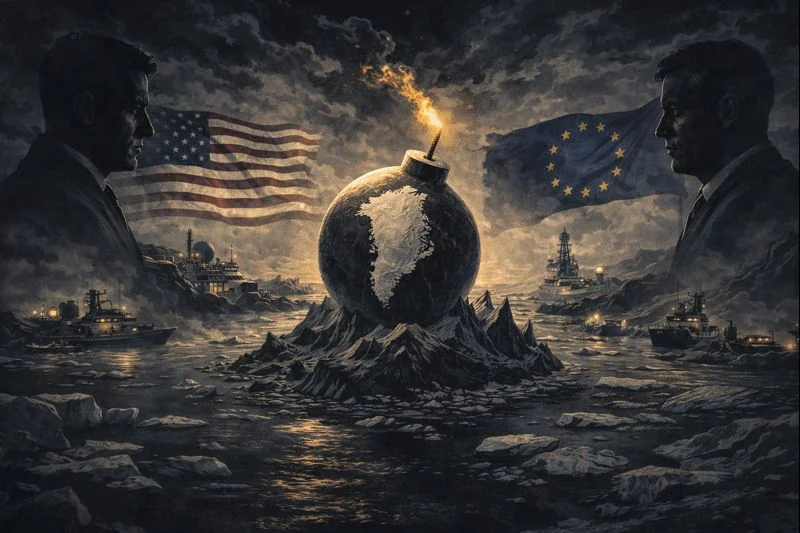
The remote Arctic island of Greenland has never been at the forefront of the global political scene, but in recent years it has become a geopolitical hotspot with the potential impact of a ticking time bomb. Despite its isolated location and population of only 57,000, Greenland has become the focus of an indirect conflict between major powers and a sensitive card in relations between Europe and the United States.Today, the island represents a unique combination of military strategic importance and rich natural resources, making the question of its sovereignty and exploitation a hot topic on the tables of decision-makers. The question arises: How can such a remote geographical issue become a direct threat to European-American relations and the calculations of security deterrence in the Arctic?
First, the issue of Greenland's sovereignty and the international power struggle
Although Denmark has formal sovereignty and defense of the island, Greenlanders have the right to self-determination and have previously voted in favor of broad autonomy. The island even exited the European Common Market in 1985 in protest of European fishing policies.Some have long dreamed of Greenland becoming fully independent in the future, but economic dependence on Copenhagen's support has been an impediment. But what was once a Danish internal affair has become an arena of great power competition in recent years, making the issue of Greenland's sovereignty a geopolitical ticking time bomb.The United States has shown unprecedented interest in the island, from a historic offer to buy it after World War II to US President Donald Trump publicly floating the idea of buying Greenland in 2019 (CNN, 2019; The Guardian, 2019).The proposal was met with widespread Danish and European disapproval, with Denmark's prime minister emphasizing that the island was not for sale (Frederiksen, 2019). Initially seen as an oddity or political whim, it soon turned out to be an early indicator of Greenland's strategic importance.
Tensions over Greenland's sovereignty peaked with recent developments as late as early 2026. After Trump's re-election, US rhetoric about the need for the US to acquire the island returned with vigor, citing its importance to US national security (Wieslander, 2026). Trump even went further, stating: "I think we will get it" and hinting that Greenlanders themselves would like to join the US (The Guardian, 2025).A recent poll showed that 85% of Greenlanders reject the idea of their island becoming part of the United States (with only 6% in favor), confirming that the demand for national sovereignty is deeply rooted among the islanders (Bryant & Rankin, 2025).Despite this, Trump escalated his rhetoric, arguing that Greenland should be "in the hands of the United States" and that anything less was unacceptable, even openly claiming that he could not rely on Denmark to defend the island. This hostile rhetoric towards an ally and Danish sovereignty shocked Europe and raised serious concerns about the cohesion of the Western alliance (Egmont Institute, 2026).
Denmark's prime minister explicitly warned that any US attempt to militarily impose a fait accompli in Greenland would effectively mean the end of NATO (Haesebrouck, 2026).This unprecedented statement reflected the extent of European concern that the foundations of trust between allies could collapse over an ambition concerning a distant territory (ECFR, 2026). In parallel, European leaders were quick to show solidarity with Copenhagen, issuing a joint statement categorically rejecting any unilateral encroachment on Greenland (European Council, 2026).Some European countries, at Denmark's request, even took symbolic steps to strengthen the military presence in Greenland. France, Germany, and Scandinavian countries reportedly sent small military units to participate in maneuvers on the island in support of Denmark and to emphasize that Greenland is not alone. These moves, even if demonstrative, send a clear message to Washington that Europe is ready to politically and possibly practically defend its ally and its territorial sovereignty, even if the threat this time comes from the American partner itself (Wieslander, 2026).
In the midst of this tug-of-war, the voice of the Greenlandic government has been present to remind everyone that Greenlanders have the final say in their future. Greenland's foreign minister recently emphasized that her country wants to be "an ally of the United States, not a follower" (Al Jazeera, 2026). This statement reveals Greenlanders' desire for an equal partnership with Washington rather than submission to its dictates or surrendering sovereignty.It is also in line with the popular mood, which is overwhelmingly opposed to joining America, meaning that any unilateral American action would ignore the will of the local population itself (Bryant & Rankin, 2025). Another international player complicating the scene is China.In recent years, Beijing has sought to economically penetrate Greenland with offers to invest in infrastructure projects and mines, particularly in the rare minerals sector, which Greenland possesses in large quantities (Nathanielsen, 2025; ECFR, 2026). These Chinese moves have alarmed both Denmark and the United States, leading them to coordinate to thwart some of these attempts, with Copenhagen providing alternative funding for airport projects to prevent Greenland's dependence on Chinese funds (ECFR, 2026).The West fears that China's economic engagement could lead to strategic influence on the island, threatening to transfer the global power struggle to Greenland's own soil. The Greenlandic government thus finds itself between the hammer of American and Chinese temptations and the anvil of European concern, in a delicate balance to preserve as much autonomy as possible (Wieslander, 2026).
In short, the issue of Greenlandic sovereignty has turned into a highly sensitive international file. What was once an internal Scandinavian affair has become a real test of the principles of respect for state sovereignty within Western alliances. If this issue is mishandled, a small spark in this remote island could ignite a major crisis of confidence between Europe and America, threatening to blow up the foundations of the Atlantic Alliance, which was historically based on trust and mutual respect for the sovereignty of members (Haesebrouck, 2026; Wieslander, 2026).
Second: Greenland in NATO's calculus and Arctic security
Greenland has always occupied a strategic position in the Atlantic security system despite its geographical remoteness. From a purely military perspective, the island constitutes a forward fortress for the defense of North America as well as a northern flank for Europe.During the Cold War, the United States recognized Greenland's importance against the Soviet Union and in 1951 signed a defense agreement with Denmark that allowed U.S. forces to establish a large military presence on the island (U.S. Department of State, 1951). Under this agreement, the Thule Air Base (now called Petrovik Space Base) was established in the far north of Greenland, which became one of the most important early warning nodes against a Soviet nuclear missile attack.Indeed, since the 1960s, Greenland's giant radars have been a key pillar in the early warning network to protect America from trans-Arctic ballistic missiles (Defense News, 2025). This vital role of the island has continued to this day, as the warning radars at Petovik remain a pivotal element of the US missile defense system. This military importance has made Greenland an indispensable island in NATO's nuclear and conventional deterrence calculations (NATO, 2025).
Moreover, Greenland occupies an exceptional geographical position between America, Europe, and the Arctic Ocean, making it a gateway to the Arctic and a center of gravity in the so-called GIUK gap (the maritime gap between Greenland, Iceland, and the United Kingdom) (ECFR, 2026).During the Cold War, the gap was considered the first line of defense to prevent the Soviet Union's nuclear submarines from launching from the Arctic Ocean into the deep Atlantic and threatening U.S. shipping lanes or territory (Levine, 2019).The bases and waters around Greenland were an essential part of the strategy to track and hinder those hostile submarines (NATO, 2025). Today, with the resurgence of competition with Russia, this location remains critical to the Atlantic Navy. Russia has increased its military presence in the Arctic in recent years, establishing new bases in the far north and modernizing its fleet of icebreakers and strategic submarines in the Barents Sea (Conley & Rohloff, 2024).This has led NATO allies to repeatedly emphasize that the Arctic is a critical dimension of the Atlantic deterrence and defense system (NATO, 2025). For example, NATO officials emphasized in 2025 that the security of the High North is essential for trade and communications between North America and Europe, and that climate change and increased international competition - especially with Russia's growing military presence - require greater vigilance and cooperation on that front (NATO, 2025).With the recent admission of Finland and Sweden to NATO, seven of the eight Arctic states are now part of the alliance (excluding Russia), effectively placing most of the Arctic Circle within the scope of Western security coordination (Haesebrouck, 2026).
Against this backdrop, it is understandable that the scenario of an exploding crisis over Greenland would be dangerous for NATO's cohesion and capabilities. The alliance, which was originally built on the principle of collective defense (Article 5) and the assumption that any attack on any member would be met with a response from all, did not take into account the possibility that the threat would come from within its own ranks (Wieslander, 2026). Hence Copenhagen's stern warning that a Washington attempt to seize Greenland by force would mean the complete collapse of NATO's credibility (Haesebrouck, 2026).How can the alliance survive if a leading nation violates the sovereignty of another ally? The very thought of such a scenario strikes at the core principles on which NATO was founded. Analysts have put it clearly: "Such an aggressive move by the United States would be a coup de grace for NATO from within (Wieslander, 2026)." (Wieslander, 2026).It would break one of the most important foundations of the alliance throughout its history, namely that members refrain from military conflict with each other (ECFR, 2026). While this scenario is unprecedented and catastrophic, the mere escalation of verbal tensions has cast a shadow of doubt and uncertainty between the two sides of the Atlantic (Egmont Institute, 2026).
On the U.S. side, the Pentagon recently reorganized its military command responsibilities for Greenland, shifting Greenland defense operations from U.S. European Command to U.S. Northern Command, which is charged with U.S. homeland security (U.S. Department of Defense, 2025). This 2025 move was interpreted as a political signal that Washington views Greenland as part of the U.S. homeland defense system (Defense News, 2025).As much as this decision may have a military logic (given Greenland's geographical proximity to North America), it raised the ire of some in Europe who saw it as an implicit American attempt to establish Greenland as a special American sphere of influence rather than a shared Atlantic responsibility. These suspicions were reinforced by Trump's repeated statements about the island and his rejection of Danish offers of expanded security cooperation there, suggesting that Washington under his leadership is not interested in cooperative solutions but rather seeks direct control (Wieslander, 2026).
In short, Greenland has become a cornerstone in the Arctic security equation. If it remains under the umbrella of the close Danish-American partnership, its location will continue to strengthen early warning capabilities and Atlantic deterrence against any threat from the north. If the disputes over it explode, the repercussions will destabilize military and intelligence cooperation mechanisms in a sensitive region and may undermine the effectiveness of Western deterrence as a whole. As recent developments have confirmed, remote Greenland may be the most difficult test for NATO cohesion in decades, and perhaps the most dangerous in its history if the situation gets out of control.
Greenland and transatlantic trade: resources and sea lanes
The interest in Greenland is not limited to military and political aspects, but extends to transoceanic economic and commercial considerations. This vast island (the largest island in the world by area) has enormous natural resources that have been buried under the ice for centuries.With the accelerating pace of climate change and the melting of polar ice, many of Greenland's mineral and energy resources have been exposed, and the possibility of new trans-Arctic sea routes that shorten the distances between Asia, Europe, and America is on the horizon. These developments have added an additional economic and geostrategic dimension to the Greenland issue, making it the focus of attention of not only the West but also its global adversaries (Conley & Rohloff, 2024).
Greenland's natural resources are a geo-economic treasure. According to geological reports, the island has huge reserves of rare earth elements (neodymium, dysprosium, etc.) necessary for high-tech industries and defense systems. It also contains large quantities of uranium, as well as potential oil and gas deposits on the northern continental shelf.In the recent past, these resources were not economically viable due to the difficulty of extracting them in a harsh and remote environment. But as the ice retreats due to global warming, they have become relatively easier to access, whetting the appetites of countries and major corporations. One analyst described the scene as the retreat of the ice around Greenland transforming it from a frozen spot to a gateway to "navigable sea routes and untouched natural resources" (ECFR, 2026).
For the United States and Europe, Greenland's resources are of particular strategic importance as the global economy shifts. On the one hand, they seek to reduce their dependence on China for rare earth elements and strategic metals essential to the electronics, clean energy, and weapons industries. China currently dominates the supply chain for many of these materials and has used this as a political leverage in the past.Greenland is an attractive alternative, as its vast reserves of rare minerals could help diversify Western sources of supply away from Chinese influence. Trump has explicitly emphasized this perspective, considering control of Greenland's resources a matter of economic and national security, and arguing that China's capture of most rare metal production makes securing these resources a priority for US national security (Wieslander, 2026).In this sense, Trump's rhetoric about Greenland has shifted from previously characterizing it as a "real estate deal" to focusing on it as a strategic dam to protect American supply chains (Haesebrouck, 2026).
The European Union has recognized the importance of integrating Greenland into its vital raw materials strategy and signed a memorandum of understanding with the Greenlandic government in 2023 to establish a strategic raw materials partnership (European Commission, 2023). The partnership aims to develop sustainable mineral supply chains from Greenland to Europe, creating mining and processing projects that help European industry and economically benefit the islanders.For its part, Greenland aspires to utilize European support to responsibly develop its mining capacity in accordance with high environmental standards - as Greenland's Minister of Business and Mineral Resources emphasized, noting that strict European environmental standards are in line with Greenland's ambitions to develop sustainable and responsible mining (Nathanielsen, 2025).In addition to the political agreement, concrete projects have already emerged that embody this cooperation, such as a Canadian mining company operating in Greenland signing a long-term agreement in 2025 to supply molybdenum metal to a major European steelmaker (EIT RawMaterials, 2025). This deal has been described as more than just a commercial contract; it is a strategic signal of Greenland's growing role in supporting the European economy and ensuring its vital resources (European Commission, 2024). In other words, Greenland has become an important stone in drawing the map of future European economic security.
Greenland has become an influential element in the equation of global trade and economic security for the West. Its resources attract the attention of industrialized capitals, its location shapes new shipping lanes, and its political status can facilitate or hinder the West's access to these benefits.In today's world where security and economic considerations are intertwined, a sovereignty crisis in Greenland could disrupt mineral markets or ship traffic, just as a cooperative agreement could enhance Euro-American energy and trade security for decades to come.
Conclusion
Despite its icy cold climate, Greenland has become a hot-button issue in contemporary international relations. A combination of factors makes it a geopolitical time bomb: a strategic location controlling the gates to the Arctic Ocean, a pivotal role in Atlantic defense systems, and natural resources critical to the global economy. These factors have transformed Greenland from the periphery of the map to the center of great power calculations.There are two contrasting scenarios for how this issue will affect the future of the European-American relationship and the balance of deterrence in the Arctic. Either the allies will succeed in defusing this bomb through dialogue, coordination, and respect for Denmark's sovereignty and the rights of the Greenlanders; or the crisis will be mishandled and explode, potentially undermining decades of trust between Washington and Europe.
Recent developments leading up to early 2026 have shown that ignoring the sensitivities of the Greenland issue is not an option. The fiery rhetoric and defensive responses from both sides raise the alarm that the situation could descend into the most serious internal crisis NATO has seen since its founding. It has also sent a signal to the rest of the world that the Western house may not be as united as it once was.On the other hand, this latent crisis has shown Greenland's immense value and reminded Europeans of the need to strengthen their defense and economic independence so that their security or economy is not subject to sudden shifts in US policies. It is a wake-up call for Europe to strengthen its Arctic defenses and secure its supply chains for essential minerals, and a wake-up call for America that its policy of dealing with allies through deals and fait accompli may lead to its isolation and weakening of its alliances.
Comments