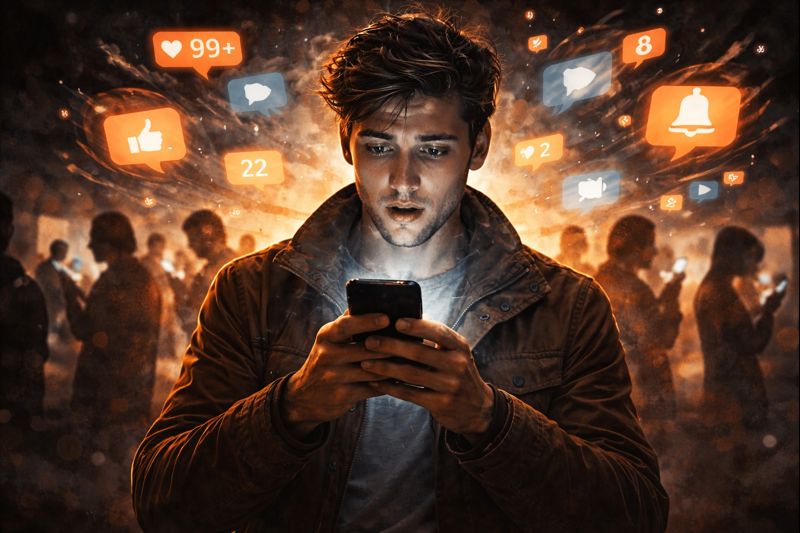
FOMO, or "fear of missing out," is no longer a fleeting feeling, but a daily experience created by the content environment itself. The basic idea is that platforms don't just show "what's happening," they build a sense that what's happening is important, rare, and happening now, and that missing it is a social loss. This is why FOMO is associated with increased social anxiety: Not a fear of the event itself, but a fear of being left out of the circle: The circle of friends, the shared conversation, or the "moment" that gives you a sense of belonging.
Content creates this fear through overlapping design features, most notably temporal scarcity and social cues. Stories, for example, create the "pressure of the moment": A short viewing window, and then the story disappears, creating the impulse to check back frequently so you don't miss anything. A 2023 study published in SAGE Open found that content ephemerality triggers FoMO, which increases follower engagement with accounts, while at the same time can increase "fatigue" due to constant attrition (Maar, 2023). In addition, likes, comments, and views act as status signals: Not only do you see the event, but you also see the "value" of the event through people interacting with it, and you feel that falling behind is equivalent to falling behind a social norm. Algorithms amplify the impact: When the platform rewards certain content for going viral, it feels like "everyone is talking about it," curiosity turns into anxiety, and anxiety turns into compulsive following behavior.
Why does FOMO specifically raise social anxiety? Because its mechanism of action is often through social comparison and self-esteem. A research model published in 2024 shows that FoMO is associated with problematic social media use, and that this association runs along a continuum: A greater tendency for social comparison and then lower self-esteem, making the user more sensitive to the idea of "exclusion" or "inadequacy" (Servidio, 2024). When you see selective snapshots of others' lives (travel, encounters, successes), you are not comparing event to event, but your own self-worth to a repeated "perfect" image, and social evaluation anxiety rises: How do people see me? Why am I not there? Am I out of the group? This anxiety may turn into hyper-following in order to regain a temporary sense of belonging, but it often reproduces the issue: The more you follow, the more you compare.
Recent data supports this correlation between circles of use and anxiety. In a 2025 meta-analysis of 32 studies and 26,166 students, there was a positive correlation between social media addiction and both anxiety (r≈0.31) and FoMO (r≈0.41). This does not mean that FoMO "causes" anxiety alone, but it shows that it is part of a psycho-behavioral package that feeds off each other: Greater anxiety, greater attachment to the platform, and greater fear of missing out. More importantly, recent research has directly linked FoMO to so-called "online social anxiety". A 2025 study of university students (451 participants) found that FoMO predicts online social anxiety, with mediating roles such as media multitasking and irrational procrastination (Wu et al., 2025). The picture here is clear: Content not only creates a desire to follow, it creates an "always-on" social environment that makes stopping seem risky, increasing an individual's sensitivity to how others perceive them and their place among them.
The bottom line is that FOMO is not a personal weakness, but an interaction between a human need to belong and content designed with scarcity, indicators, and algorithms. Therefore, elevated social anxiety occurs when digital presence becomes a condition for feeling accepted. Minimizing its impact starts with understanding the trick: What we see is not the whole life, but an algorithmically selected and rewarded snapshot, and that true belonging is not measured by the number of stories you've seen, but by the depth of relationships you have off-screen.
Comments