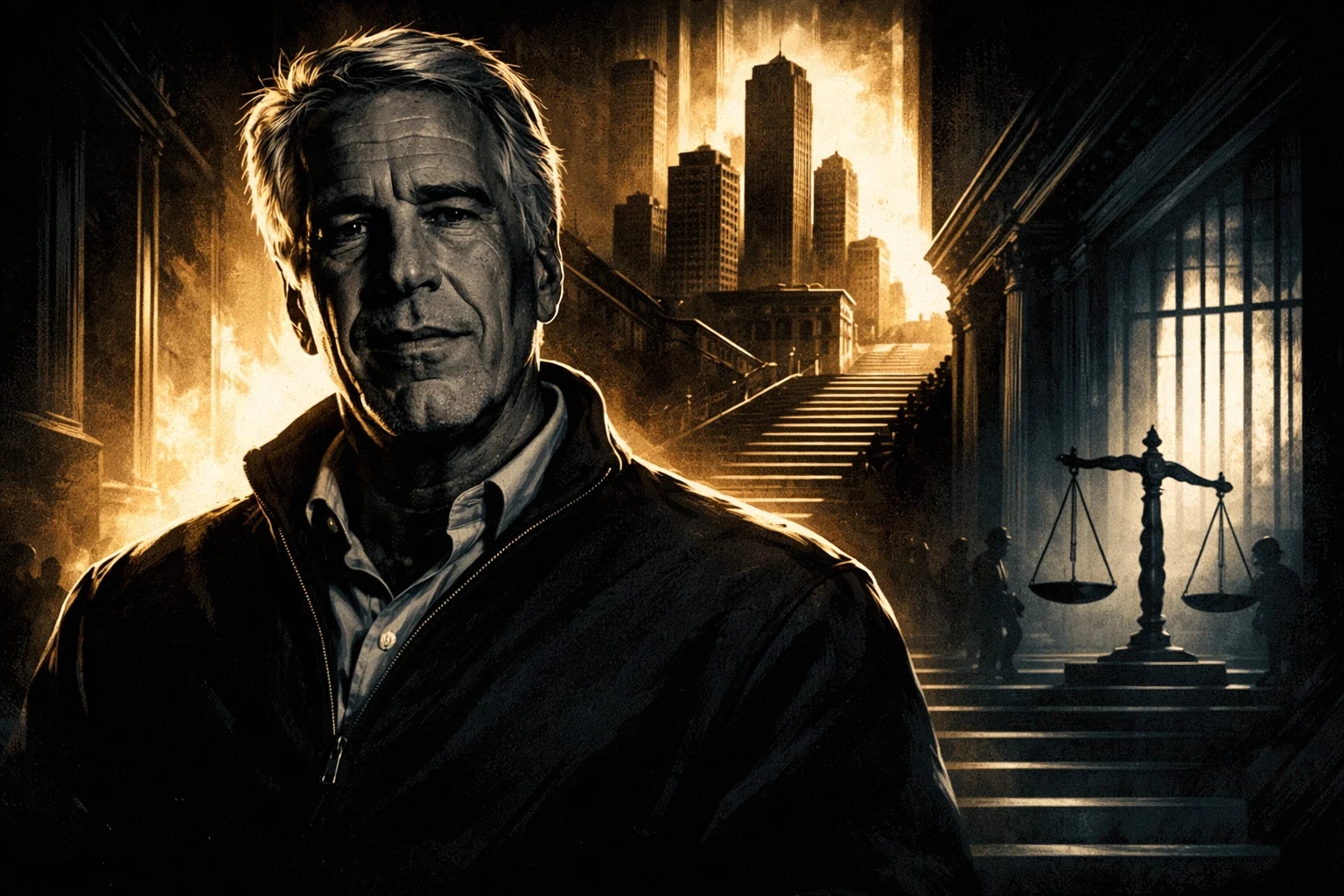
Jeffrey Epstein is one of the most controversial figures in modern American history, not only because of the crimes he was accused of, but also because of the unconventional path of his social and financial rise and the vast network of relationships that surrounded him within finance, politics, and academia.After his death in 2019, his name became a symbol of a complex institutional failure, where financial opacity was intertwined with abuse of power and a clear failure of justice and oversight systems. Understanding "who Epstein is" requires moving beyond a quick characterization as a sex offender, towards a structural analysis of how his informal power emerged and why he went for so many years without decisive accountability.
Born in 1953 in Brooklyn, New York, to a middle-class family, Epstein did not complete a distinctly elite college track as is common among Wall Street financiers. However, in the early 1970s, he landed a job as a math teacher at the prestigious Dalton Private School in Manhattan, a position that provided him with direct contact with children of wealthy and elite families.This seemingly mundane stage was crucial in building his first social network, serving as the gateway from education to finance. Later, he joined the investment bank Bear Stearns, where he learned the basics of finance, before leaving to set up a private wealth management entity, which he presented as an "advisory office" to a very limited number of ultra-wealthy clients.
The most questionable aspect of Epstein's biography concerns his actual sources of wealth. Unlike traditional fund managers, he had no transparent investment track record, no known financial products, and no publicized client base.Lengthy investigative reporting, especially by The New York Times,suggests that his relationship with American billionaire Leslie Wexner was central to his rise, as the latter granted him extraordinary and unusual financial powers, including managing billions of dollars in assets, purchasing real estate in his name, and granting him broad power of attorney.This role cemented his status as an "elite financier" and created an aura of mystery and symbolic power around him, as he came to be seen as an intermediary to access a closed world of influence and money, even without a clear understanding of how it worked.
By the 1990s and early 2000s, Epstein's social network had expanded to include former politicians, businessmen, academics, and public figures. He capitalized on these relationships to bolster his image as a patron of scientific research and philanthropy, establishing foundations and research grants and associating his name with academic projects. However, this "philanthropic mask" was not separate from a dangerous pattern of exploitation.In the background, complaints about the exploitation of minors began to accumulate, especially in Florida, where he was accused of luring underage girls to his house under the pretext of "massage sessions", before sexually assaulting them.These accusations were not marginal, but documented in multiple and consistent statements.
In 2008, the case reached a turning point when Florida prosecutors reached a plea deal with Epstein that was widely described as "exceptionally lenient." Under the deal, he pleaded guilty to one reduced charge and served a limited sentence, including partial incarceration, while being granted broad immunity from potential federal prosecution and even from prosecution of "potential co-conspirators." The dealcame under scrutiny.This agreement was later subject to official scrutiny by the US Department of Justice, whose report concluded that the handling of the case had been grossly miscalculated and that the rights of the victims had not been adequately respected.
Epstein's case was not effectively closed after 2008, but remained dormant until it was reopened in 2019, when federal prosecutors in the Southern District of New York brought direct charges of sex trafficking of minors and conspiracy. This time, the legal framework was different and the charges were more comprehensive, including an organizational network to facilitate exploitation through employees and associates. However, this judicial process ended abruptly with Epstein's death in his Manhattan jail cell in August 2019, before the trial began.
However, the official investigation conducted by the Justice Department's Office of the Inspector General, published in 2023, concluded that the death was officially classified as a suicide, while documenting a series of serious failures in the prison's custody and surveillance procedures, including understaffing, malfunctioning cameras, and failure to adhere to protocols.The importance of this report lies not only in its final conclusion, but in its highlighting of a complex institutional failure, beyond undocumented narratives.
After Epstein's death, the judicial process continued with the prosecution of his associates. Most notably, Ghazalin Maxwell, described as his main partner in recruiting victims and organizing the exploitation network, was convicted in 2022 and sentenced to 20 years in prison.This conviction confirmed that what was known as the "Epstein case" was not an isolated individual deviation, but a systematic exploitation system that relied on long-term social and financial facilitation.
In short, Jeffrey Epstein was not just a mysterious financier who ended up as a convicted felon, but a revealing case of the intertwining of money and power with the loopholes of justice. His story shows how someone without a traditional professional track record can rise through obscurity and connections, and how elites and institutions can fail to detect or curb the abuse of power, until the scandal becomes of such magnitude as to shake public trust.Therefore, Who is Epstein is not just a biography of an individual, but a mirror of a broader crisis in accountability mechanisms within contemporary democratic societies.
Comments