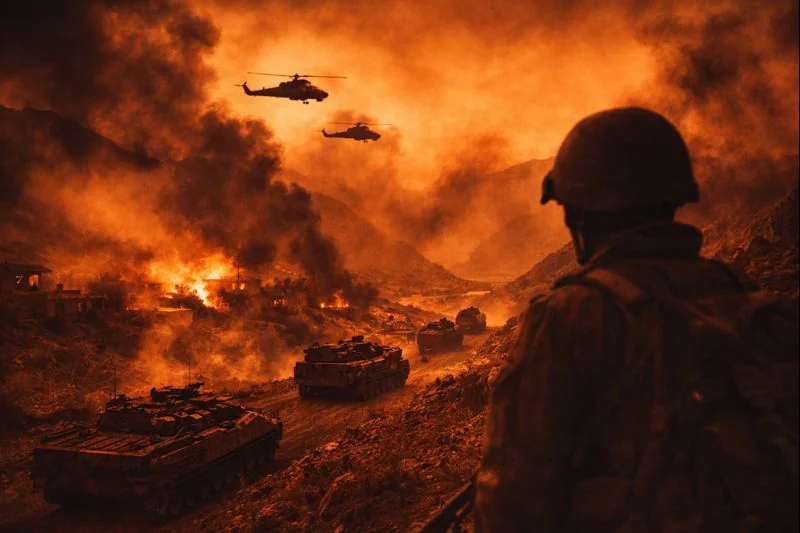
On this day, December 24, 1979, Soviet tanks crossed the Amu Darya River into Afghanistan, in what seemed at the time a limited intervention to protect an ally, but soon turned into a long war that reshaped the maps of the Cold War and the concepts of security, migration and alliances for decades to come.The Soviet invasion came in late December 1979 in support of an Afghan communist government that was facing an armed insurgency, and the Soviet presence lasted until February 1989. But the importance of history lies not only in the beginning, but in the chains of influence the decision created: how a long intervention can open doors for new alignments, produce a war economy, and transform corridors, borders and refugees into fixed elements in international politics.
Afghanistan in the late 1970s was in deep political turmoil after a popular pro-Soviet democratic party came to power. Rapid reforms, repression, and power struggles sparked widespread resistance, and Moscow began to fear the collapse of an ally on its southern border.According to the presentation of the Office of the State Department Historian, the Soviet decision-maker saw that losing Afghanistan would mean that his opponents would come closer to his borders and threaten the Cold War balance in South Asia. Here begins the first chain of effect: the decision to intervene for a long time does not address the internal crisis but rather internationalizes it. Instead of a domestic power struggle, Afghanistan became an arena in which the world watched with the eyes of two camps: Moscow wants to install a friendly government, and Washington wants to prevent the expansion of Soviet influence.
Immediately after entry, the war turned into a war of attrition. Soviet forces had firepower and organizational superiority, but Afghanistan's mountainous nature, the spread of resistance, and the complexity of local society made permanent control almost impossible. Instead of a quick resolution, time dragged on, the human and economic costs rose, and the legitimacy of the government protected by tanks declined. Meanwhile, the United States and regional allies took another course: supporting resistance forces through multiple channels, especially through Pakistan. The US State Department's description of this phase shows how the conflict moved from an internal Soviet decision to a huge international file in which funding, weapons and intelligence are mixed.
The second series was humanitarian par excellence: forced migration as a long political aftermath. UNHCR materials describe that by the end of 1979, Afghanistan had experienced massive displacement: about 400,000 refugees to Pakistan and 200,000 to Iran, and the numbers quickly doubled the following year to reach millions. These figures are not a footnote; they are key to understanding how an entire country becomes a producer of chronic migration.The impact did not end with the Soviet withdrawal, as the collapse of the state and the subsequent multiple wars made the refugees renewed generation after generation. Even in recent statistics, the Migration Policy Institute indicates that there are approximately 6.1 million Afghan refugees around the world, and about 90% of them reside in Iran or Pakistan, with Afghanistan continuing to be a major source of displacement in recent decades.
The third series was geopolitical: the redefinition of security and alliances. The entry of the Soviets led Washington to harden its reading of the region as a strategic node linked to energy, corridors, and borders, and contributed to expanding its military interest in the region. It also led regional states to reposition themselves: Pakistan as a pivotal ally in South Asia, and other parties as supporters, financiers, or intermediaries.Over time, Afghanistan ceased to be a single country's issue and became the intersection of larger conflicts: influence, borders, ideology, and competition over who has the right to define the threat. This is the crux of the question: who defines the threat and who defines the solution? In prolonged interventions, the people are often no longer the sole decision makers, and the country becomes an arena over which endless interests jostle.
In the end, when the Soviets withdrew in 1989, the world was not the same as it was before 1979: the Soviet Union itself was headed for disintegration a few years later, and the United States emerged more confident in the effectiveness of indirect wars, while leaving Afghanistan at the center of a prolonged state fragility.
Comments