First: Introduction
We often wake up to a day that begins before it really begins: a screen where notifications jump, a conversation we check for a response, a mail we update as if searching for a signal. The wait is not a passing event but a pattern: a message, a result, a job, or an event to which we attach a sense of stability. The irony is that our schedule is full, but a subtle sense whispers that what we are living now is just a passage.According to Digital 2025, the average daily online time is 6 hours and 38 minutes, while the typical user spends 2 hours and 21 minutes on communication platforms, which is about 10 minutes less than two years ago.Globally, content consumption on social platforms reaches 15 billion hours per day, equivalent to more than one full day of wakefulness per week for the typical user. In such a climate, modernization is the air we breathe, and "soon" is the language of the day (DataReportal, 2025).
This raises the central question: Why do we live as if real life will start later? How to turn the future into a condition for happiness rather than a planning trend? This paper proposes that the issue is not hope or time management, but the normalization of time: the transformation of time into moments that hang on a future event, and into an economy and culture that profit from keeping people in a state of expectation.We will first deconstruct how time has become conditioned, then how notifications and reading indicators create an economy of anticipation, then analyze the psychological and social cost of this pattern based on data from the World Health Organization, which estimates that 4.4% of the global population has an anxiety disorder and 359 million people suffered from anxiety in 2021 (WHO, 2025a), before proposing a practical deconstruction to break the cycle of waiting.
Second: How did life become a state of perpetual waiting?
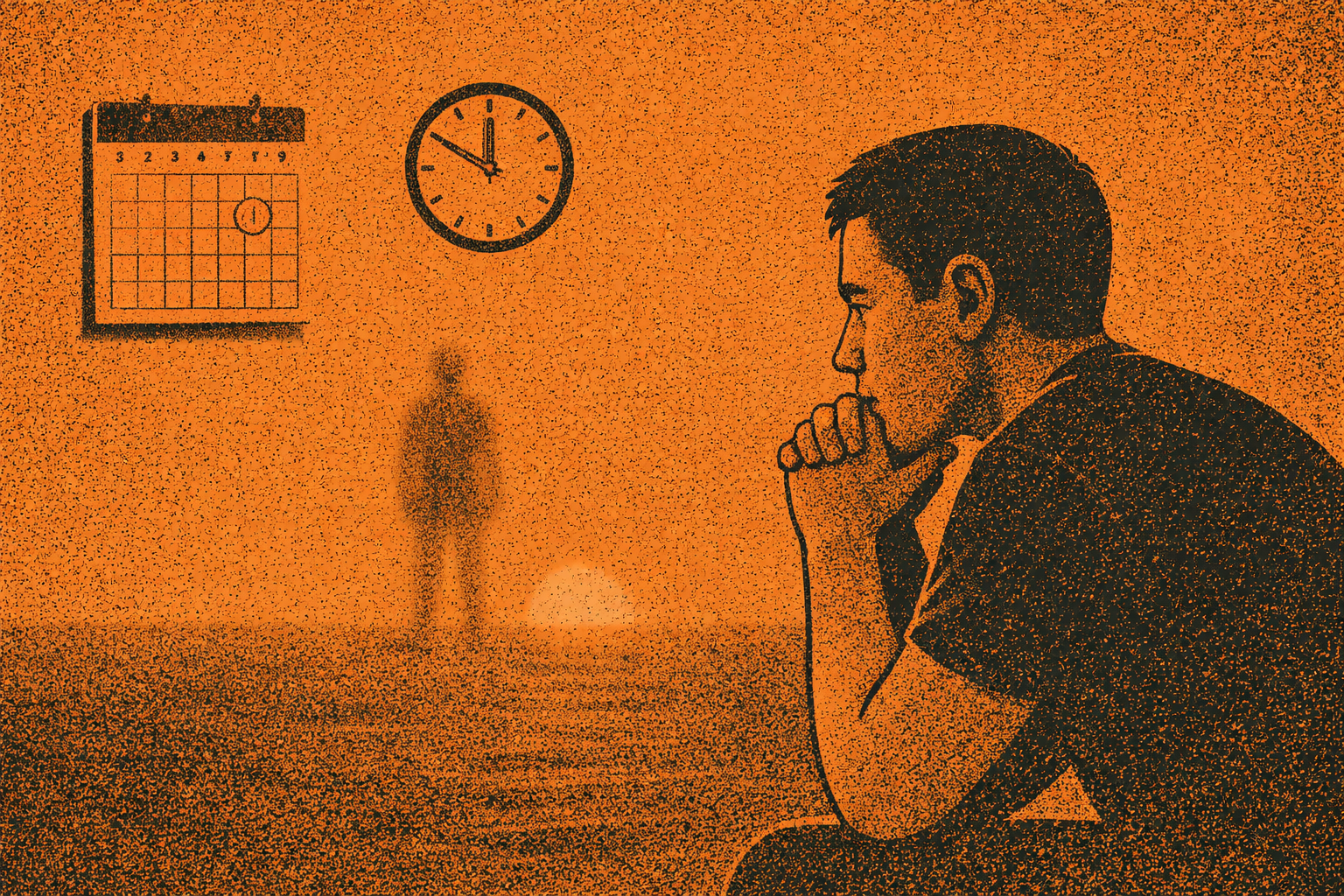
The transformation of waiting into a permanent state begins with the transformation of time itself: from an open time in which we live, to a conditional time in which we attach meaning to an "arrival point." In open time, the path carried value on its own, but conditional time measures the present by its ability to bring us closer to a future event: "after the result," "after the acceptance," "after the response." This shift did not come from a philosophical idea.This shift does not come from an abstract philosophical idea, but from the reshaping of our day on very precise scales: minutes, updates, indicators, and small appointments that impose themselves. When the average online presence becomes 6 hours and 38 minutes per day, the day is fragmented into recurring communication spaces that put the present under constant surveillance (DataReportal, 2025a).A person who spends 2 hours and 21 minutes a day on communication platforms is not only adding a new activity, but a new time pattern based on waiting for a signal from outside, especially when we know that this average, although down by about 10 minutes compared to two years ago, is still equivalent to more than 14 hours per week per person (DataReportal, 2025b).In this sense, the future is no longer a horizon, but an "appointment" that asks us to stay ready, to evaluate now as an incomplete stage, and to postpone the right of satisfaction until a moment of arrival that may change once we reach it. The conditional time does not explicitly say that the present is worthless, but it makes its value borrowed from tomorrow; therefore, the inner void expands even within busy days, because the criterion of satisfaction is not what we do, but what has not yet happened.
If conditional time is the structure, the economy of anticipation in the digital age is its daily engine. Platforms don't just offer content, they offer a small, repetitive promise: maybe there is something new, maybe there is a reply, maybe there is a signal. A notification works not only as news, but as a suspension of the present, because it opens two possibilities at once: reward or disappointment, both of which force a subsequent follow-up.This is why we see the phenomenon of notification fatigue expanding even in news, a field that supposedly "needs" urgency: in a Reuters Institute analysis for its 2025 report, 79% of respondents across 28 countries said they do not receive any news alerts in a typical week, while 43% admitted that they have already disabled them due to overload, uselessness, or emotional exhaustion (Newman, 2025).This may seem like evidence of the declining power of notifications, but it actually reveals a paradox: people flee from notifications because they have experienced their ability to pull consciousness into expectation mode, not because they are freed from the logic of anticipation. Even those who disable news alerts often keep their message alerts and social apps, where the reward is more personal and the wait is more closely tied to identity. Anticipation becomes a buyable commodity: every minute of attention is an economic unit, and every jump to the screen is an advertising, recommendation, or tracking opportunity.
As an indication of the size of this economy, Statista data summarized in the Digital 2026 report suggests that global spending on social media advertising in 2025 could reach around $277 billion, with double-digit annual growth (DataReportal, 2025d).This means that "human suspension" is not a sideshow, but part of a business model: to remain suspended means to remain targetable, and to remain inside the loop that reopens the same question: "Did I get something? Did something change? Am I close?" This is how anticipation turns from a feeling into a market, and from a habit into a structure.
The culture of deferred promise acts as a layer of justification that gives waiting a moral meaning: "Be patient now to live better later." This is where the discourse of success and the discourse of platforms intersect: both ask you to postpone satisfaction, associate happiness with a future event, and accept the present as a price. But the difference between realistic hope and marketing promise is that the former motivates action in the present, while the latter turns the present into a mere launch pad for tomorrow.When we know that the world consumes 15 billion hours a day on social platforms, we understand how the "promised future" becomes packaged and sold: a better experience, a better body, a better opportunity, and an image-filtered life (DataReportal, 2025c).This industry does not need to convince you that your life is bad, it is enough to convince you that your life is not yet complete, and that completion is linked to a step, purchase, approval, or message. In this culture, life stages turn into worthless transit stations, and the question becomes urgent: When did the present stop being a place to live and become a mere corridor to the future ?
This shift takes on added force when we consider the size of the community living within platforms as a space of social time. At the beginning of 2025, Kepios analytics estimated that platform user identities reached 5.24 billion, equivalent to 63.9% of the global population, after a 4.1% increase over 12 months (DataReportal, 2025c). DataReportal updates indicate that the number of user identities reached 5.66 billion in early October 2025, with 259 million new identities in one year, with an annual growth rate of approximately 4.(DataReportal, 2025c). These figures do not only mean that the market is expanding, but that anticipation has become a common language: what we wait for does not happen to us alone, but rather happens in crowded digital corridors where expectations intersect, the value of a small signal (reply, like, view) increases, and happiness becomes more fragile when linked to external indicators that can fluctuate.
Third: The second axis - the suspension of happiness: the psychological and social effects of waiting
When life turns into a series of waiting, happiness itself becomes postponable: we do not rejoice in what is available now, but in what we expect to be realized. This postponed happiness is like a psychological contract that ties calm to an external condition: an acceptance letter, a number on a transcript, or job news. The issue is that the condition is not fixed; as soon as it is realized, another condition is born, because the environment of anticipation teaches us that completeness is temporary, here anxiety creeps in as the permanent background of the suspended life.The latest World Health Organization (WHO) fact sheet estimates that 4.4% of the world's population lives with an anxiety disorder, and 359 million people suffered from anxiety in 2021, making anxiety disorders the most common psychiatric disorder (WHO, 2025a). These figures do not explain all anxiety with digital anticipation, but they help to read the climate: when anxiety is this widespread, the culture of waiting is able to amplify it, because it adds to anxiety a concrete daily material: an open possibility that does not close.
Interestingly, anxiety in anticipation doesn't always manifest as loud symptoms, but often takes the form of low-grade tension: slight constriction, distraction, and a sense that something has to happen for us to settle down. Part of this is because waiting robs people of the right to completeness; even when a response arrives or an outcome is realized, many people are only relieved for a short time and then go back to a new cycle.The phenomenon of alert fatigue provides a standard example of this logic: when 79% say they don't receive news alerts in a typical week, and 43% admit to having disabled them due to overload or emotional exhaustion, the nervous system itself begins to resist (Newman, 2025).But this resistance may be partial: we close one door and leave other doors open, so the state of constant readiness continues. This is why "calm" becomes rare, not only because there are so many events, but because our relationship with time has become one of constant surveillance of what is to come.
Decision paralysis and loss of initiative are the behavioral face of the suspension of happiness. In anticipation, people hesitate to make small decisions, arguing that the picture is not yet complete: "Let me wait for a response," "Let me see the result," "The plan may change." This hesitation seems wise on the surface, but it turns into a pattern that disrupts action in the present.If the average daily connection is 6 hours and 38 minutes, the chances of interruption are much higher than when the signal was less frequent (DataReportal, 2025a). In addition, the attention economy rewards quick response rather than slow thinking, leading us to favor short reactions over long-term decisions. Over time, true deliberation becomes rare: not because we are always in a hurry, but because we are always waiting.
This structure is also reflected in relationships and human presence. When two people live in the same room, but each mentally lives in a different possibility, presence is weakened and misunderstandings abound. Part of this has to do with the emotional energy consumed by anticipation: waiting for a response can mean mood swings, a slight delay can be interpreted as a rejection, and an undecided choice can turn into a perpetual argument.In the background, the World Health Organization (WHO) estimated that in 2025 more than one billion people will be living with mental disorders, warning of the human and economic cost if services are not supported (WHO, 2025b). This big picture helps to understand how a culture of waiting can raise the temperature of relationships: when psychological burden is widespread, everyday friction becomes more sensitive, and relationships become less able to absorb ambiguity.
The cost of waiting also shows up in our relationship with public information, as news exposure itself becomes a source of anticipation and psychological burden. Digital News Report 2025 offers a striking indicator: the global average of those who say they "sometimes or often" avoid news is 40%, with high levels in Bulgaria (63%), Turkey (61%), Croatia (61%), and Greece (60%), and low levels in Taiwan (21%) and Japan (11%) (Newman, 2025).This avoidance does not only mean a loss of interest, but it means that the news itself is seen as something that increases stress and deepens the sense of helplessness, which is consistent with the idea of deferred happiness: when the future is crowded with risks, the present becomes a restless place, and the self looks for exits. But these exits may reproduce the issue in another way: those who avoid the news to avoid expecting the worst may return to other platforms where they personally expect the best, so the logic of suspension continues and only the subject of waiting changes.
Fourth: Breaking the Waiting Cycle: From Awareness to Reclaiming Time
The first step to breaking the cycle of waiting is not a motivational speech or denying the future, but distinguishing between planning and suspending life. Planning is an organizational tool that allows the present to function efficiently, while suspending life turns planning into an excuse to freeze action until an external signal arrives. In a world where humans spend an average of 6 hours and 38 minutes a day online, it becomes easy to confuse the two: we open the phone under the pretext of following up on something urgent, and we fall into an automatically expanding chain of anticipation (DataReportal, 2025a).Therefore, planning can be understood as setting time limits rather than a commitment to wait: instead of checking messages dozens of times, we set two or three fixed windows per day for checking, and allow the rest of the day to be a path rather than a waiting screen. This is not a fantasy; when 43% admit that they deliberately disable news alerts, it shows that setting limits is a realistic option that many people use to protect their attention (Newman, 2025).
When we associate happiness with a future event, we give tomorrow power over how we feel today, and allow any delay or ambiguity to control our mood. But if the typical user spends 2 hours and 21 minutes a day on platforms, which equates to more than one full waking day each week, a large part of our "future" is already being created in an attention-grabbing digital present (DataReportal, 2025).Redefining here means connecting meaning to what we are doing now rather than what we are waiting for: study is a value in itself rather than a bridge, daily work is a life practice rather than a phase, and relationships are a path to be lived rather than a project to be completed. In a world with 5.66 billion user identities on platforms in October 2025, reclaiming the present also becomes a cultural stance: refusing to turn life into a competition for external signals, and recognizing that self-worth should not be measured by volatile indicators.
The third step is to move from awareness to a simple self-measurement that reveals whether you are unknowingly stuck in waiting.A quick diagnostic exercise can be done within a day, it only takes a few minutes, but it requires honesty:Do I associate my daily mood with news that hasn't happened yet? Do I often repeat the phrase "I just need to get through this phase" as a condition for rest? Do I feel that my real life will start later? If your answer is "yes" once, this is closer to a normal waiting associated with a specific circumstance, but if it is "yes" twice or more, this indicates a life suspension that needs a rearrangement of the relationship with time.To empirically validate the finding, observe over a 24-hour period how many times you interrupt the present to examine a possibility: a notification, reading status, or update. Then ask: Does this examination add real knowledge or just anticipation? This is where the example of disabling comes in handy: when 43% disable notifications due to fatigue, they are not averse to knowledge, they just refuse to let it become a burden of constant anticipation (Newman, 2025).
However, breaking the wait cannot be reduced to an individual decision, because the economy of anticipation is built on huge material incentives. When global spending on social platform advertising reaches $277 billion in 2025, it becomes understandable why interfaces are designed to generate repeat returns rather than quiet fulfillment (DataReportal, 2025d). Part of reclaiming time therefore becomes simple reverse engineering of the daily environment: reducing unnecessary notifications, mitigating readiness indicators that turn every conversation into an instant test, and defining screen-free spaces at home and at work.Even news avoidance, which averaged 40% globally in 2025, can be read here as a sign of a collective search for boundaries, not just apathy (Newman, 2025). The practical question that should accompany each adjustment is: "Does this choice bring me back to the present or put me on a new path of anticipation?" The bottom line is that reclaiming time does not require daily heroics, but small, repetitive steps that redefine what is worth paying attention to.
Fifth: Conclusion - Getting Out of the Waiting Station
Getting out of the waiting station does not mean giving up on dreams or planning, but rather rearranging the relationship between the present and the future. Waiting itself is a natural part of life, but the trouble starts when it becomes a way of life: when every day becomes dependent on an external signal, when happiness is always postponed, and when the present is reduced to a worthless corridor.What this paper proposes is to reclaim the present as a space of action and meaning: to plan from within the day rather than from outside it, to redefine the future as a direction rather than a condition, and to test ourselves with a simple exercise that reveals whether we are living in a "just get through this phase" or a real life.Even the news avoidance index, which averages 40% globally in 2025, reminds us that the mind looks for limits when it feels overwhelmed (Newman, 2025). In the end, the existential question returns: What if it is not the thing we are waiting for that will change our lives, but our exit from the waiting itself? Then we may discover that the future does not need to lead us by chains; it is enough to see it and walk towards it, without stopping living in the now.
Comments