Introduction:
In recent years, the world has witnessed an unprecedented rise of artificial intelligence (AI) technologies as "salvation technologies" capable of solving complex problems efficiently and quickly. AI applications are touted as solutions to climate change, smart city management, pollution monitoring, and energy efficiency, with some estimates even suggesting that global emissions could be reduced by 5-10% by 2030 thanks to AI applications (Google, 2023).However, this celebratory rhetoric hides a fundamental paradox: every "immaterial" digital service provided by AI actually relies on a physical infrastructure that is resource-intensive in terms of energy, water, and minerals. The cloud is not an actual cloud in the sky but huge farms of servers that consume huge amounts of electricity and water and require minerals and raw materials to build them.
Recently, the international debate has taken a significant turn after UN reports and specialized press coverage warned of the hidden environmental costs of these technologies. The central research question is: Is AI really a tool for environmental sustainability, or is it a new environmental burden promoted with misleading green rhetoric?
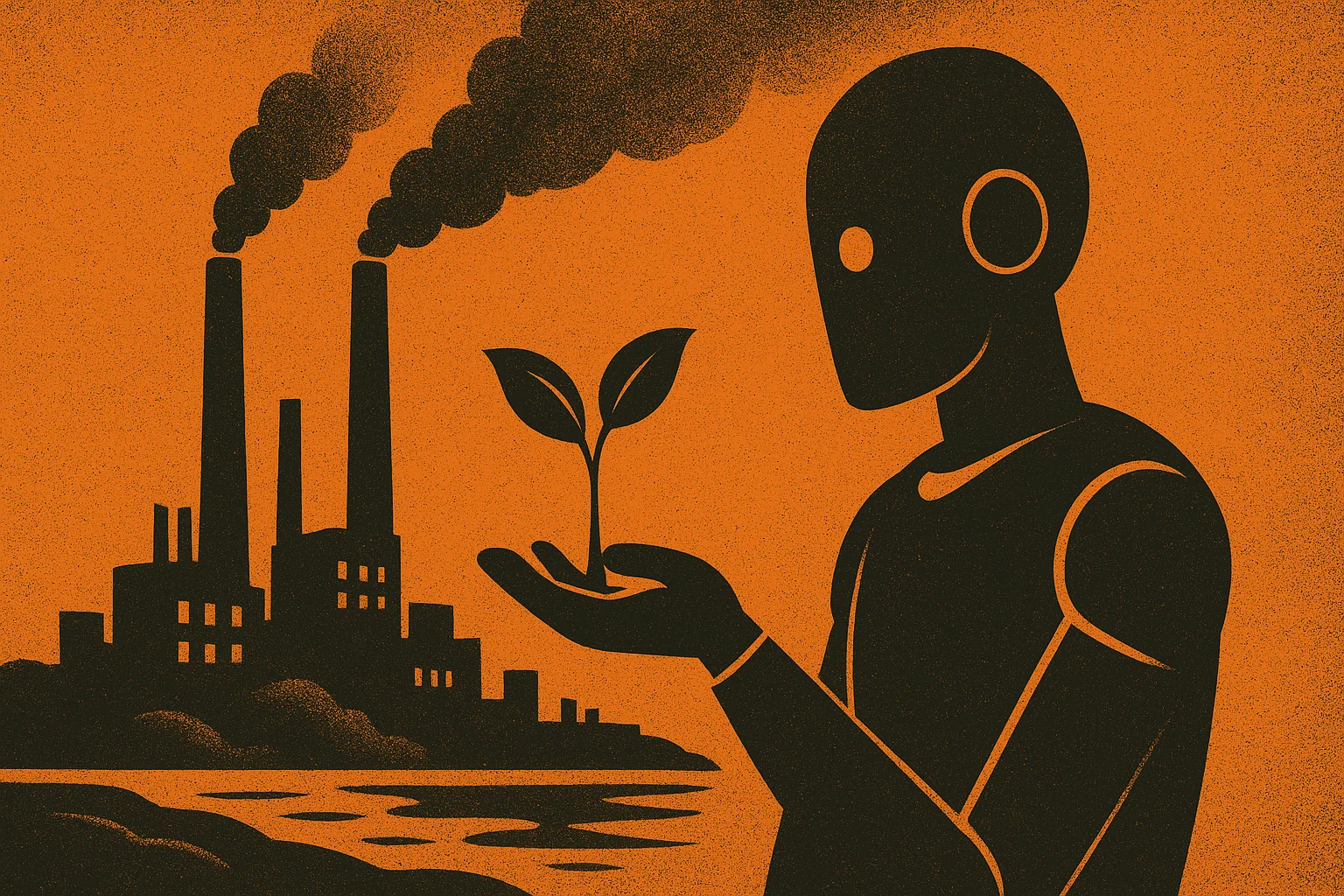
This paper argues that AI is not environmentally neutral. Its carbon and material footprint is large and growing. In the absence of rigorous environmental governance, the AI boom may turn into a digital reproduction of the climate and extraction crises of the last century's industrial economy.
Theme 1: Energy and water consumption - the invisible face of smart infrastructure
Data centers are the invisible backbone of modern AI. These massive warehouses of computer servers run around the clock to process AI's training and runtime algorithms, requiring an enormous supply of electricity.The demand for electricity by these centers has been steadily rising as the use of AI expands. In 2023, the consumption of data centers in the United States was estimated at 176 TWh of electricity, equivalent to the consumption of a country like Ireland, with this figure expected to double or even triple by 2028 (Lincoln Institute of Land Policy, 2023).
Globally, the International Energy Agency has warned that data center consumption could double by 2030 to a level similar to that of Japan today (Climate Change News, 2025). Part of this demand is related to training massive models: it has been estimated that training a superlanguage model like GPT-3 consumed about 1,300 MWh of electricity (equivalent to 130 US homes per year), while training the newer GPT-4 model required about 50 times more energy (Library Journal, 2023).Even the day-to-day use of these models is not insignificant; a user query to an AI service like ChatGPT can consume ten times more electricity than a traditional internet search. In light of this, it is not surprising that the global proliferation of data centers is accelerating to about 8 million in 2022 from only about 500,000 in 2012 (United Nations Environment Programme, 2023).
Most data centers rely on electricity grids that are still a mix of conventional and renewable energy sources. In the United States, for example, they get about 50% of their power from fossil fuel power plants (natural gas and coal) (Lincoln Institute of Land Policy, 2023), and in China they are currently heavily dependent on coal. The International Energy Agency predicts that about half of the increase in data center consumption will be provided by renewable sources by 2030, but the other half will come from gas and coal plants, making these centers a driver of increased emissions until the end of the decade.
This concern is reinforced by the recent spike in tech company emissions. For example, Microsoft's emissions rose by 30% in one year as a result of its heavy investment in developing and running AI models (Jacobin, 2024), despite its pledge to reach carbon neutrality by 2030. This points to the limits of relying on renewable energy alone to meet the massive demand, and the potential for a rebound effect where new uses eat up the efficiency savings.
Water "thirsty" data centers are another invisible face of digital infrastructure. Servers need constant cooling to keep them from overheating and crashing, so heavy water-cooling systems are used.One study shows that by 2030, data centers in the US state of Texas alone could consume 399 billion gallons of water annually-equivalent to draining the largest reservoir in the US (Lake Mead) by more than 16 feet (Lincoln Institute of Land Policy, 2023). A local lawsuit revealed that a single Microsoft data center in Iowa used 6% of the total cooling water in its area during a single month while training the GPT-4 model in 2022 (Library Journal, 2023).
Even at the scale of everyday use, each conversation with an AI model consumes a significant amount of water; a study in 2023 estimated that a 20-question, 20-answer interactive session with a model like ChatGPT consumes about 500 milliliters of water (the size of a water bottle) in the necessary behind-the-scenes cooling.This amount varies by data center location and season of the year, but globally it adds up with all the millions of daily queries. The irony is that about two-thirds of new data centers since 2022 have been built in areas already experiencing high or moderate water stress-including hot and dry areas like Arizona-meaning that "cloud services" are consuming scarce local water resources (Lincoln Institute of Land Policy, 2023).
In addition to the direct water used for cooling, there is an enormous indirect consumption in the water used by traditional power plants (to cool steam turbines) as well as the water needed to manufacture computer chips. The production of each silicon chip requires treatment with ultra-pure water to remove impurities, and a typical chip factory uses about 10 million gallons of water per day to achieve this - the equivalent of 33,000 households consuming water per day (Lincoln Institute of Land Policy, 2023).
Despite these alarming figures, researchers and policymakers struggle to obtain transparent data on the actual energy and water consumption associated with AI. Tech companies are reticent to disclose exact details, perhaps out of commercial competition or fear of backlash. Experts have noted that "the true environmental costs of AI remain closely guarded trade secrets," with companies publishing only sometimes aggregated information in their annual sustainability reports without detailing the impact of AI projects alone.Some tech giants use these reports as a public relations tool, highlighting renewable energy initiatives and carbon offsets, while omitting the full figures of their centers' water and electricity consumption. This lack of transparency makes it difficult for the public and policymakers to hold these companies accountable or objectively assess the "greenness" of their services.
This raises serious questions:Can AI be considered a truly green technology if its infrastructure is based on an energy- and water-intensive, emissions-intensive network? To what extent is the environmental cost being shifted from the end-user who benefits from easy "cloud" services to the local communities that host the server farms and suffer from resource pressures and pollution? An honest answer requires seeing the full picture of this "smart" infrastructure and the environmental burdens hidden behind promises of efficiency and speed.
Theme 2: Rare metals and supply chains-AI as a new extractive economy
Behind the virtual world of AI lies a physical foundation of electronic equipment that requires a wide range of minerals and raw materials. Advanced computer chips and massive servers rely on base metals such as silicon, copper and gold, as well as rare earth elements such as niobium and dysprosium in magnets and gallium and germanium in semiconductors.Uninterruptible power supply batteries for data centers also require lithium, cobalt, and nickel. It is estimated that manufacturing a modern 2-kilogram computer requires about 800 kilograms of raw materials from various minerals (United Nations Environment Programme, 2023), highlighting the enormous material weight behind immaterial digital services.
Mining and prospecting operations often lead to the destruction of natural ecosystems and the clearing of vast tracts of land, as well as the contamination of water and soil through the discharge of toxic waste. For example, the rare earth element mining fever in China-which provides the bulk of these elements globally-has left a toxic legacy of radioactive waste and chemical pollution in major mining areas in Inner Mongolia and Jiangxi provinces (Environmental Health News, 2023).
Similarly, the extraction of lithium-essential for batteries-in South America's salt deserts requires massive amounts of saltwater pumping and evaporation, with nearly 2 million liters of water consumed to produce one ton of lithium via conventional solar evaporation (247Storage Energy, 2023). This process depletes scarce groundwater in desert areas and disrupts local ecosystems (247Storage Energy, 2023).Cobalt mining in the DRC, the main source of global cobalt production, is associated with serious environmental and social issues, including heavy metal contamination of rivers and exposure of workers to toxic substances without adequate protection. The supply chains of these minerals also have a significant carbon footprint, as their transportation and processing require significant energy and result in additional greenhouse gas emissions.
The geographical dimension is particularly important in understanding the mineral economy of AI. Mining and extraction areas are concentrated in countries and regions of the Global South, while the consumption of these resources is concentrated in rich industrialized countries and large technology companies. For example, most of the global wealth of rare earth elements is located in China, which accounts for about 69% of the production of rare earth element ores and more than 85% of global refining capacity (Econofact, 2023), making it the main supplier of rare metals that go into the components of servers and chips.Similarly, the Lithium Triangle countries (Bolivia, Argentina, and Chile) contain more than half of the world's lithium reserves (World Economic Forum, 2023), and the Democratic Republic of Congo produces nearly 70% of all cobalt mined globally (Discovery Alert, 2025), as noted above.
This geographic concentration means that communities in the South bear the brunt of pollution and the consequences of extraction-from the pollution of rivers in Congo to the depletion of groundwater in Chile's deserts-while tech companies in the digital North capitalize on cheap raw materials to build their advanced processors and infrastructure.Mining operations often take place in environments with less stringent regulatory regimes, allowing extracting companies to ignore many environmental or social standards. Human rights reports have reported harsh working conditions in cobalt mines in Africa, including child labor and fatal accidents, and conflicts between companies and local people demanding protection of their land and resources.
This reality raises fundamental questions about the economic model that accompanies the rise of AI. Are we facing a digital extractive economy that revives old patterns of exploitation in a new technological guise? The dominant discourse about the knowledge economy and its positive impact hides a continued reliance on limited physical resources that are extracted in unsustainable ways.In the absence of transparent supply chain traceability, the end consumer remains unaware that their smartphone or cloud service is associated with emissions, pollution, and environmental burdens out of their sight. AI may become a new digital front for an old economic model based on intensive resource extraction, calling for a thorough reassessment of the hidden cost of technology and ensuring that it is not wrapped in the rhetoric of green innovation.
Theme 3: Environmental Governance of AI - Between Late Regulation and Absent Responsibility
Despite the rapid expansion of AI and its escalating environmental costs, the environmental dimension remains largely absent from the regulatory frameworks and legal standards governing these technologies. Most current AI policies and legislation focus on issues of privacy, security, ethics of algorithms and their impact on the labor market, while limited attention has been paid to carbon emissions or resource consumption.Although more than 190 countries have adopted non-binding ethical recommendations on AI within the UNESCO framework, including calls to consider environmental sustainability (United Nations Environment Programme, 2023), these recommendations remain voluntary and have yet to be translated into effective national laws.
At the international level, a symbolic step this year was the adoption by the United Nations Environment Assembly of the first-ever resolution on the impact of AI on the environment. The resolution aims to maximize the benefits of AI for the environment and minimize its risks and tasked the United Nations Environment Programme to prepare a report on the environmental benefits and risks of AI.However, the resolution was watered down after disagreements between countries, as the reference to the need to track the entire life cycle of AI systems - i.e. monitoring their consumption of water, energy and minerals through the supply chain - was removed due to the objection of some oil and mineral producing countries.While experts welcomed this decision as a first step, they warned of blind spots that must be addressed in future rounds of negotiations to achieve comprehensive accountability across the technology lifecycle. Without integrating sustainability criteria into all stages of the AI lifecycle, we risk repeating the patterns of environmental injustice that accompanied previous technological revolutions (Climate Change News, 2025).
The question remains as to whose responsibility it is to reduce AI's environmental footprint. So far, governments have relied heavily on voluntary corporate initiatives; tech companies produce sustainability reports and announce targets of zero carbon emissions and zero waste by 2030-but without rigorous independent oversight, these claims are difficult to verify. On the other hand, some governments are reluctant to impose stringent environmental restrictions for fear of stifling innovation or pushing companies to move their investments to more lenient states.
Policymakers find themselves in a difficult balancing act between attracting high-tech investment and protecting the environment and resources. As for consumers, their awareness of the impact of their daily use of AI-powered apps and services remains limited-no one directly feels the carbon emissions of a simple question posed to a virtual assistant.
The current gap in the governance of AI's environmental impact calls for the creation of new regulatory tools. It may be necessary to develop the concept of environmentally responsible AI by setting indicators and benchmarks for the energy and water footprint of each model and service, and mandatory transparency for companies to disclose this data. Some experts also suggest introducing tools such as a digital carbon tax or caps on resource consumption in large data centers (Frontiers in Sustainability, 2024).Energy efficiency and recycling requirements could also be incorporated into the operating licenses of AI systems. The goal is to ensure that the next technological revolution does not come at the expense of the environment. If heavy industry has been subject to strict standards for decades to reduce pollution and protect air and water, it is time for the digital economy to be subject to similar principles of sustainability and environmental accountability.
Conclusion: Towards cost-conscious AI
We have seen that the operation of AI relies on infrastructure that consumes huge amounts of electricity and water, creates emissions and pollutants, and relies on mineral resources that are extracted from the ground at a high environmental and social cost.While the adoption of AI is accelerating globally, environmental regulation is lagging behind, leaving the door open to reproducing climate change and the over-extraction model but in a digitalized form.
If we continue to celebrate AI as a silver bullet without subjecting it to environmental accountability, we risk creating a hidden crisis in which the environmental cost shifts from factories and mines to data centers and algorithms. The big question is: are we really facing a green tech revolution, or are we just witnessing a hidden transfer of environmental cost from the factory to the algorithm? The answer to this question calls for a radical rethinking of the approach to AI development.The point is not to call for slowing down the progress of this groundbreaking technology, but to emphasize the need to subject it to the principles of sustainability and environmental justice. This requires policymakers and companies to take a proactive approach - through international cooperation and good governance - to establish binding standards to ensure that smart technologies are truly in the service of sustainability, not a new burden on it.
Comments