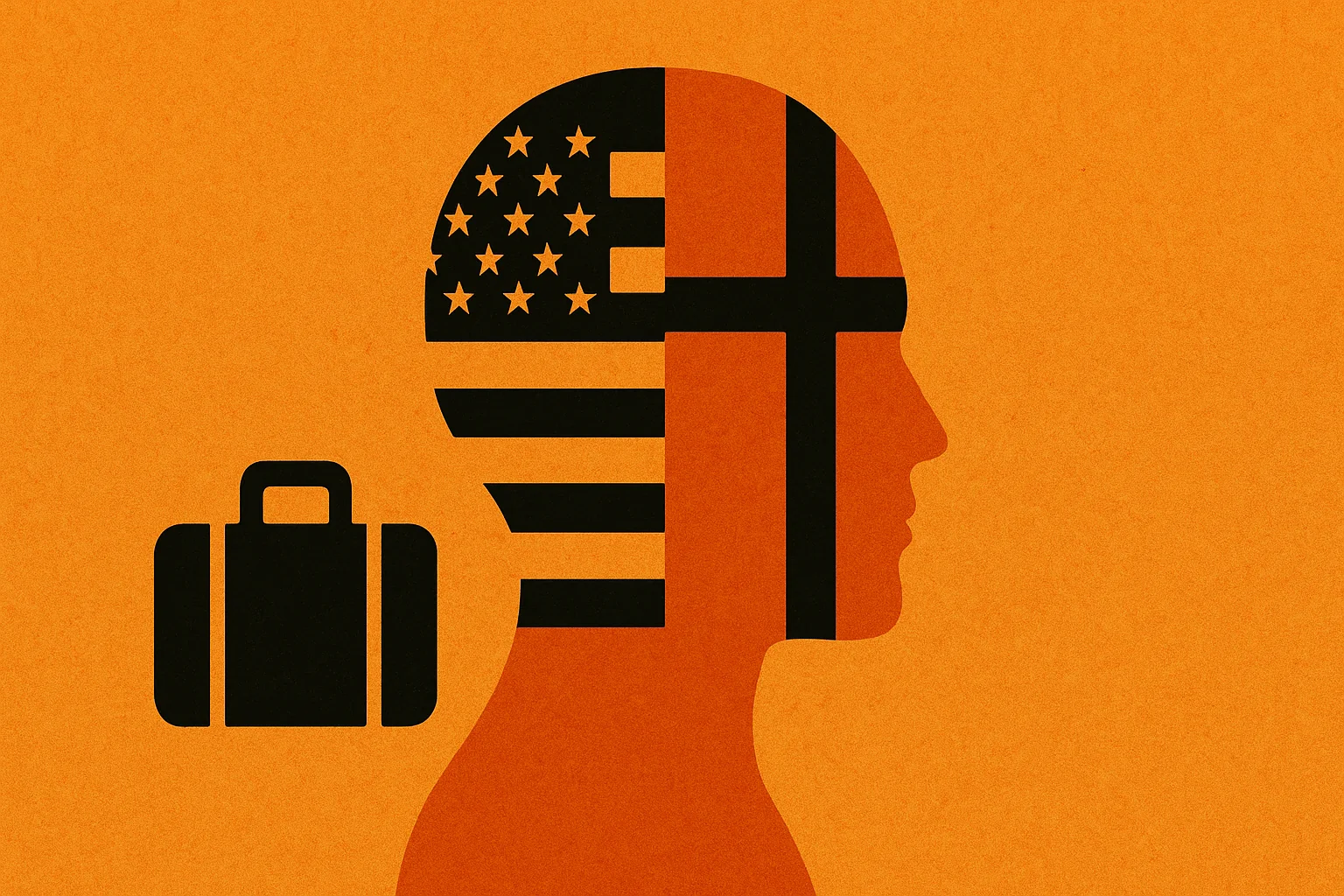
According to recent UN reports, the number of international migrants has reached about 280 million people (2020). The concept of hybrid identity arises in the face of the migrant/Arab living in a multicultural world, where linguistic, national, and value references are intertwined.Stuart Hall (1996) points out that identity is not static, but an evolving process of representation that negotiates daily between the "self" and the "other." When an individual lives between two cultures, he is forced to reconcile his original cultural heritage with the requirements of the new identity, leading to the creation of a hybrid identity. This theoretical framework shows that a person between two cultures experiences a deep internal conflict between his roots and the reality of alienation, and a dual connotation of belonging and feeling lost emerges at the same time.
First: Between belonging and loss
When living between two cultures, the individual moves in a third symbolic space that does not fully belong to the origin or the host. Edward Said describes this as "internal exile", where the immigrant feels alienated from his original homeland without fully belonging to the new society (Said, 1993).The loss of social support networks and familiar habits leads to a deep sense of not belonging, accompanied by depression and existential anxiety. At the same time, collective memory plays a central role in instilling lasting nostalgia; migrants carry with them the smell of food or a melody from their childhood as a cultural symbol of a virtual homeland (Cohen, 1997).
Field studies indicate that about 68% of immigrants suffer from an internal conflict between nostalgia for the past and trying to integrate into the host society (Abouel Fotouh, 2015). This conflict generates for some a sense of a dual place to which they partially belong, while others feel the rupture of identity between two environments.While some second-generation immigrants consider themselves "Arab-Canadian" or "Arab-American," reflecting a constructive cultural integration, others may feel completely unaffiliated with either. This dual status allows the individual flexibility in navigating between the two identities, but at the same time poses psychological and ideological challenges around the contradictory "I" (Mubarak, 2020).
On the other hand, integration policies and the degree of societal acceptance play an important role in determining whether this ambivalence will contribute to a sense of binaries or create a common space for identity. A migrant with diverse institutional and media support finds more opportunities to embrace a "global ego" without abandoning the "home ego," while legal instability and discrimination weaken the sense of belonging to either world.For example, a European study showed that Syrians who considered their identity as "host country identity"-that is, having a strong sense of psychosocial belonging to Turkey-succeeded in their own businesses and performed better financially (Al Jazeera, 2017). Conversely, when legal protection is delayed or discrimination persists, the degree of national belonging is cumulatively weakened even after legal status is achieved (Al Jazeera, 2017).
Second: Hybrid Identity: Resilience or Rupture?
The answer to this question is complex. Hybrid identity can be seen as a resilience strength in the lives of migrants, and at the same time as a heavy psychological burden. From the perspective of advantage, hybrid identity provides flexibility and adaptability in multicultural environments; the person expands their social networks, is exposed to multiple values, and becomes a cultural mediator between two groups. Research experiments confirm that biculturalism leads to greater creativity and professional success.For example, Grogan (2013) found that people with dual cultural identities created more ideas and excelled in projects than others. The researchers explained this by their increased "integrative complexity" - the ability to combine multiple perspectives - which makes them creative problem solvers and increases their chances of career success. Cultural hybridity also contributes to the development of mental skills such as cognitive diversity and tolerance for ambiguous information, which has a positive impact on personal and professional performance (Williams, 2012).
However, living between two worlds presents a notable psychological challenge. Studies highlight the emotional costs of a migrant living a "double life". Some experts warn that the generation of a "false hybrid identity" can lead to psychological distress if the individual cannot reconcile it with the reality of the host society (Sodiman, 2021).Psychiatrist Merten Südemann (2021) describes this condition as "stressful" because it turns an individual's life into a difficult equation between their original and integration identities. According to this view, the immigrant lives in a state of constant adaptation between two cultures, which may drain their mental and emotional energy and increase the risk of frustration and depression.This burden increases if the migrant feels that the host society does not fully welcome them, or if they have to ignore an aspect of their identity to avoid discrimination, which increases their sense of internalized division.
In general, hybrid identity is a double-edged sword: on the one hand, it offers flexibility and creativity and enables a person to adapt effectively in two environments, and on the other hand, it can cause psychological stress and a greater need to reconcile conflicting values.Therefore, research findings emphasize that surrounding factors - such as positive integration policies, social support and diverse media - play a crucial role in transforming hybrid identity from a burden to an advantage (United Nations, 2020; Al Jazeera, 2017). When host societies accept and support dual identity, the individual can retain their roots and absorb the global aspect more smoothly, thus feeling the strength of their cultural resilience instead of feeling torn apart.
Third: Youth and Multiple Identity: Between the Arab and the Global
Modern technology and social media have removed geographical and cultural boundaries. Field studies indicate that more than 68% of Egyptian and Gulf university students use communication platforms for more than 60 hours per week (Al Jazeera Mubasher, 2018). These platforms are no longer just a means of entertainment; they have become a major force of influence that shapes public taste, success values, and role models. As a result, many young people have formed a new identity without clear roots, which they rely on adopting away from family or school supervision.
This reality creates a clash between the traditional "Arab I" that belongs to the family, tribe, and local values, and the "global I" that seeps through the phone screen and reflects multiple cultures and visions.Young people today sometimes live with two contradictory identities: a disciplined outward identity in front of their families and communities, and a more liberal digital identity that they adopt behind pseudonyms (Al Jazeera Mubasher, 2018). This duality places an entire generation between two worlds, which may weaken the sense of national belonging and fuel dreams of migration and alienation towards what is believed to be the "better West" (Al Jazeera Mubasher, 2018).However, the positive side of this phenomenon is that youth are developing their ability to innovate and adapt through digital hybrid spaces. As a recent study found, youth identity is characterized by dialectic and fluidity; it is formed from a dynamic negotiation between global trends and local cultural references. Social media acts as experimental spaces for their identities, enabling them to blend their languages and customs with new global values (Al-Ain Al-Jami, 2020).
Today's generation deals with the "Arab" and the "global" by seeking a balance between authenticity and openness. Some young people use digital platforms to spread their local culture in attractive ways, while others adopt global practices without completely abandoning their original identity.In conclusion, the identity crisis does not lie in the openness of youth to the world, but in the lack of a local cultural project that embodies this openness in a balanced way (Al Jazeera Mubasher, 2018). If society succeeds in investing technology in favor of local identity (such as producing original and engaging digital content), digital globalization can become an opportunity to renew identity rather than obliterate it.
Conclusion:
Hybrid identity is an inevitable product of globalization and intensive human mobility. A person living between multiple cultural references will experience a dual sense of belonging and alienation at the same time. This cross-cultural reconciliation can be an element of strength and resilience that promotes creativity and personal success, as well as a psychological burden that imposes additional stress on the individual.Addressing this phenomenon requires societal and political recognition to support multiple identities - such as through positive integration policies, cultural dialogue, and multicultural education - so that Arab migrants and youth maintain their connection to their local heritage while capitalizing on global networks. By harnessing this balance between the "Arab ego" and the "global ego," hybrid identity can transform from a source of disruption to a bridge that enriches the human experience and helps individuals build integrated and creative identities.
Watch the video for more
Comments