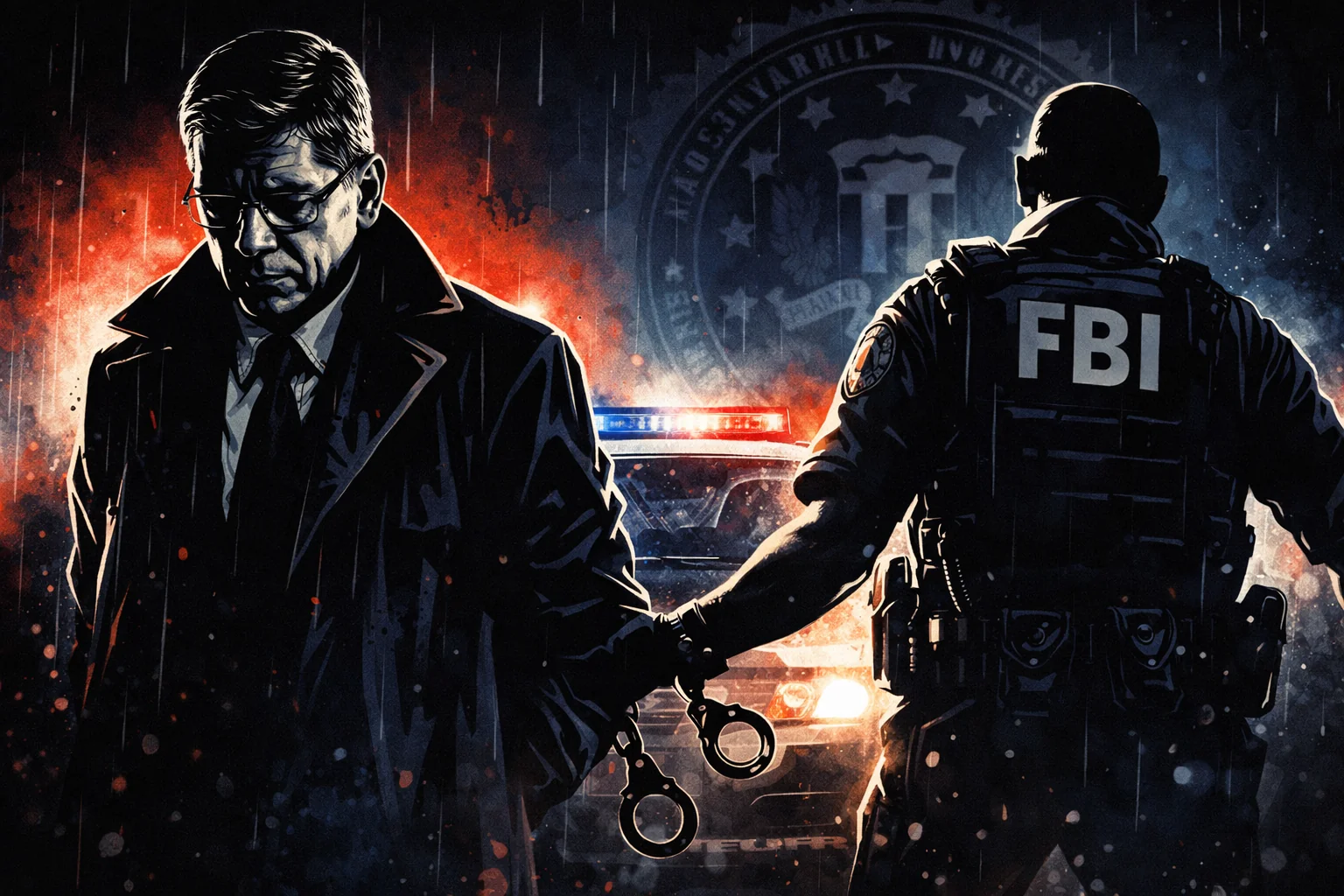
On February 18, 2001, the event was not just the arrest of a government employee, but a moment of existential trauma for an institution that considered itself a symbol of security and discipline. When the FBI arrested one of its veteran agents, Robert Hanssen, it was not arresting an ordinary spy, but facing a more disturbing reality: the most serious threat was not outside the system, but inside it. A man who had spent more than two decades protecting the state was at the same time silently working to undermine it. This paradox reveals a deeper truth about the nature of institutions, trust, and betrayal.
What makes Hanssen's case exceptional is not just the amount of damage he caused, but the way he managed to go undetected for 20 years. Hanssen was not a marginal or isolated figure. He was part of the organization, understood its mechanisms, knew its strengths and weaknesses, and moved within it with confidence. This knowledge was not just an advantage, it was his main weapon. An external spy needs to penetrate the system, but an internal spy is the system itself. He does not need to break doors, because he already has the keys.
Robert Hanssen was a spy for the KGB, and later for the SVR after the collapse of the Soviet Union. His espionage activity began in 1979 and continued on and off until his arrest in 2001. During this time, he turned over thousands of top-secret documents, including the names of undercover American agents working inside the Soviet Union, nuclear defense plans, and sensitive surveillance strategies.Some of these agents whose identities Hanssen revealed were arrested, and some are believed to have been executed as a result. In exchange for this information, Hanssen received more than $1.4 million in cash, as well as jewelry and money deposited in secret accounts. However, he never met his operators face-to-face and instead used the "dead drop" method, leaving information in specific locations to be collected later, thus reducing the likelihood of detection.
This case reveals a fundamental truth: organizations are built as much on trust as they are on control. But this trust, which makes work possible, can be turned into a weakness. Organizations, by their very nature, cannot suspect everyone all the time. There is an implicit assumption that those who belong to the system are part of it, not a threat to it. Hansen exploited this assumption. He did not have to hide, he just had to appear normal. He did his job, followed the rules, and maintained the image of the perfect employee. This "normalcy" was the best possible cover.
Organizations are designed to detect external threats: intruders, attacks, breaches. But an internal threat doesn't leave the same signals. It moves within permissible boundaries. Hansen didn't need to bypass the system, he worked within it. Every move he made was, on the surface, part of his job. This ability to hide within the "normal" is what makes internal betrayal so difficult to detect.
Although he went undetected for decades, Hanssen's demise was the result of a critical shift in U.S. intelligence work. In the late 1990s, suspicions of an insider began to grow. The CIA was able to obtain a classified file from a former Russian source, in exchange for a large sum of money, containing information suggesting the existence of an agent within the FBI.This file did not explicitly mention the name, but it contained enough details, including an audio recording and letters, that allowed investigators to gradually identify Hanssen. The FBI then placed Hanssen under close surveillance, and an agent was assigned to secretly monitor him. On February 18, 2001, he was caught leaving a secret package in a dead spot in a park in Virginia, the same method he had used for years to transfer classified information. This moment was not just an arrest, but an unraveling of two decades of silence.
There is a belief that complex systems, with their rules and procedures, can prevent hacking. But Hanssen showed that complexity does not prevent betrayal, it can hide it. The more complex a system is, the more space there is for deviations to hide. Complexity creates noise, and within that noise signals can go unnoticed.
The answer lies in the nature of organizational cognition. Organizations tend to see what they expect to see. When someone is part of the system for a long time, they become part of the "normal landscape." They are no longer seen as a variable, but as a constant. This cognitive shift reduces the likelihood of doubt. Over time, trust shifts from a conscious state to an automatic one.
In the end, Robert Hansen's story reveals that the greatest danger is not always the one who stands outside the walls, but the one who sits quietly inside them. The most effective betrayal is not the one that breaks down doors, but the one that passes through them without attracting any attention. Perhaps the most disturbing lesson is that the most dangerous spy is not the one who manages to enter the system, but the one who has always been part of it.
Comments