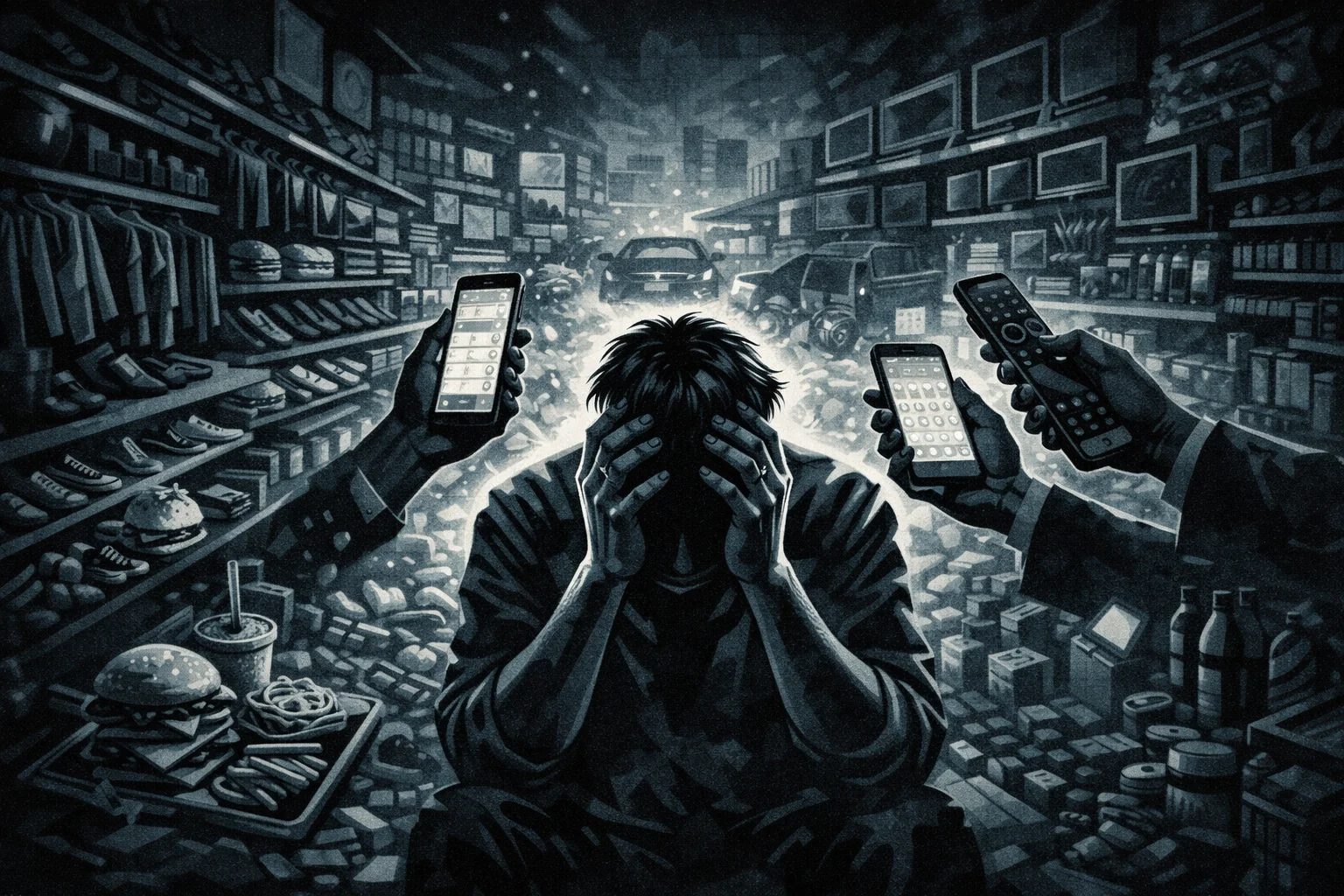
In recent decades, the concept of modern freedom has been associated with the idea of an abundance of choice. Contemporary societies have offered people what was not available at any previous point in history: Hundreds of television channels, thousands of majors, millions of products in digital markets, and countless choices in food, work, and relationships. In theory, this abundance should lead to greater satisfaction and happiness, because people can choose more precisely what suits them. However, modern psychology poses an interesting counter-question: What if too much choice is itself a source of stress and dissatisfaction?
One of the most influential concepts in this field is the so-called Paradox of Choice, a concept associated with the work of American psychologist Barry Schwartz. The basic idea is that increasing choices up to a certain point promotes freedom, but when they exceed a certain level they turn into a psychological burden. Instead of being relieved to have so many options, people start to feel anxious about making the wrong choice, or fearful of missing out on the best option. Freedom becomes a constant state of comparison and indecision.
This analysis is not just a philosophical idea, but has been supported by a number of psychological studies. One of the most famous is an experiment conducted by researcher Sheena Iyengar with psychologist Mark Lepper at Columbia University. In this study, the researchers showed shoppers in a food store two types of displays: Once they were shown 24 types of jam, and another time only 6 types. The result was surprising: Although the large display attracted more attention, people who were faced with fewer options were more likely to buy. This finding supported the idea that too many choices can lead to decision paralysis, sometimes called choice overload.
To understand this phenomenon, consider contemporary daily life. In the past, choosing a college major, a job, or even a type of food was limited in scope. Today, a student may face dozens of majors and hundreds of career paths, while a consumer browses thousands of products on a single online store. This expansion of options does not necessarily mean greater clarity, but may lead to increased mental effort required for comparison and analysis.
From a cognitive psychology perspective, this is related to the concept of Decision Fatigue. The human brain has a limited capacity to process information and make decisions throughout the day. As the number of options increases, the brain is forced to consume more mental energy, leading to fatigue. Studies in consumer behavior have shown that when faced with too many choices, people may take simple mental shortcuts or avoid the decision altogether.
But the issue doesn't stop with the difficulty of making a decision. Even after the decision is made, another issue arises: Potential regret. When we only have two options, the likelihood of thinking about what would have happened if I had chosen the other option is limited. But when we have dozens of options, the mind keeps comparing the decision made to the options that weren't chosen. This is what psychologists call Opportunity Cost. Too many alternatives make people more likely to feel like they may not have made the best choice.
Modern digital culture amplifies this issue. Social media and digital platforms constantly showcase other people's lives, choices and experiences. A personal decision becomes part of a constant web of social comparisons. Choosing a major, a job, or even a travel destination is no longer a personal decision, but a constant comparison to what others are doing.
However, this is not to say that an abundance of choice is a bad thing. Many economists and sociologists point out that ample choice is the foundation of individual freedom in modern societies. The issue is not the existence of choices, but the way they are organized and presented. When options are clearly organized and categorized, decision-making becomes much easier. This is why many digital companies rely on recommendation algorithms, which minimize the number of options presented and make specific suggestions to the user.
In fact, recent research suggests that the solution is not to reduce options entirely, but to design better decision environments. For example, so-called Behavioral Design can be used to organize options in a way that helps people make better decisions without feeling pressured. Examples include ranking the most popular products first, or offering recommended default options.
On a deeper level, the phenomenon of choice fatigue may reveal something about human nature itself. Humans did not evolve in an environment full of unlimited options. Throughout most of human history, choices have been limited by resources and social conditions. So the human brain may be more comfortable operating within a reasonable range of alternatives, rather than facing an open sea of possibilities.
In the end, too many choices cannot be said to be an absolute evil or an absolute good. But it does present modern man with a new paradox: We live in an age of unprecedented freedom of choice, but this same freedom can turn into a psychological burden if it exceeds the mind's ability to handle it. Perhaps the most important question today is not how many choices we have, but how to choose between them without losing our psychological comfort.
Thus, the abundance of choices, once seen as a sign of progress and well-being, has also become the subject of a deep scientific debate about the limits of human freedom. Between freedom and pressure, between possibilities and potential regrets, modern man stands at a new crossroads: A world where almost everything is available... but which asks us to constantly decide what we really want.
Comments