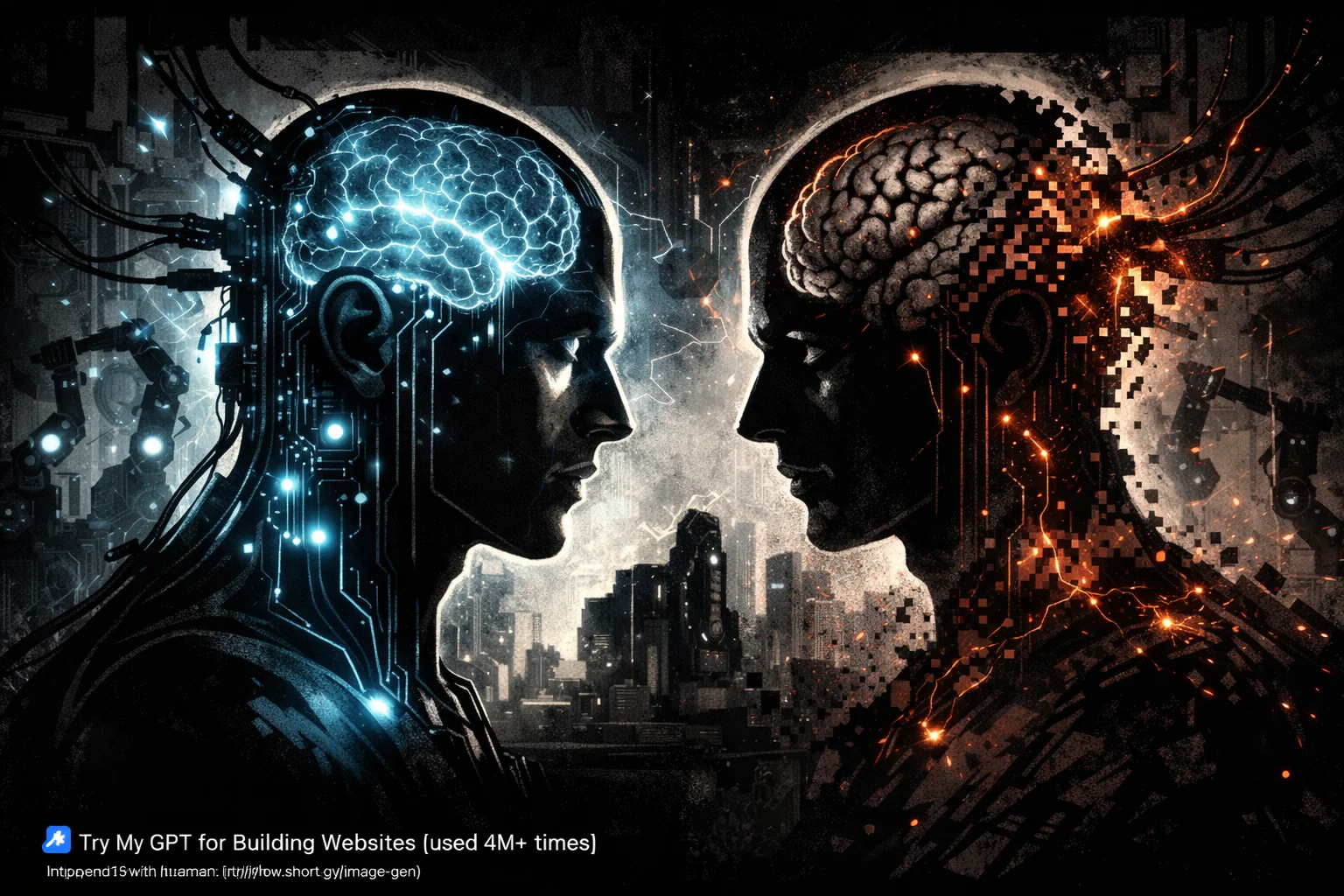
In recent decades, the world has witnessed an unprecedented surge in the development of artificial intelligence (AI) and its applications in various aspects of life, as it has become an essential part of education, work, health and daily decision-making. AI is often presented as a tool that can boost efficiency, accelerate learning and improve human productivity, allowing quick access to information, providing accurate analytics and helping solve complex issues in ways that were previously not possible.
On the positive side, AI provides powerful educational tools that can improve the quality of learning and accelerate knowledge acquisition. For example, AI-powered education systems allow for the delivery of personalized learning content to each student, helping to address their weaknesses and enhance their strengths in a more efficient manner than traditional education (Holmes et al., 2019).A study at Harvard University found that students who used a robot tutor were able to learn twice as much material in less time than students who learned in the traditional way, provided that the student remains active in the thinking process and does not rely on technology passively (Kulik & Fletcher, 2016).An educational experiment in Nigeria showed that students who used AI under intensive pedagogical supervision were able to achieve learning outcomes equivalent to a year and a half of traditional learning in just six weeks (World Bank, 2021). These results clearly indicate that AI can serve as a tool to enhance human intelligence, by accelerating learning and providing continuous cognitive support that helps students understand the material more deeply and efficiently.
However, scientific evidence suggests that AI may also be counterproductive if used in an uninformed manner. A 2023 MIT study showed that participants who used ChatGPT to write essays showed the lowest level of brain activity compared to those who wrote using a traditional search engine or without digital assistance (MIT Media Lab, 2023).The researchers also observed that ChatGPT users became more dependent on the tool over time, copying answers directly without trying to think about them, and when they were later asked to rewrite their essays without the help of AI, they had difficulty remembering what they had previously written, and showed impairment in neural markers associated with deep memory (Kosmyna et al., 2023).These findings emphasize that real learning requires active mental effort, and that over-reliance on AI may lead to superficial understanding and poor consolidation of information, which is consistent with the "productive struggle" theory that emphasizes that effective learning depends on the mental effort exerted during thinking (Bjork & Bjork, 2011).
A 2023 OECD report showed that 42% of secondary school students rely almost entirely on AI tools to complete their assignments, without attempting to understand the content or verify its accuracy. Another report indicated that 18% of college students in the United States admitted to using AI to prepare their final papers (Pew Research Center, 2023). These figures indicate a serious shift in learning behavior, where students get the answers easily without developing the critical thinking skills needed to analyze and understand the information.Professor John Crawford of Oxford University has warned that we may be entering a phase where "AI learns instead of the student", where the student becomes a passive recipient of information rather than an active participant in the learning process (Crawford, 2021).Field studies in schools in Riyadh and Abu Dhabi have also shown that students' ability for personal written expression has declined, and they have become more dependent on texts generated by AI tools, resulting in less creativity and originality of thought (UNESCO, 2023; Dwivedi et al., 2023).).
Despite these risks, the impact of AI is not inherently negative, but depends mainly on how it is used. In a study conducted in Turkey, students who used AI without pedagogical guidance performed 17% worse than those who did not, while another experiment at Harvard University showed that using a pedagogically designed intelligent learning assistant doubled the speed of learning and improved academic results (OECD, 2023; Kulik & Fletcher, 2016).This shows that AI can be a powerful tool for enhancing learning if it is used to support rather than replace thinking, and that the issue is not the technology itself, but the way it is used.
The impact of AI extends to the field of decision-making, where it is widely used in the financial, medical, and technology sectors to analyze data and make recommendations (Topol, 2019). In the medical field, for example, AI has helped improve the accuracy of diagnosing diseases by analyzing medical images and detecting patterns that humans may not be able to easily notice.Financial institutions also use AI to analyze risks and predict economic trends, helping to make more accurate decisions (Brynjolfsson & McAfee, 2017). On a personal level, navigation apps like Google Maps use advanced algorithms to analyze traffic and suggest the best routes, helping users make faster and more efficient decisions (Dwivedi et al., 2023), and on a more personal level, navigation apps like Google Maps use advanced algorithms to analyze traffic and suggest the best routes, helping users make faster and more efficient decisions (Dwivedi et al., 2023).).
A study conducted by Microsoft in collaboration with Carnegie Mellon University on 319 employees showed that increased reliance on AI tools was associated with decreased critical thinking and autonomy, as employees became less inclined to review results or consider alternatives (Microsoft & Carnegie Mellon University, 2025).Studies in the medical field have also shown that some doctors who relied excessively on AI systems became less able to diagnose cases themselves, indicating the risk of erosion of professional skills as a result of over-reliance on technology (Topol, 2019; Chow, 2023). This phenomenon is also seen in everyday life, as social media algorithms rely on analyzing user behavior to deliver personalized content, which may reduce cognitive diversity and promote reliance on ready-made information rather than independent research (Firth et al., 2019).).
AI is not an inherently positive or negative force, but rather a tool whose results depend on how it is used. It can enhance human intelligence by accelerating learning and improving decision-making, but may lead to cognitive laziness if used as a complete replacement for human thinking (Saavedra et al., 2025). The balanced use of AI, so that it acts as an assistant that supports human thinking rather than replacing it, represents the best solution to maximize the benefits of this technology while preserving human cognitive capabilities (Saavedra et al., 2025).
In conclusion, AI represents a radical shift in the way humans think, learn, and make decisions. It gives us unprecedented abilities to analyze information and learn quickly, but at the same time it carries the risk of reducing mental effort if used excessively. AI is like a powerful tool that can enhance or weaken our abilities, depending on how it is used.If it is used to support thinking and creativity, it can make us smarter and more productive, but if it is used as a complete replacement for thinking, it can lead to a decline in basic cognitive skills. Therefore, the real challenge is not whether AI exists, but how to use it in a way that ensures humans remain at the center of the thinking and decision-making process, so that AI becomes a tool to enhance human intelligence, not a replacement for it (Ranganathan & Ye, 2026).
Comments