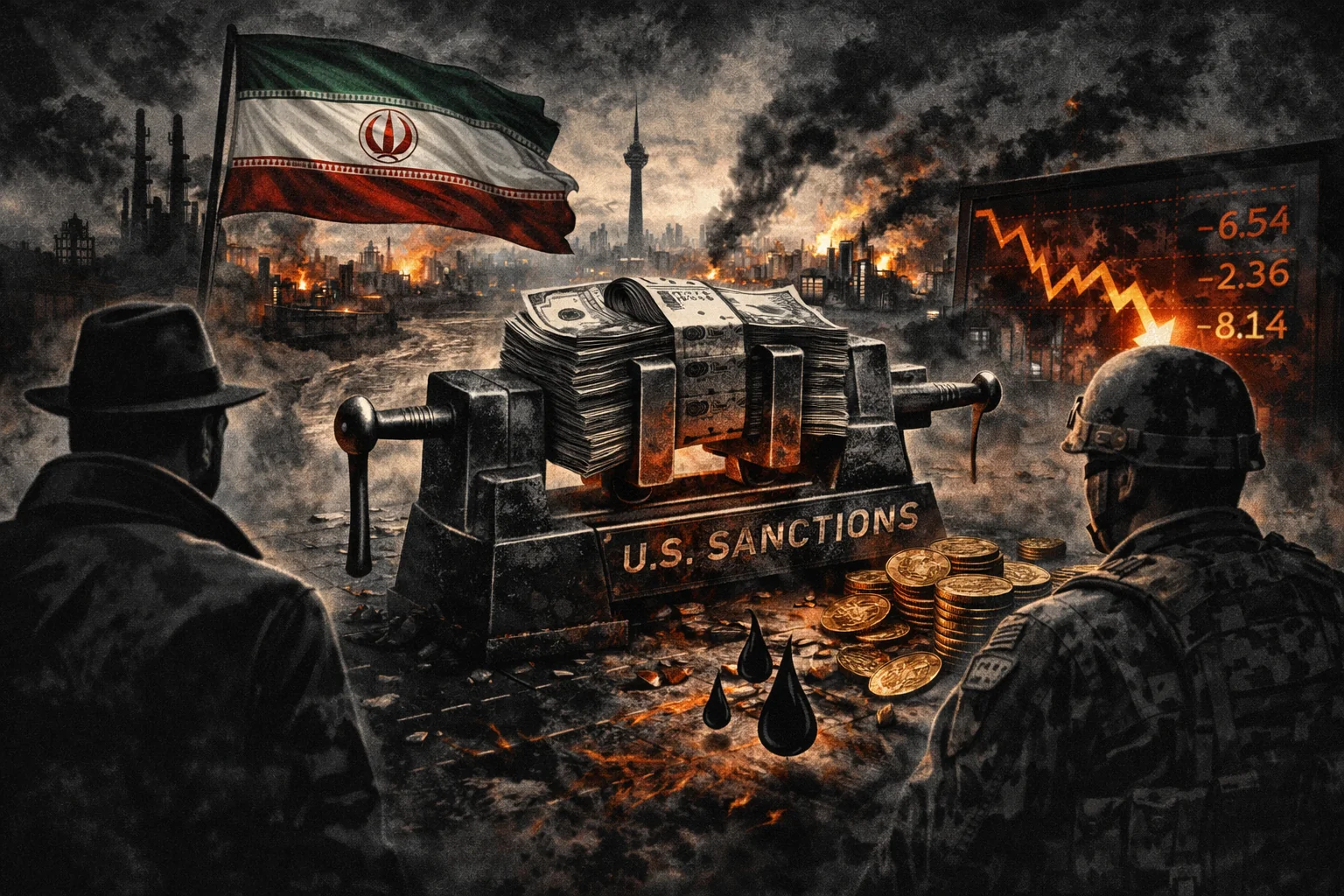
US economic sanctions on Iran began in 1979 in response to the hostage crisis at the US embassy in Tehran, and have since escalated over successive decades to include multiple aspects of Iran's economy. In November 1979, President Jimmy Carter's administration imposed the first sanctions by banning Iranian oil imports and freezing Iranian assets in the United States. The frozen funds were estimated at $8 billion at the time, in response to the holding of 52 American diplomats hostage for 444 days. Some of those sanctions were lifted after the hostages were released in 1981 under the Algiers Agreement, but Washington soon returned to the sanctions approach. In 1984, the State Department listed Iran as a state sponsor of terrorism, leading to additional sweeping restrictions. In 1987, Ronald Reagan's administration reactivated trade sanctions because of Iran's continued support for what the United States considered terrorist activities and attacks on ships in the Gulf (Wikipedia, 2026a).
During the 1990s, the United States tightened the economic stranglehold on Iran even further. In 1992, Congress passed a law prohibiting the transfer of military-use technologies to both Iran and Iraq, followed in 1995 by President Bill Clinton's executive order imposing a comprehensive trade embargo on Iran, prohibiting American companies from investing in or trading with Iran (Council on Foreign Relations, 2023). This was followed by the Iran-Libya Sanctions Act of 1996 (ILSA), which unprecedentedly targeted foreign actors through so-called secondary sanctions, threatening to penalize any non-US companies investing more than $20 million annually in Iran's oil and gas sector (Sen, 2018). Although Washington's European allies objected to the law and its implementation was delayed, the principle of pursuing foreign investment in Iran took hold. At the same time, successive U.S. administrations continued to add new sanctions related to Iran's accusations of supporting designated terrorist groups and developing its missile program.
Entering the new millennium, the international focus on Iran's nuclear program intensified, leading to new rounds of tougher sanctions. Beginning in 2006, the UN Security Council passed punitive resolutions against Tehran for failing to comply with demands to halt uranium enrichment. The United States backed these efforts with additional sanctions that targeted Iran's oil and gas sector, banned the export of sensitive technologies, and prohibited transactions with the Central Bank of Iran, isolating Iran financially from the global banking system. By 2012, European and Asian countries joined the pressure campaign. European countries stopped importing Iranian oil and Asian countries such as Japan and South Korea reduced their imports in compliance with secondary US sanctions. This escalation put Iran's economy under stifling pressure and paved the way for a change in Tehran's negotiating calculus.
After years of procrastination, Iran finally came to the negotiating table on its nuclear issue. After intensive diplomatic rounds, Tehran and the P5+1 reached a nuclear agreement (the Joint Comprehensive Plan of Action (JCPOA)) in July 2015. Under the JCPOA, Iran pledged to significantly restrict its nuclear activities (lower enrichment level, reduce the stockpile of enriched uranium, and accept strict international monitoring) in exchange for a gradual lifting of international sanctions related to the nuclear program (Wikipedia, 2026a). Indeed, in January 2016, UN nuclear sanctions were lifted and most US secondary sanctions related to the nuclear program were canceled, allowing Iran to recover part of its frozen assets and relatively return to the oil and financial markets - with the main US embargo imposed since 1995 still in place (Jung, 2016). The Iranian economy then experienced a relative recovery as oil exports rose and some foreign companies returned to explore investment opportunities inside Iran.
However, this breakthrough was short-lived. The United States unilaterally withdrew from the nuclear deal in May 2018 by President Donald Trump, who reimposed and tightened all suspended sanctions as part of his maximum pressure policy (Wikipedia, 2026a). As of November 2018, Washington reinstated sanctions on Iran's oil, petrochemical, banking, and maritime transportation sectors and expanded the sanctions list to include hundreds of new entities. This was followed in 2019 and 2020 by additional unprecedented sanctions: Targeting the metals sector (iron, steel and copper), designating the IRGC as a foreign terrorist organization, imposing personal sanctions on Supreme Leader Ali Khamenei and his office (June 2019) and Foreign Minister Mohammad Javad Zarif, and banning any dealings with Iran's construction, manufacturing and mining sectors (January 2020). By 2020, Iran had become one of the most sanctioned countries in the world; more than 1,500 U.S. sanctions designations were imposed on Iran and its entities, covering most aspects of its economy (Wikipedia, 2026a). Despite the change of administration in Washington in 2021, these sanctions have largely remained in place in recent years, with some being added for human rights violations (such as after the crackdown on protests in 2019 and 2022) or sponsoring destabilizing activities (such as supplying drones to Russia in 2022). This long context of pressure has shaped the Iranian economy and largely determined the choices made by decision-makers in Tehran.
U.S. economic sanctions have severely impacted the Iranian economy, causing a contraction in growth and disrupting macro indicators such as inflation, currency and foreign investment. The tightening round of sanctions between 2012 and 2015 sent the Iranian economy into a severe recession. GDP contracted by nearly -7% in 2012 followed by -2% in 2013 (Jung, 2016), fueling an annual inflation rate of over 35% in 2013. Although the economy relatively recovered after the nuclear deal, indicators deteriorated sharply with the reinstatement of sanctions in 2018. Iran experienced a new economic contraction in 2018 and 2019, with GDP falling again as oil exports dropped to unprecedented levels (from around 2.5 million barrels per day in 2017 to less than 1 million in 2019) (Freedom House, 2023). The 2011-2020 period has been described as a lost decade for the Iranian economy with average annual growth close to zero (Wikipedia contributors, 2026a). Inflation returned to staggering levels; the annual rate ranged between 30% and 50% during 2018-2022, eroding the purchasing power of citizens and exacerbating poverty rates. The Iranian currency continued its steep decline, losing a large percentage of its value (about 90% compared to 2018) by early 2025, which was reflected in an unprecedented rise in the prices of basic commodities and a severe weakening of Iranians' standard of living.
In addition, the sanctions have alienated foreign capital and weakened foreign investment in Iran. With the imposition of financial and banking sanctions, Iran was cut off from the global financial system, and international companies were reluctant to risk investing or even trading with Tehran for fear of being subject to U.S. secondary sanctions. For example, US sources estimated that Iran could lose up to $60 billion in potential investments in the energy sector due to international isolation (Wikipedia contributors, 2026c). After the US withdrew from the nuclear deal in 2018, major European companies that had returned to the Iranian market (e.g. Total, Siemens, etc.) withdrew, and a number of major deals with US companies were canceled (e.g. the license to sell Boeing aircraft to Iran was revoked). Iranian assets frozen abroad also increased as sanctions expanded, and the Central Bank of Iran had difficulty accessing even its hard currency reserves; the IMF estimated that Iran's effectively available foreign reserves fell to less than $4 billion in 2020 (Wikipedia contributors, 2026a). As pressure mounted, the flow of foreign direct investment (FDI) collapsed to very low levels, and Iran received little foreign capital except from some countries willing to defy sanctions (such as China and Russia) or through special financing arrangements with allied neighbors.
On the political level, the United States sought through these sanctions to achieve strategic objectives related to modifying the Iranian regime's behavior and limiting its capabilities, which it considers a threat to regional stability and U.S. interests. The most prominent of these goals were to push Iran to abandon its potential military nuclear ambitions, limit its support for allied armed groups in the region (such as Hezbollah in Lebanon, Hamas in Palestine, and armed forces in Iraq and Yemen), and curb its ballistic missile program. Some policymakers in Washington have also implicitly bet that suffocating economic pressure would weaken the Iranian regime internally and possibly fundamentally alter its calculations or behavior. Assessing the extent to which these goals have been achieved shows a mixed picture.
On the nuclear side, the sanctions policy is credited with pushing Iran toward negotiations in 2015, resulting in an agreement that effectively limited Iran's nuclear capabilities for the duration of the deal (Sen, 2018). In other words, sanctions partially achieved the goal of behavioral change by extracting important technical concessions from Tehran on its nuclear program (Fatima, 2025). However, this achievement was temporary. The deal subsequently collapsed and Iran returned to increasing the level of uranium enrichment and expanding its nuclear program after 2018, when many restrictions were removed and sanctions returned without corresponding incentives (Freedom House, 2023). As for Iran's regional role and military behavior, there is no clear indication that sanctions have succeeded in curbing Iran's interventions in its periphery or reducing its support for its proxies. On the contrary, Tehran has continued to fund and arm its regional allies despite the financial hardship, and may even have increased its reliance on these proxies to compensate for its declining conventional capabilities under pressure (Fatima, 2025). While sanctions have financially squeezed institutions like the IRGC, they have not led Tehran to change its strategic directions in the region or abandon its ballistic missile program. As for the goal of weakening the regime, sanctions appear to have failed to shake the Iranian leadership's grip on power. Despite severe economic damage and popular protests against poor living conditions, the ruling structure (represented by the Supreme Leader's establishment and the military-security elite alliance) has maintained its cohesion and its ability to suppress unrest.
In the face of this immense external pressure, Iran has adopted various strategies to adapt and circumvent sanctions in an attempt to minimize economic damage and preserve its ability to continue its policies. One of Tehran's most prominent tactics has been the use of smuggling networks and informal trade to bring in banned goods and export oil in roundabout ways. Through secret ports, reflagging tankers, and falsifying shipping documents, Iran has been able to sell quantities of its oil beyond the control of official markets, particularly to risk-taking destinations such as China, or through intermediaries in neighboring countries. Iran has also activated the so-called resistance economy as an official approach announced by Leader Ali Khamenei since 2012 to increase self-reliance and immunize the domestic economy against external shocks (Wikipedia contributors, 2026b). In practice, this strategy has encouraged the promotion of domestic production of basic commodities instead of importing them, expanding non-oil exports, and developing trade with friendly countries in local currencies or barter instead of dollars. For example, Iran has established oil-for-goods swap arrangements with countries such as India, and has relied on the UAE market as an outlet for re-exporting its goods through smuggling networks. It has also sought the support of major non-Western powers, finding in Russia and China important economic partners to overcome isolation through Chinese investments in several sectors and financial and technical cooperation with Moscow (Freedom House, 2023).
In addition, the IRGC took advantage of the sanctions to build an internal economic empire. Through its networks and subsidiaries, it controls a large part of the Iranian economy (from oil and petrochemicals to construction and telecommunications), taking advantage of the withdrawal of foreign competitors and managing shadow trade and cross-border smuggling of goods (Freedom House, 2023). This created an informal parallel economy run by cronies of the ruling elite, which provided the regime with alternative - albeit limited - financial resources and helped it remain relatively resilient despite the severity of the sanctions, but at the same time deepened institutional corruption and created internal interest networks that benefited from the continued circumvention of sanctions. Indeed, Tehran's financial networks were able to find back channels to obtain hard currency from some neighboring countries despite the restrictions.
Ultimately, these tactics have enabled the Iranian economy to avoid total collapse and maintain a minimum level of growth despite the severity of isolation. For example, the Iranian economy was still able to achieve some limited growth and continued exports and imports through these alternative channels. Iran continued to export hundreds of thousands of barrels of oil per day even during the height of sanctions (oil exports reached around 1.0-1.2 million barrels per day in 2022 compared to 2.5 million in 2018 before sanctions) (Freedom House, 2023). However, this resilience has come at a high price in terms of delayed development, deepening distortions in the structure of the economy, and increasing Iran's dependence on a limited circle of partners.
In conclusion, US sanctions on Iran from 1979 until today are one of the longest unilateral economic pressure campaigns in modern history. These sanctions have succeeded in inflicting significant damage on the Iranian economy and reducing its financial resources to the extent that they have affected Iran's policies in some areas (most notably the nuclear negotiations in 2015), but they have not led to a fundamental change in the behavior of the political regime or ended the challenges to Iran's regional role. Tehran has shown remarkable resilience and adaptability by promoting self-reliance, exploiting gaps in the global economic system, and relying on limited international support from U.S. adversaries, while the average Iranian citizen has borne the brunt of the cost of the sanctions through rising inflation and a declining standard of living.
Comments