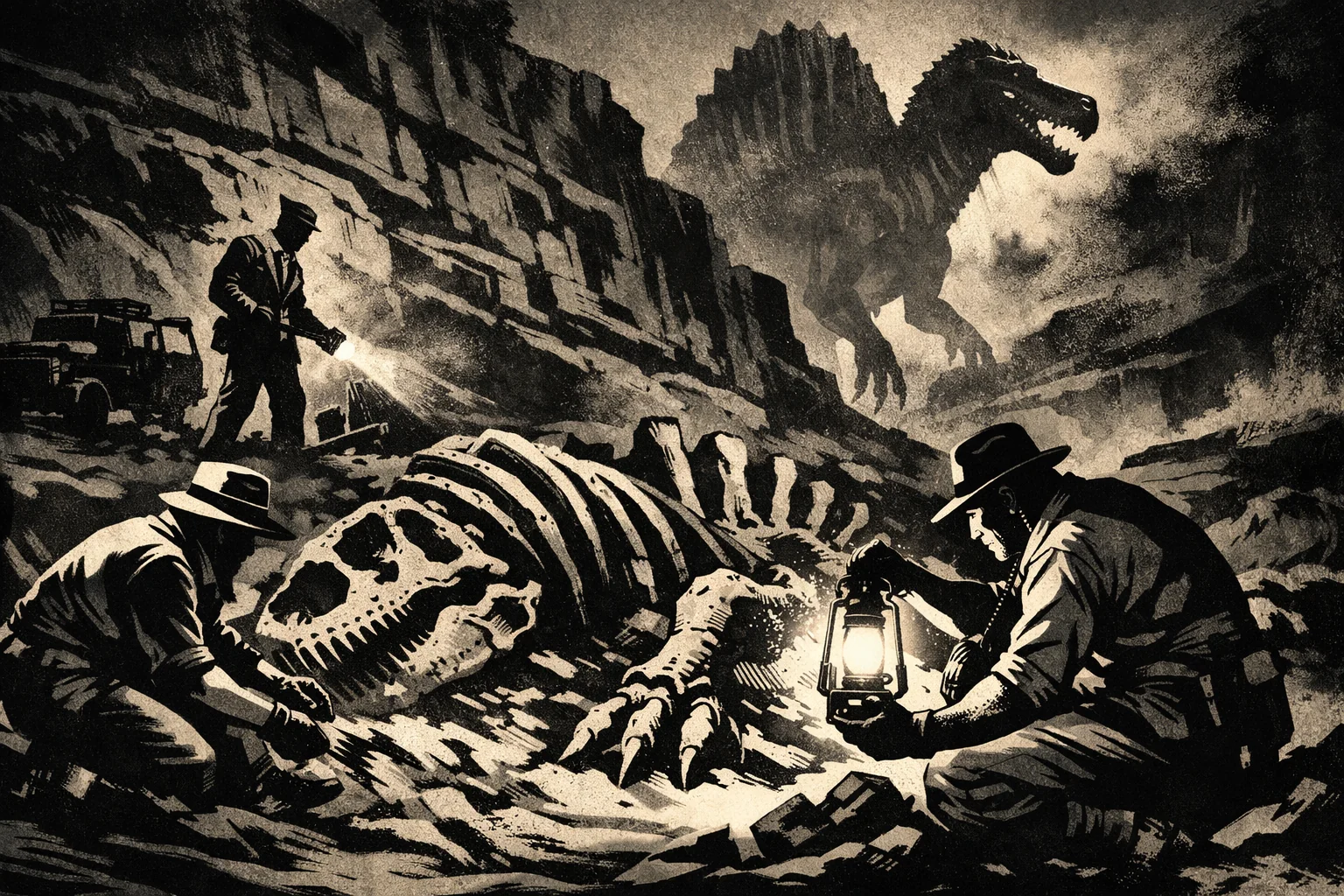
In 2026, paleontologists announced the discovery of a new species of Spinosaurus in the Niger Desert with the scientific name Spinosaurus mirabilis, which can be translated as "Amazing Spinosaurus". This new dinosaur discovered in Niger is not only a significant addition to the fossil record, but a turning point in our understanding of Spinosaurus: were they fully aquatic as previously thought, or were they predators that lived between land and shallow water?
To understand the significance of this discovery, we need to remember that Spinosaurus is a group of large carnivorous dinosaurs that lived during the Cretaceous period. They are known for their long, crocodile-like skulls, conical teeth, and long bony spines on their backs. The previously famous species,Spinosaurus aegyptiacus, was found in ancient coastal sediments in North Africa, reinforcing the hypothesis that these dinosaurs were water-bound and possibly active swimmers in marine environments.
But the new dinosaur discovered in Niger - Spinosaurus mirabilis - came from a completely different location. Its fossils were found in inland river deposits, hundreds of kilometers away from any ancient shoreline. This geological detail is crucial, as it indicates that this species lived in an environment of rivers, swamps and freshwater bodies, not open seas.
This means that the "all-water Spinosaurus" picture needs to be revised. Some 95 million years ago, during the Late Cretaceous, the Niger we know today was not an arid desert with sand stretching to the horizon, but part of a water-rich ecosystem. Geological studies indicate an extensive network of branching rivers, inland lakes, and seasonal swamps, fed by seasonal rains and continuous water sources. These rivers were not just shallow streams, but wide, slow-flowing water systems, surrounded by dense vegetation and abundant wetlands.
The fossils also revealed great biodiversity in that area, including large fish such as Mawsonia, crustaceans, aquatic reptiles, and herbivorous dinosaurs that frequented the water's banks. This ecological landscape is more akin to a wide river delta or tropical floodplain, rather than an open marine environment.
Analysis of the skull and teeth in Spinosaurus mirabilis provides strong evidence for this lifestyle. The skull is long and narrow, and the teeth are conical and overlapping so that the lower jaw teeth fit between the upper jaw teeth, forming what looks like a natural net that prevents slippery prey from escaping.This structure is not suited for tearing the flesh of large land prey as the teeth of other carnivorous dinosaurs do, but rather for the rapid capture of fish. The position of the nostrils backwards allows the animal to breathe while the front of its head is submerged in water, a feature we see in modern animals that specialize in shallow-water hunting.
One of the most distinctive features of this new species is a large, curved bony projection at the front of the skull, not seen in other species. Scientists believe that this projection was covered with a horny layer in life, and may have been used for social purposes such as mate attraction or displays of power. This detail adds an important behavioral dimension: Spinosaurus niger was not just a predator, but may have had complex social interaction patterns.
Redefining behavior and adaptation: Why does this discovery change our understanding?
When we say that Spinosaurus niger was "semi-aquatic," we don't mean that it casually spent time near water, but that it developed anatomical and behavioral adaptations that allowed it to exploit riverine resources very efficiently. The difference between a fully aquatic organism and a semi-aquatic one is a major evolutionary difference. A true aquatic organism relies on continuous swimming and shows drastic changes in the shape of the limbs, pelvis and body.
In the case of Spinosaurus mirabilis, the evidence points to this intermediate model. It is not a deep-diving marine swimmer, but neither is it a traditional terrestrial predator. It is a hunter that stands on the border between the two ecosystems, taking advantage of the interaction between land and water. This strategy gives it a competitive advantage in a fish-rich environment and allows it to occupy a unique position in the food chain. This discovery redefines Spinosaurus as a species. Instead of conceptualizing it as a group with a single lifestyle, it appears to have been more diverse than previously thought. Some species may have been more associated with coasts, while others-like the new Spinosaurus niger-adapted to inland river systems.
In the end, Spinosaurus mirabilis represents not just a new scientific name, but a reframing of our understanding of the nature of Spinosaurus. We have gone from envisioning a "fully marine" dinosaur to seeing a predator standing on the border between water and land, a specialized hunter in an ancient riverine environment, in a world that was radically different from the desert we know today.Thus, the discovery of the new Spinosaurus niger not only adds to the list of dinosaurs, but rewrites an important part of the history of life 95 million years ago-when water flowed in the heart of what is now dry sand.
Comments