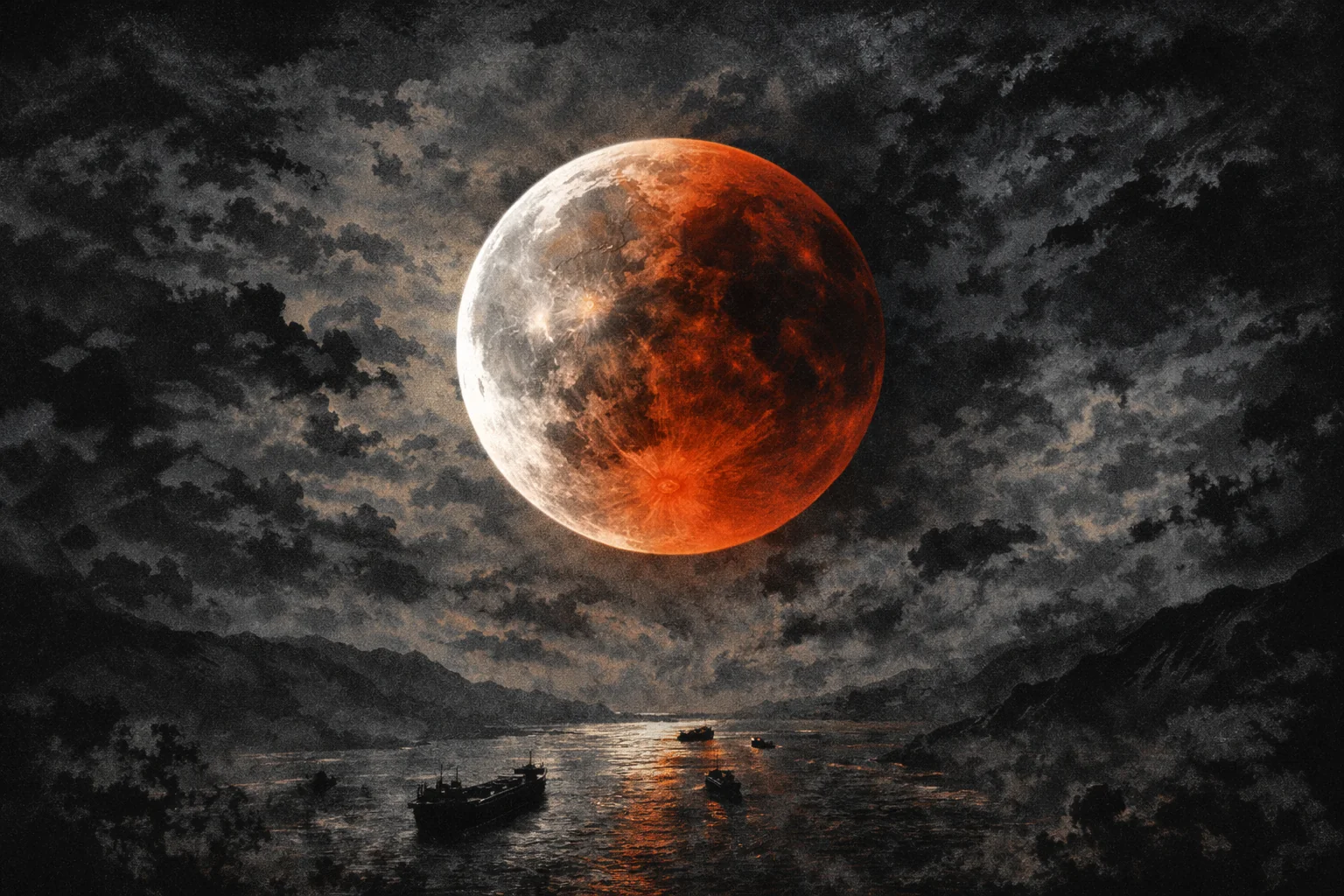
On the evening of March 3, the world will witness an astronomical phenomenon that is repeated every year or two but never loses its charm: a lunar eclipse. This phenomenon occurs when the sun, Earth, and moon are aligned in a nearly single line, so that the Earth lies between the sun and the moon, and the moon enters the Earth's shadow in whole or in part. Despite the simplicity of the idea from a physical point of view, the resulting visual spectacle - especially in the case of a total eclipse - remains one of the most interesting phenomena in the night sky.
Scientifically, a lunar eclipse only occurs when there is a full moon, but not every full moon is an eclipse. This is because the moon's orbit is tilted about 5 degrees from Earth's orbit around the sun, which means that perfect alignment does not occur every month. When the full moon coincides with the moon passing through what is known as the two nodes of the orbit (the two points where the moon's orbit crosses the plane of the Earth's orbit), an eclipse is possible.In the case of the March 3 eclipse, the moon first enters the Earth's semi-shadow, where a slight dimming of illumination begins that may not be easily noticeable, and then, if the alignment continues, it enters the area of full shadow, and here the obscured part of the moon begins to turn a dark color that sometimes tends to red.
This red color, popularly called the blood moon, is not the result of a burning or change in the moon itself, but rather due to the refraction of sunlight through the Earth's atmosphere. When light passes through the atmosphere, short waves (such as blue) are scattered while longer waves (such as red) are deflected to reach the moon's surface, giving it that copper glow. In other words, during a total eclipse, the moon is indirectly illuminated by all sunrises and sunsets that occur on the edges of the Earth at the same moment.
From an observational point of view, a lunar eclipse is completely safe to view with the naked eye. No special glasses or complicated equipment is needed, just a clear sky and the moon above the horizon. In many areas, the eclipse can be followed from start to finish within several hours, as the transition from entering the semi-shadow to fully exiting the shadow takes a relatively long time compared to other astronomical phenomena. This time extension gives the public a real opportunity to meditate, photograph and observe the visual gradient in the change of the moon's shape and brightness.
But the importance of lunar eclipses is not limited to the aesthetic or popular aspect, but extends to scientific dimensions. By studying the intensity of illumination and color during an eclipse, scientists can infer information about the components of the Earth's atmosphere, such as the amount of dust or fine particles suspended. Historically, eclipse observations have also been used to confirm the sphericity of the Earth, as the shadow of the Earth that appears on the moon's surface is always circular, regardless of the location of the observation.
In ancient civilizations, it was seen as a mysterious sign or an exceptional event with symbolic connotations. Today, it has become a collective learning opportunity, with observatories and universities around the world organizing open observation events and broadcasting the phenomenon live via digital platforms. This shift from fear to understanding reflects the evolution of man's relationship with the sky from mystical interpretation to scientific explanation.
In the context of the digital age, the March 3 lunar eclipse has the added dimension of its instantaneous spread across social media. Within minutes of its onset, images of the moon in its gradient colors from white to dark orange spread across the world, making the phenomenon a shared cosmic experience. Although the eclipse is a natural phenomenon that has been precisely calculated for centuries, each time it happens it feels like a new event, because the sky gives us a vivid reminder of the movement of objects that orbit above us in silence and with amazing precision.
In the end, a lunar eclipse represents a convergence of science and beauty, of rigorous orbital calculations and majestic visual spectacle. On the evening of March 3, when the moon enters the Earth's shadow, we will be treated to an astronomical display that reminds us that the universe never stops moving, and that the fleeting alignment of three bodies can create a moment of collective planetary reflection.
Comments