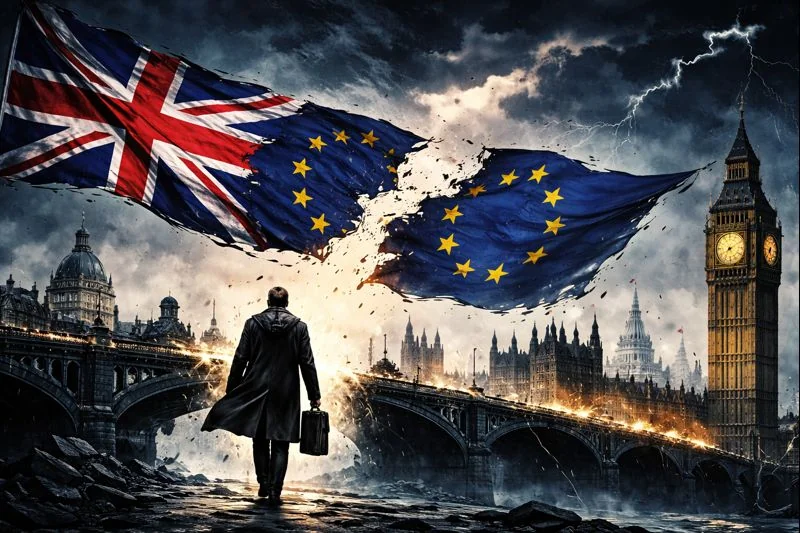
On the evening of January 31, 2020, at 11 o'clock London time, Britain officially left the European Union, ending 47 years of membership in the largest Western unitary project in the modern era. The event was not just a legal or political step, but a watershed moment that revealed profound shifts in the Western mood and societies' relationship with the nation-state, globalization, and supranational institutions.
The process actually began in the June 2016 referendum, when 52 percent of Britons voted to leave. But the four years that followed were a severe test of the ability of Western democracies to translate a complex "popular will" into realistic policies. Governments changed, prime ministers fell, parliament was disrupted, and British society was divided: between those who saw the exit as a restoration of sovereignty and those who saw it as a gamble on a stable economic and political future.
Britain's exit is significant because it is the first withdrawal of a major country from a unitary project that was built not only on economic interests, but on a deep historical idea: transcending the rigid nationalism that led Europe to two world wars. The EU was, from its inception, a response to devastation and an embodiment of the idea that economic and political interdependence is the guarantor of peace.
Economically, Brexit proponents promoted the idea of "taking back control": over borders, trade, and legislation. But the ensuing years revealed that sovereignty in an interconnected world is not absolute. Britain found itself negotiating from a weaker position with larger blocs, facing complexities in supply chains, labor shortages, and challenges in the financial services sector that was one of its pillars of strength within the Union. The exit did not end interdependence, but reshaped it on more costly terms.
Politically, Brexit represented a pivotal moment in the course of Western representative democracy, exposing the deep tension between the logic of the popular referendum and the logic of complex governance. The slogan that topped the campaign, "Take back your country," reduced a complex web of policies and international agreements to a simple sovereign promise, easy to market and difficult to implement. As Brexit moved from the ballot box to the negotiating table, it became clear that the popular decision was not a road map, but the starting point for a series of unprecedented constitutional crises in modern Britain.
Brexit also redefined the relationship between the people and the political elite. Much of the vote to leave was an expression of social protest against what was perceived as a disconnect between London's economic and political elites and disadvantaged industrial areas that felt that globalization and European integration had not delivered the promises of prosperity. In this sense, Brexit was a vote against a style of governance, not just a position on the EU.
Paradoxically, the exit, which was promoted as a restoration of national unity, opened the door to severe internal fissures. Scotland reintroduced the idea of independence, while Northern Ireland reopened questions of borders, identity, and sovereignty. Thus, the decision to "take back control" turned into a factor of internal renegotiation of the shape of the British state itself.
At the European level, Brexit was a wake-up call. While it did not trigger a series of withdrawals as some feared, it forced the EU to rethink its relationship with its citizens and the trust gap between elites and institutions on the one hand and the electorate on the other. The event revealed that a unitary project, no matter how solid it seems, remains fragile if it is not accompanied by a sense of justice, representation and the ability to respond to people's daily concerns.
In addition, Brexit revisited a fundamental question about the future of supranational projects in a world of rising anxiety and anxious identities. It showed that political legitimacy is not only built on economic efficiency, but also on an inclusive narrative and the ability to convince citizens that integration does not mean assimilation, but rather protection in a turbulent world.
Internationally, the world watched Brexit as a precedent. For rising powers and populist movements in other countries, the exit was proof that large systems could be challenged from within. At the same time, it provided a cautionary lesson about the cost of dismantling versus reforming, a lesson that many European political forces later internalized.
Five years later, Brexit seems less "liberal" than it was promised and less "disastrous" than its opponents warned. But in essence, it marked the end of one era and the beginning of another: an era in which liberal certainty is waning and the nation-state is making a strong comeback, not as a ready-made solution but as a psychological refuge in times of global anxiety. In this sense, Brexit was not just a political flashback, but a mirror of the post-globalized world as we know it.
Comments