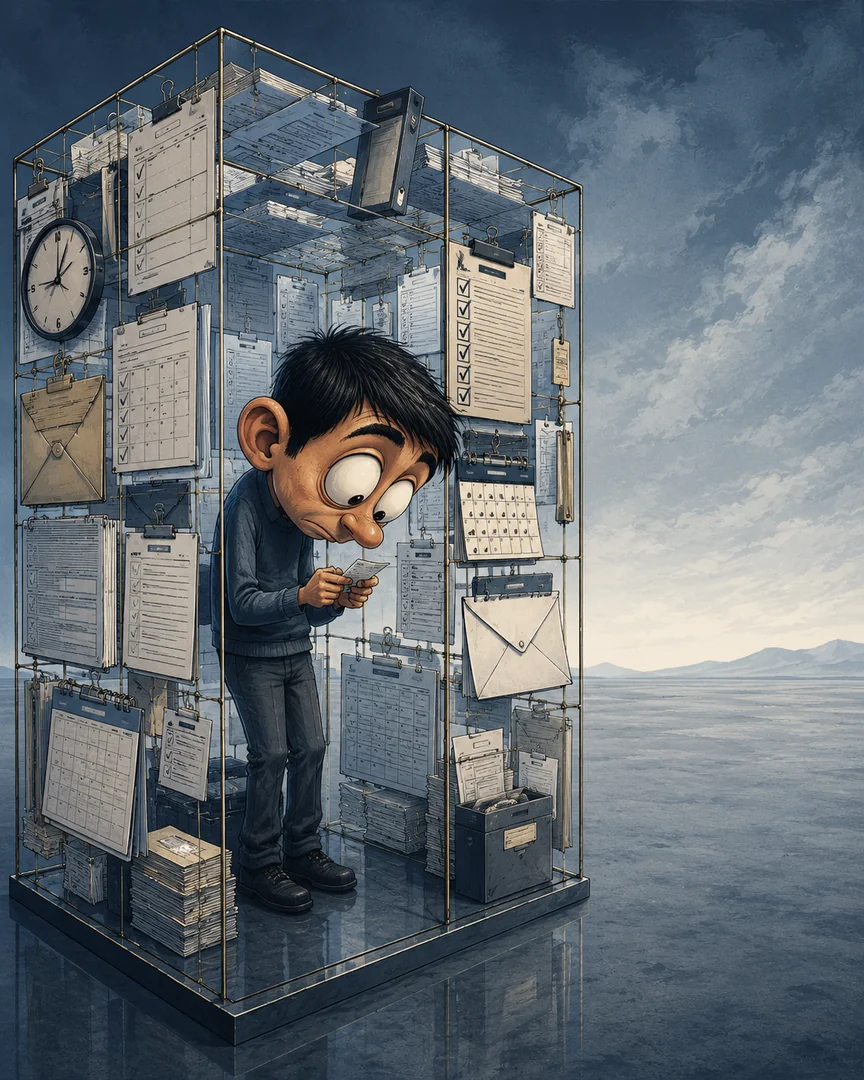
It is not always the case that you are prevented from speaking.
Sometimes the issue is more serious: to be allowed to speak, but within paths that do not touch the origin of the question.
In repressive regimes, the question is buried in fear. People there know why to keep quiet: because behind the question there is a clear price: a threat, censorship, punishment, or a door that may be closed.
In European administrative democracy, the picture is much softer. No one comes to tell you, "Don't ask." You are not prevented from complaining, from objecting, from voting, from writing your opinion. On the contrary, you have many alternatives: an objection form, a request for compensation, a formal appointment, a court, an email, a right to complain, and a free press.
But amidst this abundance, a strange thing happens:
The question doesn't die, it just shifts.
Instead of asking:
What is this all about?
You ask:
What's the missing piece of paper?
And that's where the crux of the idea begins.
Soft authoritarianism: when democracy doesn't need a stick
The most disturbing prophecy of the 19th century didn't come from Marx. It came from a French aristocrat who visited America, Alexis de Tocqueville.
In the second volume of his 1840 book Democracy in America, Tocqueville painted a picture that he did not call oppression, but saw it growing at the heart of democracy itself. He spoke of an immense paternalistic power that does not break man's will, but rather softens and directs it. It does not prevent him from acting by force, but weakens his ability to act, occupying him with details until he forgets to ask about the whole picture.
This is what later came to be known as soft despotism.
Interestingly, Tocqueville wrote this almost a hundred years before the modern European welfare state emerged.
Administrative democracy is not like traditional repression. It does not often need to silence a person, because it has a higher capacity to keep them busy: by procedure, by waiting, by form, by appointment, by automated response, by cold sentence:
Your request is being processed.
On the surface, everything is legal and organized.
But deep down, a person may feel that their energy is spent on surviving within the system, not on questioning the system itself.
Administrative Burden: When Service Becomes a Small Battle
In the science of public administration, there is a precise concept for this situation:
Administrative Burden.
The concept was developed by scholars such as Donald Moynihan and Pamala Hurd, especially in their seminal 2015 study and then in their 2018 book Administrative Burden: Policymaking by Other Means.
The idea is simply that a citizen's interaction with the state costs not only money, but also three layers of fatigue:
First, the cost of understanding
what is required of him, which form he needs, which office to visit, and which document is missing.
Second: the cost of compliance
to collect the paperwork, book the appointment, go, wait, and try again if something goes wrong.
Third: the psychological cost
the anxiety, stress, waiting, fear of rejection, and the feeling that your life hangs in the balance.
Importantly, these burdens are not always innocent technical errors. Sometimes they are an indirect way of managing policies. That is, the state does not say, "I won't give you the service," but it makes it long and tiring to access it, so your energy is diverted from asking about the system to trying to navigate it.
This is where bureaucracy becomes more than paperwork.
It becomes a way of shaping the citizen.
Germany is an example: the system is there...but does it serve the human being?
Germany is not a failed state, nor is it a state without institutions. On the contrary, it is one of the most present European countries in the global imagination as a symbol of order, precision, and law.
But the numbers reveal that an organized system is not always an effective system from the perspective of the average person.
According to the OECD's Government at a Glance 2025 report, only 51 percent of users of administrative services in Germany said they were satisfied with them, compared to an average of 66 percent in OECD countries.
When almost half of users are not satisfied with administrative services in a developed country, it's not just an individual bad experience with the municipality, a late appointment, or an employee who didn't respond.
We are facing a model in which citizens feel that the state is strongly present, but not always present to serve them with the expected speed and clarity.
And it doesn't stop at the office.
In German railways, the punctuality of long-distance trains throughout 2025 was only 60.1%, down from 62.5% in 2024, while regional trains recorded a higher percentage, 88.7%.
This is where the everyday example becomes political.
A delayed train is not just a delayed train. It is a small moment that reveals the human relationship with the system:
Do I deserve compensation?
How do I apply?
Where can I find the form?
But he rarely lingers long on the deeper question:
How did a country of this size come to the point where wasting time is a normal part of everyday life?
And why does repeated dysfunction become manageable rather than a cause for greater accountability?
This is the quiet trick:
turning a political question into a procedural one.
The cost of a slow system: not just citizens' nerves
The bureaucracy here is not just a daily inconvenience.
It is a huge cost.
In November 2024, in a study commissioned by the Chamber of Commerce and Industry of Munich and Upper Bavaria, the ifo Institute estimated that excessive bureaucracy cost Germany the equivalent of €146 billion a year in lost economic output during the period 2015-2022.
The figure is huge, because it means that the administrative burden consumes not only the citizen, but the economy itself: the time of companies, the energy of employees, the speed of delivery, and the ability to innovate.
The question is no longer:
Is bureaucracy a nuisance?
The question becomes:
How much does an entire country lose because it organizes life more than it facilitates it?
It's not oppressive...but it's not completely innocent
This is not to say that Europe is oppressive. That's a cheap simplification.
It's more nuanced than that.
Administrative democracy gives people a wide freedom of expression, but at the same time it teaches them to move within specific channels.
You are free to complain, but the complaint has a form.
You are free to object, but the objection has an appointment.
You are free to raise your voice, but your voice often goes through a long processing path.
You are free to say your opinion, but a big question is redirected to a file, a request number, and a procedure.
In repression, the question is forbidden.
In an administrative democracy, the question may be replaced.
That's the difference.
Fear kills the question outright.
The administrative system replaces it with smaller questions:
What paper is missing?
When is the appointment?
Where do I send the application?
How do I get reimbursed?
What is the file number?
Thus, instead of asking the system about itself, you are busy proving that you understand its method.
Big issues: When the answer comes before the question
Substitution doesn't just happen in everyday services.
It also happens in big issues: laws, rights, education, data, public language, and social norms.
Here the citizen is often not told: "Don't ask."
Instead, the answer comes ready before the question even begins:
This is for your protection.
This is for rights.
This is for progress.
This is for safety.
This is against discrimination.
Of course, these words are not inherently evil. Protection is an important value, rights are a central value, and equality is not a minor detail.
But the danger arises when these words turn from a doorway to debate into a ceiling that closes the debate.
When questioning the way the law is enforced becomes an attack on the whole idea.
When you ask: "Who decided? How was it discussed? What are its effects after ten years? Did the community really participate in drafting it?"
Then you find that the question itself has become suspicious.
In the little things, questions are buried under procedures.
In the big things, questions are surrounded by justifications.
The citizen is no longer afraid in the traditional sense.
He becomes cautious. He chooses his words. He hesitates before asking, not because he is against the truth, but because he fears that his question will be presented as hostility to the truth.
The Acclimatized Citizen: Free in Details, Obedient in Substance
A new form of obedience is emerging.
Not the obedience of the soldier before the order.
nor the obedience of the fearful before the jailer.
but the obedience of the acclimatized citizen.
A citizen who knows how to fill out the form.
How to book an appointment.
How to wait for a response.
How to ask for compensation.
How to choose his words.
And how not to ask the question in a way that makes it out of the acceptable tone.
He is not a person without freedom. On the contrary, he may be free in many details: his appearance, his lifestyle, his personal opinion, his daily choices.
But he may become less free in the face of the structural question:
Why does life work the way it does?
Who designed these paths?
And why has adaptation become a virtue, while the big question has become an anomaly?
Herein lies the modern European paradox: freedom is there, but the path to real political action may be surrounded by layers of administration, language, rationalizations, and formal channels.
The citizen is not forcibly withdrawn from the public sphere.
but reconfigured as a user within a large system.
A user knows the password.
waits for a verification code.
reserves Termin.
uploads a PDF.
and then comes back to ask:
What's next?
Why is this idea dangerous?
The idea is dangerous because it is not talking about naked anarchy, direct authoritarianism, or a state without institutions.
On the contrary, it is talking about a system that is successful in organizing life, but sometimes too successful; so much so that man learns how to move within it, not how to ask it.
This is where the question becomes more dangerous precisely because democracy exists, rights exist, institutions exist, and dissent is possible.
But possible does not always mean effective.
You can complain, but does that change the structure?
You can object, but does that open up a public question?
You can speak, but do you get to the root of the issue?
Or do you just move within many alternatives, making the system appear open, while the real question remains far away?
Conclusion: When coping becomes a habit
In the end, the most dangerous system is not necessarily the one that prevents you from speaking.
The most dangerous system is the one that gives you so many words, so many paths, so many models, so many alternatives...that you forget to ask the first question:
What is it all for?
When coping becomes a habit, the question becomes strange.
Sources
Tocqueville, A.de.(1840). De la démocratie en Amérique,Vol.II,Partie 4,Chapitre 6.
Moynihan,D.,Herd,P.,&Harvey,H.(2015). Administrative Burden: Learning, Psychological, and Compliance Costs in Citizen-State Interactions.Journal of Public Administration Research and Theory,25(1),43-69.
Herd,P.,&Moynihan,D.(2018). Administrative Burden:Policymaking by Other Means.Russell Sage Foundation.
OECD.(2025). Government at a Glance 2025: Germany Country Note.OECD Publishing.
Deutsche Bahn.(2026). Pünktlichkeitswerte-Jahresbilanz 2025.deutschebahn.com.
Falck,O.,Mo Guo,Y.,&Pfaffl,C.(2024). Kosten der Bürokratie-Reformen dringend geboten.ifo Institut/IHK München und Oberbayern.
Comments