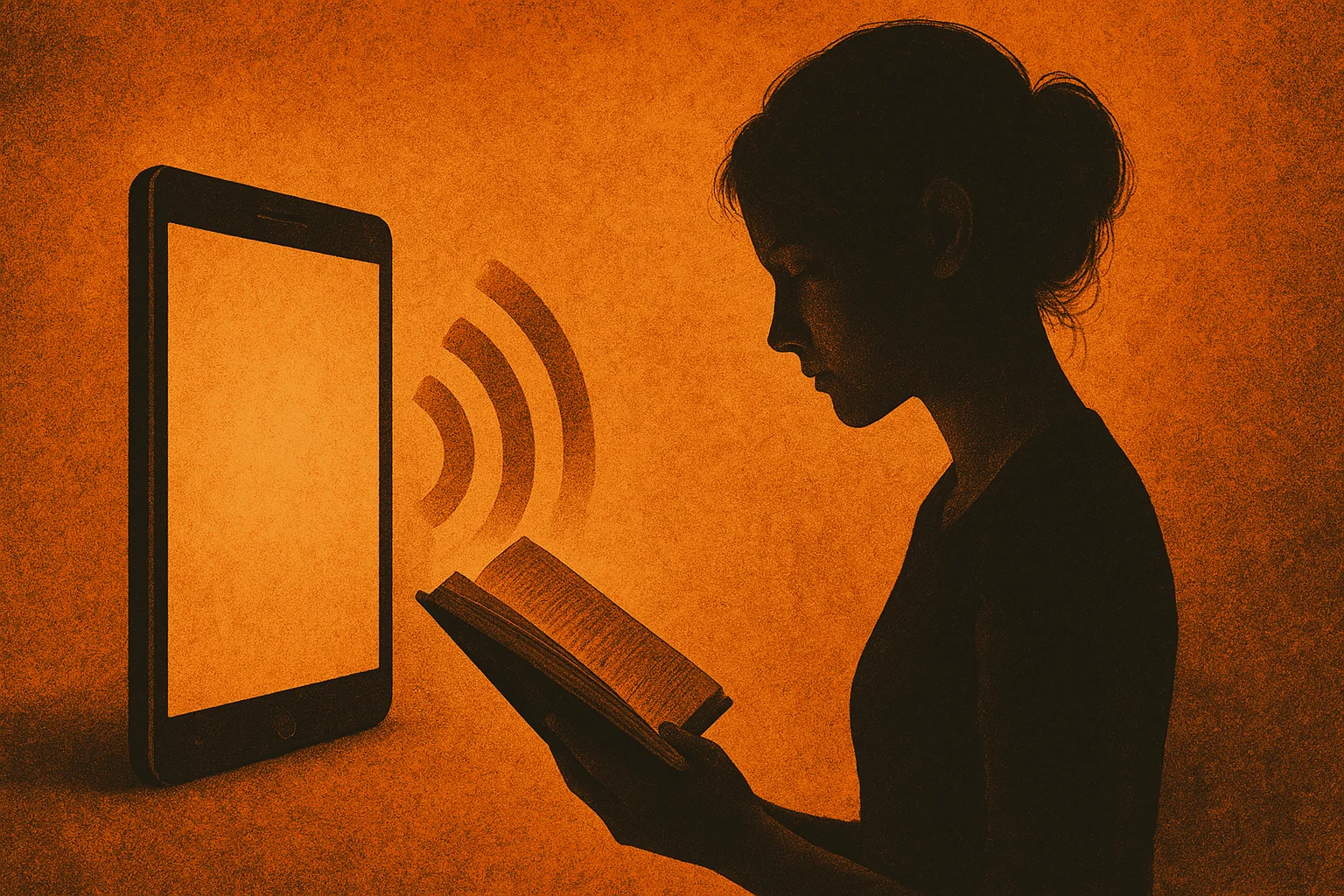
In recent decades, digitization has reshaped the human relationship with reading in an unprecedented way, as the paper book is no longer the only container for knowledge, but has become a competitor within a wide range of digital media that includes e-books, tablets, smartphones, and audio platforms. This shift cannot be reduced to a "good/harmful" binary, as its impact goes beyond the functional dimension to reshape concepts such as depth, attention, emotional attachment, and even the meaning of the act of reading itself.Global statistics indicate that almost two-thirds of readers today combine paper and digital reading, reflecting a state of overlap rather than conflict, governed by cognitive, emotional, and contextual factors (Pew Research Center, 2021). This data forces an analytical reading beyond normative judgments to understand how digitization has changed our relationship with books, and what has remained constant in this transformation.
Cognitive psychology studies show that the shift from paper to screen has clearly affected reading depth and text processing. One famous study found that reading on paper gives the reader a more spatialized representation of the text; the texture of the paper and the sensation of flipping helps create a "cognitive map" that enables better retrieval of information (Anne Mangen).On the other hand, screens-despite their accessibility-show a tendency for "quick browsing" rather than in-depth reading, with high levels of distraction due to notifications and multitasking (Baron, 2015).However, these findings are not inevitable. Recent reviews suggest that a reader who is experienced with digital media can achieve similar levels of comprehension if they control the distractions and reshape their reading habits (Clinton, 2019). Thus, the change is not in human ability itself, but in the new conditions of practice imposed by the nature of the medium.
With the expansion of digital reading, a fundamental question has emerged about the nature of the paper book: is it merely a "tool for conveying information", or does it hold symbolic and emotional value beyond function? Cultural research suggests that the paper book has long been a symbol of cultural identity, historical continuity, and personal intimacy, not a neutral container but a full sensory experience: the smell of paper, ink, texture, home shelves, and the psychological ritual of quiet reading (Darnton, 2009).Reading ethnographies confirm that readers often attribute to the paper book meanings of belonging, reassurance, and memory, especially in the contexts of education and initial cultural formation (Sellen & Harper, 2003).In contrast, the digital book is characterized by lightness, instant search, and multitasking, making it more of a functional tool than a cultural symbol. This does not mean that the paper book has declined, but rather that its role has shifted; it has become a symbol of slowing down, focusing, and returning to oneself, an act of cultural resistance rather than a mere medium of knowledge.
Audiobooks have redefined the act of reading itself. Reading is no longer synonymous with looking at a text, but rather an auditory experience that can be practiced in motion or daily chores. Audible data shows that audiobook listening has grown by more than 25% annually in many global markets (Audible, 2022). Cognitive scientists suggest that processing audible text activates different areas of the brain than visual reading, producing a cognitive experience closer to traditional oral narration (Rosenblum, 2019).However, the nature of listening-as an easily distracted experience-may affect deep comprehension unless the listener reorganizes their attention (Moore & Gordon, 2016). Audiobooks do not weaken reading, but rather expand its meaning; they rehabilitate the culture of sound in a world dominated by images, and provide a new space for those who find it difficult to read in paper or time.
In light of this, it can be said that digitization has not abolished the paper book, nor has it lost the meaning of reading, but rather produced a hybrid reading environment that combines paper, digital, and audio. The future of reading is not based on a conflict between media, but on their integration, where the reader becomes the one who chooses the medium according to the context, purpose, and psychological state.Digital reading may suit quick research, mobility, and continuous professional learning, while paper reading may offer depth, tranquility, and symbolic meaning, while audiobooks provide an oral dimension that redefines the act of receiving itself. Digitization has reshaped our relationship with the book, not by eliminating it, but by inserting it into a multichannel ecosystem that expands rather than narrows the concept of knowledge.
Watch the video for more
Comments