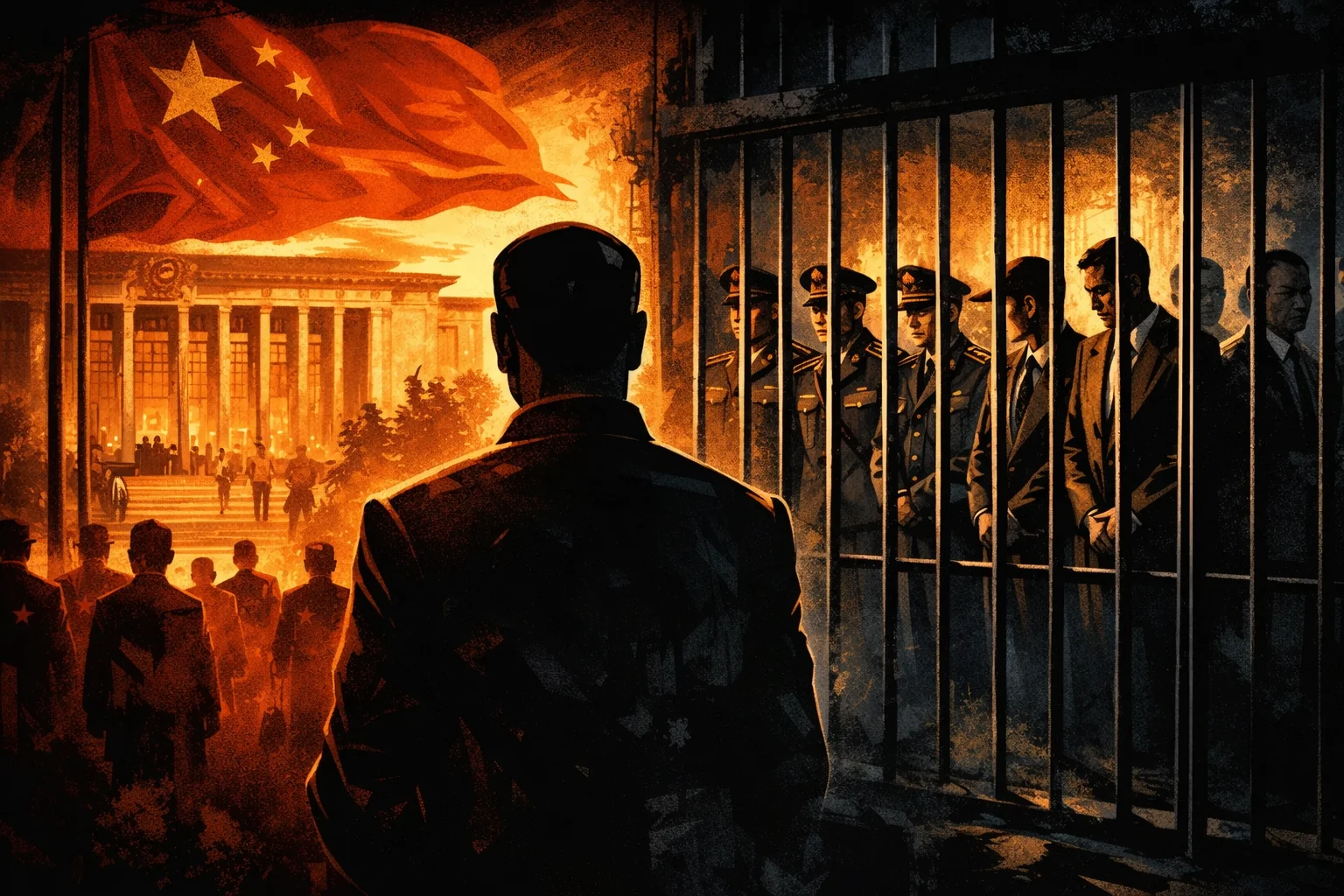
Just one week before the opening of the annual meeting of the National People's Congress (NPC), the Standing Committee of the NPC in Beijing announced the revocation of the "deputy" status of 19 members of the legislative body, including nine officers from the troop delegation, in a move notable because it came at a sensitive time when major economic, administrative, and security policies for the new year are usually announced. The official statement did not give detailed reasons, but multiple and intersecting coverage indicated that such decisions are often linked to corruption investigations or "disciplinary violations" within the party and state.
Procedurally, the NPC is not a competitive institution in the Western parliamentary sense, but rather functions mostly as a ratifying framework for decisions made within the party. However, membership revocation is not a formality; it means cutting off political and symbolic privileges associated with national representation, and is often an advanced indicator of a broader punitive process (investigations, disciplinary referrals, or subsequent judicial proceedings).In the case of the current impeachment batch, the Associated Press emphasized that the Standing Committee's announcement did not explain "why" the members were removed, but noted that removals of this nature are usually linked to corruption investigations.
According to a Channel NewsAsia report based on the Standing Committee's statement, prominent figures, including Li Xiaoming (commander of the ground forces) and Chen Jinlong (former commander of the navy), were removed, as were current or former political commissioners of various sectors such as the navy, air force, and information support force.According to reports quoted by Xinhua, the list also included names such as Ding Lifu from the ground forces, Bian Ruifeng and Wang Donghai from a department linked to the Central Military Commission, Chen Shengxiang from the navy, Yu Zhongfu from the air force, and Yang Guang from the missile force.
The "certainty" answer to date is that the official authorities have not published detailed reasons for each person's dismissal.First, in China, phrases such as "serious violations of discipline and law" are used as standard wording when there are suspicions of corruption or internal abuses, often preceding or accompanying sudden changes in positions.CNA explicitly noted that the development followed high-profile investigations of senior leaders in the institution, with "violations of discipline and law" being a common phrase. Second, AP linked the withdrawal of memberships to the longer context of the anti-corruption campaign, noting that the institution has been a central target in recent years and that the campaign is also being read as a tool to ensure political loyalty and prevent the emergence of rival power centers.
However, it is important not to reduce the issue to financial corruption alone. The nature of the names removed (commanders, political delegates, and individuals in sensitive sectors) points to two often overlapping tracks: "cleaning up" networks of interest in supply, arms, and contract chains (traditionally high-risk environments for bribery), and "policing loyalty" within the chain of command, especially in sectors that are considered sensitive in terms of strategic deterrence and readiness.AP noted that the missile force was one of the first targets in previous waves of removal, which reinforces the hypothesis that some of the dismissals are related to recurring issues within specific sectors.
First, the annual meeting is an image management moment: the authority is trying to enter the policy announcement season presenting itself as a body capable of correcting itself and cleaning up its structures. Revoking the membership of 19 MPs at once, including nine officers, a week before the opening, carries the message that "discipline precedes showmanship" and that the fight against corruption does not stop because of a political calendar.Second, the timing reduces the room for maneuver for any affected network; during the "meeting season", media and censorship sensitivity increases, making any name under suspicion a burden on official discourse. Third, and most related to internal balances, turning people into "excluded" before the meeting ensures that arrangements for attendance, voting and representation do not hinder the management of the sessions, which are supposed to run smoothly.
The direct impact of the decision on the conduct of the annual meeting may be limited, as the NPC will continue with approximately 2,878 members according to AP, and its ratification function reduces the likelihood of surprises inside the chamber. However, the indirect political impact is wider: First, reducing the representation of the forces' delegation within the NPC (as indicated by multiple reports) sends a signal that "representation" itself can be removed if trust is shaken, transforming membership from a symbolic gain to a tool of control.Second, internally, the public removal creates "institutional deterrence" by spreading the fear that investigations could turn into the loss of national prestige, not just an administrative position. Third, externally, it gives observers a dual impression: on the one hand, there is an ongoing cleanup campaign; on the other, it may reflect a degree of internal tension or deep corruption penetrations.
Reference list:
Associated Press.(2026, February 26).China removes 19 lawmakers including military officers ahead of annual session.
Channel NewsAsia.(2026, February 26).China removes senior military figures from parliament amid disciplinary investigations.
Investing.com.(2026,February 26).China removes nine military lawmakers from parliament.
Comments