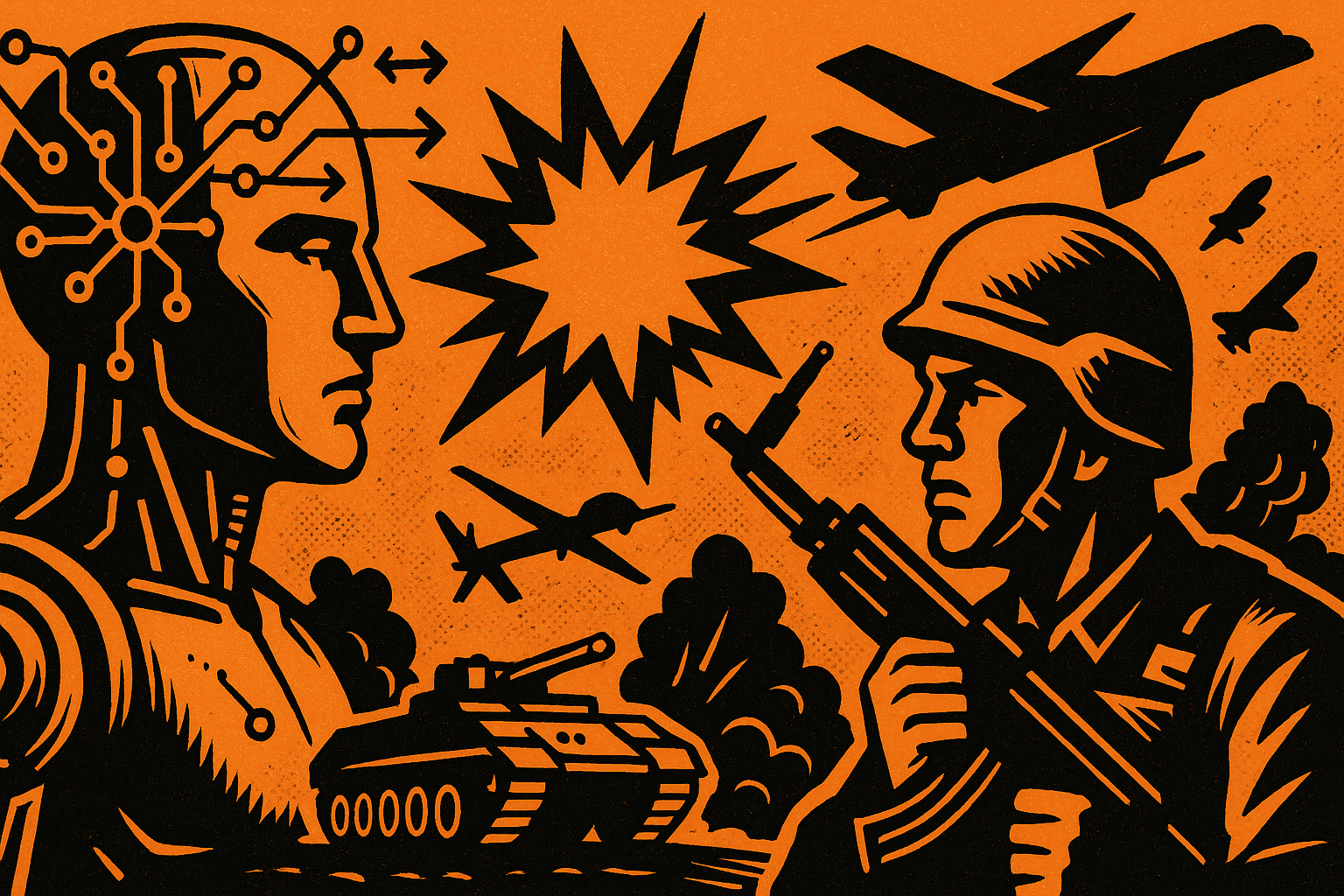
Countries are no longer outnumbered by the number of tanks or the depth of alliances, but by their algorithms, data, chips, and computing power. AI is now a strategic architecture that operates on four fronts simultaneously: warfare, awareness, cyberspace, and economics.
On the battlefield, AI is becoming a "field brain." Drones based on visual and audio recognition algorithms are able to execute missions autonomously. In Ukraine, the accuracy of strikes has increased thanks to intelligent software that has reduced response times to minutes instead of hours.Some militaries are testing a swarm of self-coordinating suicide drones, while modern missiles use a thermal and optical signature to distinguish between targets, making them harder to jam than ever before. Importantly, a military simulation indicated that a combat decision could be made in a few seconds if left entirely to autonomous systems, opening the door to "automated escalation" beyond human control.
In March 2022, a fake video showing Ukrainian President Zelensky calling on his army to surrender went viral. Although it was debunked, it was viewed by hundreds of thousands and continued to circulate for a long time.In Escalate 2025, a clip of an air strike was published that appeared "accurate and clean"-only to find out later that it was entirely AI-generated to idealize the operation. These examples confirm that the narrative itself has become a battleground and that short clips can turn public opinion within hours.
Algorithms today can scan millions of servers for a single vulnerability, generate malware that adapts in real time to defenses, and even simulate employee behavior to make the attack appear part of normal work. Countries like North Korea have used AI-powered tools to carry out massive financial attacks, while China relies on public data analysis to monitor social trends in countries with which it has sensitive projects. In contrast, defense systems are developing that can detect a single change in device behavior within milliseconds and automatically disconnect.
China dominates 60-70% of the rare metals needed to make chips, such as gallium, nickel, and graphite, while Taiwan-through TSMC-produces most of the world's advanced chips, so much so that a single plant shutdown could slow down the entire global innovation.The United States, for its part, holds the top spot via NVIDIA and AMD, and is pouring hundreds of billions into building data centers and supercomputers. Projections show that AI will add $15.7 trillion to the global economy by 2030-equivalent to the economies of China and India combined.
To view the video and read the full white paper, please scroll down
Comments