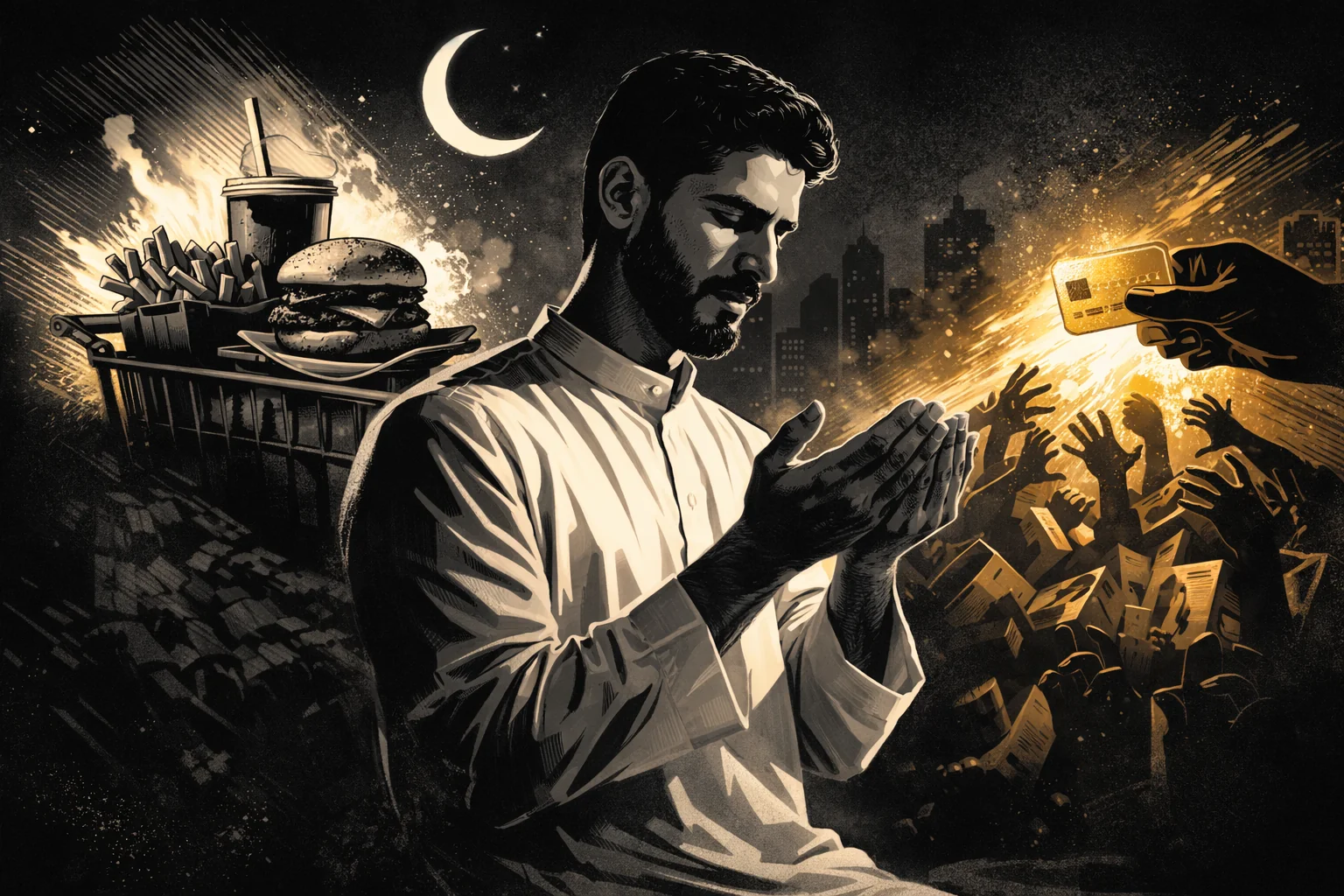
In a contemporary world of instant gratification, where technology, advertising, and markets are designed to minimize the distance between desire and fulfillment, abstinence becomes an unfamiliar act. Everything around modern humans pushes them towards consumption: Food is available at every moment, products are constantly on display, and services are offered at the click of a button. In this context, fasting is not just a religious practice, but a deeply symbolic act that redefines the relationship between humans and their desires. It is, in a way, a quiet resistance to a system that encourages an immediate response to every impulse.
Modern economics is based on a simple principle: Constantly stimulate desire. Advertising doesn't just sell products, it sells the feeling of needing them. A constant sense of lack is created, as if one always needs more to be satisfied. This constant flow of stimulation makes desire a near-permanent state, and makes responding to it seem natural. Fasting breaks this chain. When a person feels hunger or thirst and voluntarily refrains from satisfying them, he or she reintroduces the element of choice into the relationship between desire and action. Desire is no longer something that must be responded to immediately, but something that can be observed, understood, and even bypassed.
This shift has a profound psychological dimension. In everyday life, many actions are automatic. A person feels a desire and responds to it without thinking about it. But fasting creates a gap between the feeling and the response. This gap is the space of awareness. In this space, a person realizes that he is not just a being governed by his impulses, but a being capable of observing them without being subject to them. This realization reconstructs the concept of self-control, not as the suppression of desire, but as the ability to not be governed by it.
Fasting also redefines the concept of abundance. In the age of consumerism, abundance is measured by the availability of things. The greater access to resources is seen as a sign of progress. But fasting reveals a different paradox: True abundance lies not in the ability to have everything, but in the ability to not always need it. When you abstain from things that are available to you, you discover that their value comes not only from their existence, but from the relationship you have with them. A glass of water, which may seem ordinary at any other time, becomes a meaningful experience when it comes after abstinence.
In this sense, fasting represents a form of rebalancing. It slows down the rhythm imposed by the consumerist world and returns one to a more conscious experience of time, body and desire. In a world that encourages more, fasting offers the experience of "less". But it is not "less" in the sense of loss, but in the sense of liberation. Freedom from the constant need for gratification, from the assumption that every desire must be fulfilled immediately.
Fasting also carries a social dimension that goes beyond the individual experience. When millions of people fast at the same time, a collective pattern of abstinence is formed. This collective abstinence redefines the relationship between the individual and society. Instead of competing for consumption, there is a shared abstinence. This shared experience creates a kind of solidarity, where abstinence itself becomes a value, not just an absence of action.
Ultimately, fasting reveals a truth that is often overlooked in an age of consumerism: Freedom lies not only in the ability to choose, but also in the ability not to choose. The ability to say "no," even when "yes" is readily available. In this context, fasting is not just abstinence from food, but a practice that redefines the relationship between humans and their desires. It reminds humans that they are not just consumers, but beings capable of stopping, observing, and choosing. In an increasingly responsive world, this pause becomes a form of resistance.
Comments